Why I Refuse to Use Electric Knife Sharpeners
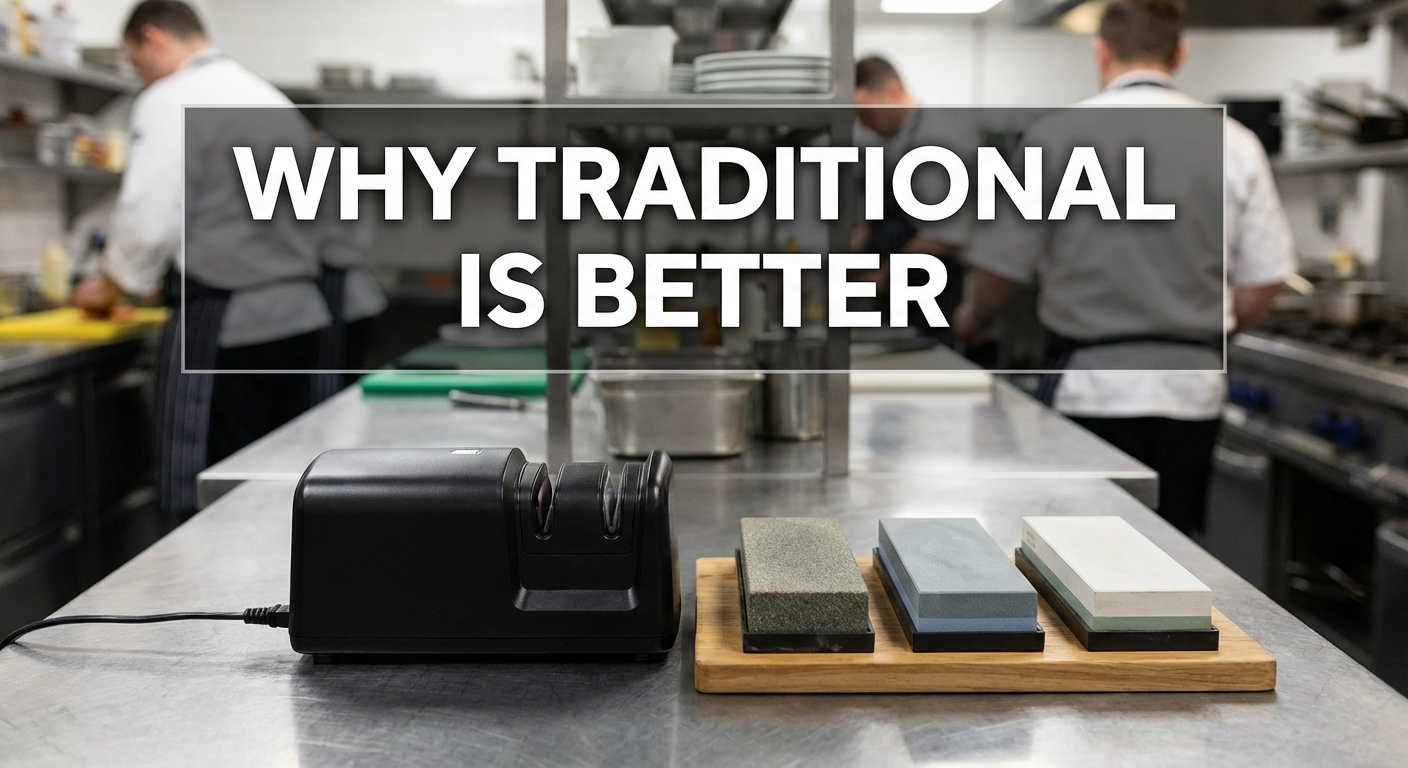
In every carnicería I trained in, from the bustling markets of Buenos Aires to the refined establishments of San Sebastián, you'll notice something conspicuous by its absence: electric knife sharpeners. "Los eléctricos matan el alma del acero," my masters would say — electric sharpeners kill the soul of the steel.
After thirty years of sharpening knives professionally, I understand why traditional methods persist. Electric sharpeners offer convenience, but they sacrifice the very qualities that make a knife exceptional. Let me explain why I refuse to use them.
The Heat Problem
Electric sharpeners operate at high speeds, generating significant heat during the sharpening process. This heat can:
- Temper the steel: Excessive heat can soften the blade edge, reducing edge retention permanently
- Create stress fractures: Rapid heating and cooling can introduce microscopic cracks in the blade
- Alter the molecular structure: Changes to steel properties affect how the edge performs and wears
Traditional whetstones generate minimal heat, preserving the blade's original properties. Water or oil cooling during manual sharpening keeps temperatures low.
Lack of Control and Feedback
Electric sharpeners remove material automatically, without the operator's ability to adjust:
- Inconsistent angles: Fixed guides may not match the blade's original geometry
- Over-grinding: Removing too much steel unnecessarily
- No feel: Cannot assess how the edge is developing through tactile feedback
- One-size-fits-all: Cannot adapt to different blade types and needs
Manual sharpening allows you to feel the blade and adjust your technique based on its specific needs.
Aggressive Material Removal
Electric sharpeners use aggressive abrasive wheels or belts that remove steel rapidly:
- Waste of expensive steel: High-quality knives represent significant investments
- Altered blade geometry: Can change the original design of the knife
- Heat-affected zone: Creates a layer of stressed steel near the edge
- Coarse scratches: Leave rough surfaces that affect cutting performance
Whetstones allow for progressive grit refinement, creating smoother, more effective edges.
The Angle Issue
Most electric sharpeners use fixed angle guides that may not match your blade's optimal angle:
- Too steep: Creates thick, inefficient edges that don't cut well
- Too shallow: Creates fragile edges that chip easily
- Incorrect for blade type: Different knives need different angles
- No adjustment capability: Cannot fine-tune for specific tasks
Manual sharpening allows you to match the blade's original angle precisely.
Traditional Methods Offer Superior Results
Whetstone sharpening provides advantages electric sharpeners cannot match:
Precision: Control over every aspect of the sharpening process
Customization: Ability to adjust for each blade's specific needs
Progressive refinement: Starting coarse and finishing fine for optimal results
Edge assessment: Ability to check and adjust the edge during sharpening
Preservation: Maintains blade integrity and extends lifespan
The Learning Curve Advantage
Learning manual sharpening develops important skills:
- Edge awareness: Understanding how edges perform and deteriorate
- Blade assessment: Ability to identify problems and correct them
- Tool appreciation: Understanding the relationship between care and performance
- Self-sufficiency: Ability to maintain tools independently
Electric sharpeners create dependency without building knowledge.
Proper Whetstone Technique
Effective manual sharpening requires technique:
Grit progression: Start with 1000 grit for edge establishment, finish with 3000-8000 grit for refinement
Angle consistency: Maintain the same angle throughout each stroke
Light pressure: Let the stone do the work; excessive pressure damages both stone and blade
Regular maintenance: Strop daily, sharpen as needed based on performance
When Electric Sharpeners Might Be Acceptable
There are limited scenarios where electric sharpeners might be acceptable:
- Infrequent use: For occasional cooks who sharpen rarely
- Disposable knives: For inexpensive knives where preservation isn't important
- Emergency situations: When whetstones aren't available and a knife must be sharpened
- Large quantities: Commercial operations with hundreds of knives to maintain
Even in these cases, manual methods remain superior.
The Craft Perspective
In traditional carnicería, we view sharpening as part of the craft, not just maintenance. The time spent with whetstones is time spent in communion with your tools, understanding their needs and capabilities.
Electric sharpeners treat knives as commodities to be serviced rather than instruments to be tended. This mindset affects how you approach the entire craft of butchery.
Take the time to learn proper manual sharpening. Your knives will last longer, perform better, and connect you to the centuries-old tradition of caring for your tools with the same respect you show your craft.
Remember, in the words of my Spanish master: "El borde verdadero nace de la paciencia, no de la electricidad" — the true edge comes from patience, not electricity.
More from the Blog
What My Argentine Grandfather Taught Me About Knives
In my grandfather's <em>carnicería</em> in Buenos Aires, I learned that a knife is not just a tool but an extension of the butcher's skill and respect for the craft.
The 3 Knives Every Home Cook Actually Needs
Forget the knife block sets — a master butcher reveals the three essential knives that will serve every home cook's needs effectively.