The 3 Knives Every Home Cook Actually Needs
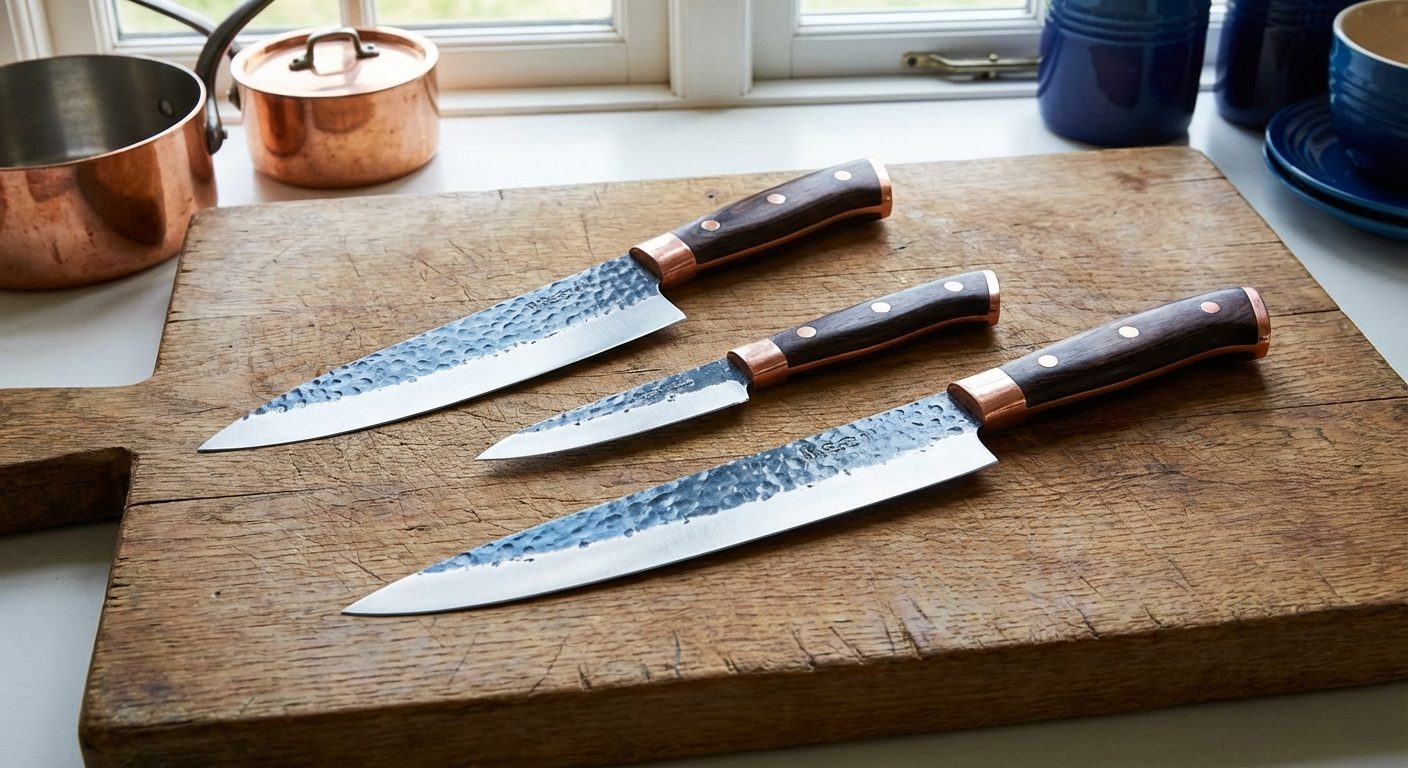
After spending decades in professional carnicerías in Argentina and Spain, I've observed a universal truth in home kitchens: most people own too many knives, and most of those knives are poorly maintained. "Es mejor tener uno bueno que diez mediocres," we say in Spanish — it's better to have one good one than ten mediocre ones.
For the home cook, three well-chosen, properly maintained knives will serve 95% of your cutting needs. Let me share which three knives I believe every kitchen should have, based on thirty years of professional experience.
1. The Chef's Knife (8-inch, High-Quality)
The chef's knife is the workhorse of any kitchen. I recommend an 8-inch blade — long enough for efficient vegetable prep and fish filleting, but not so large that it becomes unwieldy for smaller tasks.
What to look for:
- Full tang construction: The blade steel should extend through the entire handle for durability and balance
- High-carbon stainless steel: Offers the best balance of edge retention and corrosion resistance
- Comfortable grip: The knife should feel balanced in your hand, with the weight distributed toward the blade
- Proper geometry: 15-20 degree edge angle per side for versatility
Uses: Vegetables, herbs, fruits, fish, poultry, and smaller cuts of meat. The curved belly allows for rocking motions perfect for mincing herbs and dicing onions.
This knife should be your first investment. Spend money here — a quality chef's knife will last a lifetime with proper care.
2. The Paring Knife (4-inch, Precision Tool)
The paring knife is the detail artist of your knife collection. Its small size allows for precise cuts that larger knives simply cannot achieve.
What to look for:
- Sharp, pointed tip: Essential for detailed work
- 4-inch blade: Long enough for useful cuts, short enough for control
- Thin blade: Allows for precision cuts without crushing delicate items
- Good balance: Should feel nimble in your fingers
Uses: Peeling fruits and vegetables, deveining shrimp, hulling strawberries, making decorative cuts, and any task requiring precision. It's also perfect for working in confined spaces where a chef's knife would be too large.
Don't underestimate this small knife — its precision capabilities are irreplaceable in the kitchen.
3. The Slicing/Boning Knife (6-8 inches, Specialized Tool)
This is the knife most home cooks overlook, but it's essential for working with proteins. I recommend a 6-8 inch blade that's longer and thinner than a chef's knife, with a slight curve to the edge.
What to look for:
- Thin, flexible blade: Allows for smooth, continuous slicing motions
- Length: Long enough to slice through large items in a single motion
- Sharp edge: Must be razor-sharp for clean slicing
- Controlled flexibility: Should bend slightly but not feel flimsy
Uses: Slicing cooked meats, carving roasts and whole birds, breaking down poultry, and any task requiring smooth, continuous cuts. The thin blade glides through meat fibers without compressing them.
This knife makes the difference between restaurant-quality sliced meat and the torn, ragged cuts that result from using a chef's knife for slicing.
Why Not More Knives?
You might wonder why I don't recommend a bread knife, utility knife, or cleaver. Here's my reasoning:
Bread Knife: While useful, it's a specialized tool. A serrated utility knife can handle bread and tomatoes adequately. True artisan bread is best sliced with a sharp chef's knife using a gentle sawing motion.
Utility Knife: Redundant. The chef's knife handles medium-sized cutting tasks just as well, and the paring knife covers small, detailed work.
Cleaver: Dangerous for home use. Most tasks that seem to require a cleaver can be accomplished more safely with the right technique and a sharp chef's knife.
The Maintenance Factor
Having fewer knives means you can afford to buy higher quality, and you're more likely to maintain them properly. Each knife should be:
- Sharpened regularly: Use a whetstone system to maintain proper edge geometry
- Honed daily: Use a steel before each cooking session to maintain the edge
- Properly stored: In a block, on a magnetic strip, or in a knife roll — never loose in a drawer
- Cleaned immediately: Hand-washed and dried after each use
Investment Priorities
If you can only afford one knife right now, buy the chef's knife. This will serve most of your needs while you save for the others.
When you can afford two, add the chef's knife and paring knife. These cover about 80% of kitchen tasks.
When you can afford all three, you have a complete system that will serve you for decades.
Remember, in the carnicería, we say "La calidad no tiene precio" — quality has no price. A well-made knife properly maintained will outperform a dozen cheap ones. Choose quality over quantity, and your kitchen will be equipped for success.
More from the Blog
What My Argentine Grandfather Taught Me About Knives
In my grandfather's <em>carnicería</em> in Buenos Aires, I learned that a knife is not just a tool but an extension of the butcher's skill and respect for the craft.
Why I Refuse to Use Electric Knife Sharpeners
A master butcher explains why electric sharpeners damage knives and compromise edge quality compared to traditional sharpening methods.