The Essential Butcher Knife Guide
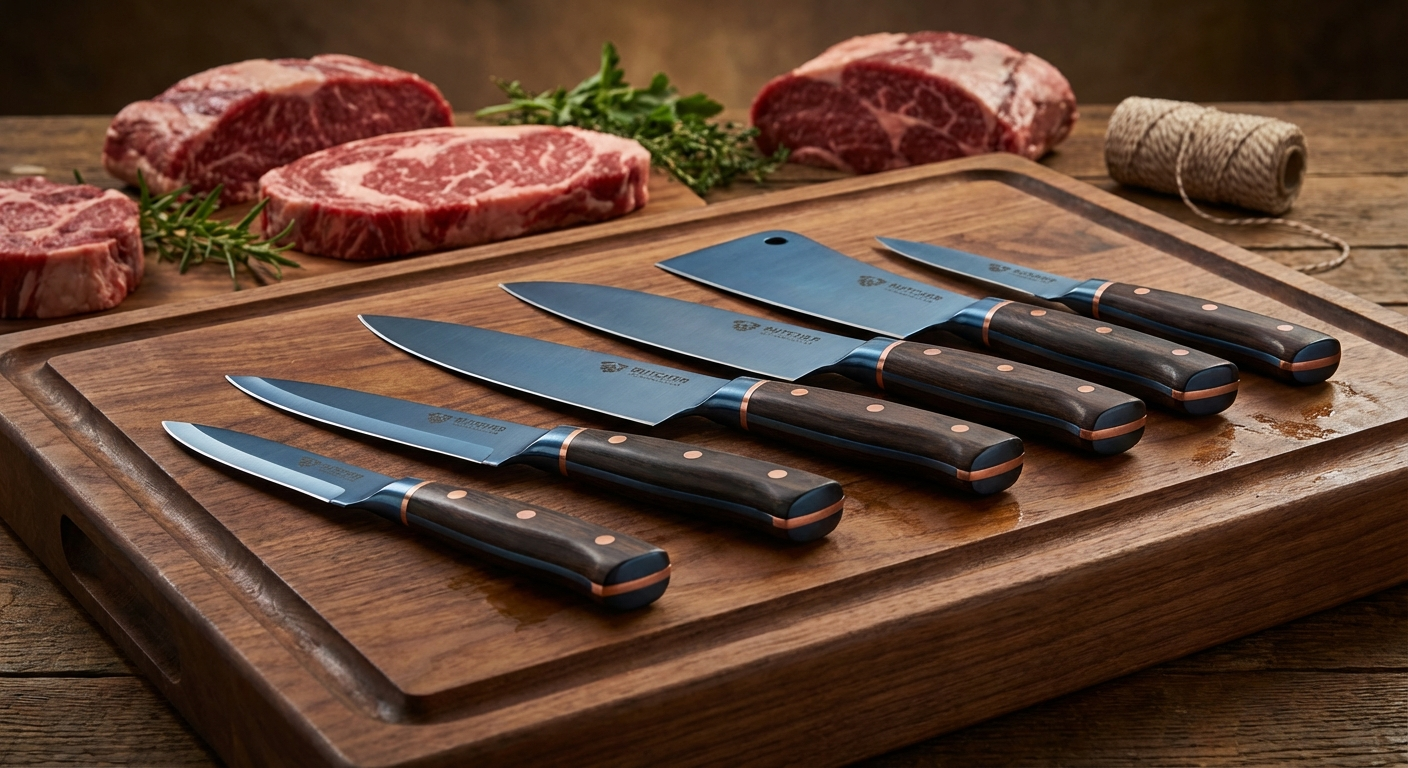
After two decades working with steel in Buenos Aires and the Basque Country, I can tell you that your knife is an extension of your hand — an instrument that requires respect, understanding, and proper technique. Too many cooks treat knives as mere tools, but in carnicería, we understand that the knife is the bridge between the animal and the craft.
The Anatomy of a Butcher Knife
Before discussing types, let's understand what makes a butcher knife effective. A proper butcher knife has specific geometric characteristics that distinguish it from kitchen cutlery:
- Blade Steel: High-carbon steel (typically 0.6-1.2% carbon) with chromium additions for corrosion resistance. My preferred steels include AUS-8, VG-10, and traditional carbon steel. The hardness should be 58-62 HRC on the Rockwell scale — hard enough to hold an edge, soft enough to resharpen.
- Blade Geometry: Thicker spine (1.5-2mm) transitioning to a thin edge (0.1-0.2mm). The blade should have a distal taper — thick at the spine, thin at the tip.
- Edge Angle: Typically 15-20 degrees per side for general work, 20-25 degrees for heavy-duty tasks. The angle determines edge retention versus cutting performance.
- Handle: Full tang construction with ergonomic grip. Wood, micarta, or composite materials that provide secure grip even when wet.
Essential Butcher Knives
Breaking Knife (10-12 inches)
The cuchillo de deshuesar — breaking knife — is the cornerstone of any butchery setup. I use a 10-inch breaking knife for separating primal cuts, portioning large roasts, and general fabrication work.
Key Features:
- Blade length: 10-12 inches for leverage and long cuts
- Blade thickness: 2-3mm spine, 0.15mm edge
- Steel: AUS-8 or VG-10 for balance of edge retention and ease of sharpening
- Handle: Full tang with ergonomic curve
Technique: Use long, smooth strokes following the natural seams of muscle. The length allows you to cut through thick cuts in a single motion, preventing the "sawing" that damages meat fibers. Hold with a pinch grip — thumb and forefinger on the blade near the bolster, remaining fingers on the handle.
Grip Position: For heavy work, move your grip forward to the bolster for better control. For precision work, grip the handle normally.
Carving Knife (8-10 inches)
Essential for slicing cooked meats, roasts, and large cuts. The longer, thinner blade allows for smooth, continuous slicing motions that preserve the meat's texture.
Key Features:
- Blade: 8-10 inches, 0.5-0.8mm thick
- Edge: 15-degree angle per side
- Tip: Rounded for safety during long slicing motions
Technique: Use long, smooth strokes with a gentle sawing motion. Keep the blade parallel to the cutting board and slice in one continuous motion. The goal is clean, even slices without tearing the meat fibers.
Utility Knife (5-7 inches)
The workhorse for detailed work — trimming, portioning smaller cuts, and precision tasks. Think of it as your "detail" knife.
Key Features:
- Blade: 6 inches optimal length
- Width: 1.5 inches at widest point
- Curve: Gentle belly for rocking motions
Technique: Perfect for trimming silver skin, portioning chicken breasts, or detailed work where a chef's knife would be too large. The smaller size allows for better control in confined spaces.
Chopping/Cleaver Knife (6-8 inches)
For heavy-duty tasks requiring downward force — splitting poultry, chopping through small bones, or crushing garlic and ginger. The weight and thickness provide the necessary power.
Key Features:
- Blade: 7-inch square or rectangular blade
- Weight: 8-12 oz for adequate force
- Edge: 20-25 degree angle for durability
Technique: Use vertical chopping motions. The blade should contact the cutting board at the same point with each strike. For splitting poultry, position the blade at the joint and apply steady downward pressure.
Steel Types and Their Characteristics
Understanding steel properties helps you select knives appropriate for your workload:
- Carbon Steel: Excellent edge retention but requires maintenance to prevent rust. Ideal for controlled environments where you can clean immediately after use.
- Stainless Steel: Contains 10-15% chromium for corrosion resistance. Slightly softer than carbon steel but easier to maintain. Good for high-volume operations.
- High-Carbon Stainless: Combines benefits of both — good edge retention with corrosion resistance. My preferred choice for most applications.
- Super Steels (S30V, M390, etc.): Exceptional edge retention but difficult to sharpen. Best for specialized applications where edge longevity is paramount.
Blade Geometry and Edge Angles
The blade geometry determines how a knife performs for specific tasks:
Primary Bevel: The main angled surface from spine to edge. Angle affects cutting performance and durability. Steeper angles (25-30°) are more durable but cut less efficiently. Shallower angles (10-15°) cut more efficiently but are more fragile.
Micro-bevel: A secondary, steeper angle added to the very edge. Allows you to maintain a sharp cutting angle while providing edge stability. I recommend a 15° primary bevel with 20° micro-bevel for general work.
Blade Thickness: Affects both durability and cutting ability. Thicker blades (2mm+) are more durable for heavy work. Thinner blades (0.5-1mm) cut more efficiently but are more prone to damage.
Selecting Your Knife Set
For a complete home butchery setup, I recommend:
- 10-inch Breaking Knife: For primal separation and large cuts
- 8-inch Carving Knife: For slicing cooked meats
- 6-inch Utility Knife: For detailed work and trimming
- 7-inch Cleaver: For heavy-duty tasks
Invest in quality over quantity. A well-made knife will outperform three cheaper ones. Look for full-tang construction, balanced weight, and comfortable grip.
Maintenance and Care
Proper maintenance extends blade life and maintains cutting performance:
- Cleaning: Clean immediately after use with warm water and mild soap. Dry completely to prevent corrosion.
- Storage: Use a magnetic strip or knife block to protect edges. Never store loose in drawers.
- Sharpening: Maintain edge regularly with a 1000/3000 grit whetstone system. A sharp knife is safer and more effective than a dull one.
Remember, in traditional carnicería, we say "Un cuchillo afilado es un cuchillo seguro" — a sharp knife is a safe knife. A sharp blade requires less force and provides better control than a dull blade.
Technique Fundamentals
Proper technique maximizes your knife investment:
- Grip: Use the pinch grip for control. Thumb and forefinger on the blade near the bolster, remaining fingers wrapped around the handle.
- Stance: Feet shoulder-width apart, body centered over the work. Keep your non-knife hand in a claw position to protect fingertips.
- Motion: Use long, smooth strokes following the blade's natural curve. Let the sharp edge do the work rather than applying pressure.
- Follow-through: Complete each cut in one fluid motion. Stopping mid-cut damages both the meat and the blade.
With proper selection, care, and technique, your butcher knives will serve you faithfully for decades, just as they have served generations of carniceros in Argentina and Spain. And once your knives are dialed in, put them to work on quality beef from The Meatery — premium cuts deserve proper tools.
Frequently Asked Questions
What is the best steel for butcher knives?
High-carbon stainless steel offers the best balance of edge retention and corrosion resistance. Look for steels like AUS-8, VG-10, or 440C with 0.6-1.2% carbon content and 58-62 HRC hardness.
What angle should I sharpen my butcher knife?
For general work, use 15-20 degrees per side. Heavier duty knives benefit from 20-25 degrees for durability. Maintain consistency in angle for optimal edge performance.
How often should I sharpen my butcher knives?
Hone with a steel before each use. Sharpen with stones when the edge starts to feel dull or stops cutting cleanly. This could be weekly for frequent users or monthly for occasional use.
What is the difference between a breaking knife and a chef's knife?
A breaking knife is longer (10-12") with a thicker spine for heavy-duty tasks like separating primals. A chef's knife is typically 8" with a curved belly for rocking motions, better for prep work.
More Expert Guides
How to Trim a Brisket: The Complete Butcher's Guide
Proper brisket trimming is the difference between a backyard experiment and competition-quality results. Here is the professional technique for shaping a whole packer brisket before it ever touches the smoker.
14 min readHow to Butcher a Whole Chicken: Step-by-Step Guide
Breaking down a whole chicken yourself saves 40-50% compared to buying individual parts. Here is the professional technique for turning one bird into perfectly portioned pieces.
14 min readHome Butchering Safety Guide: Essential Protocols for Safe Meat Processing
Learn professional butchering safety protocols from a master butcher with 25+ years of experience. Essential guidance for anyone processing meat at home.