Complete Guide to Butcher Knife Types and Their Uses
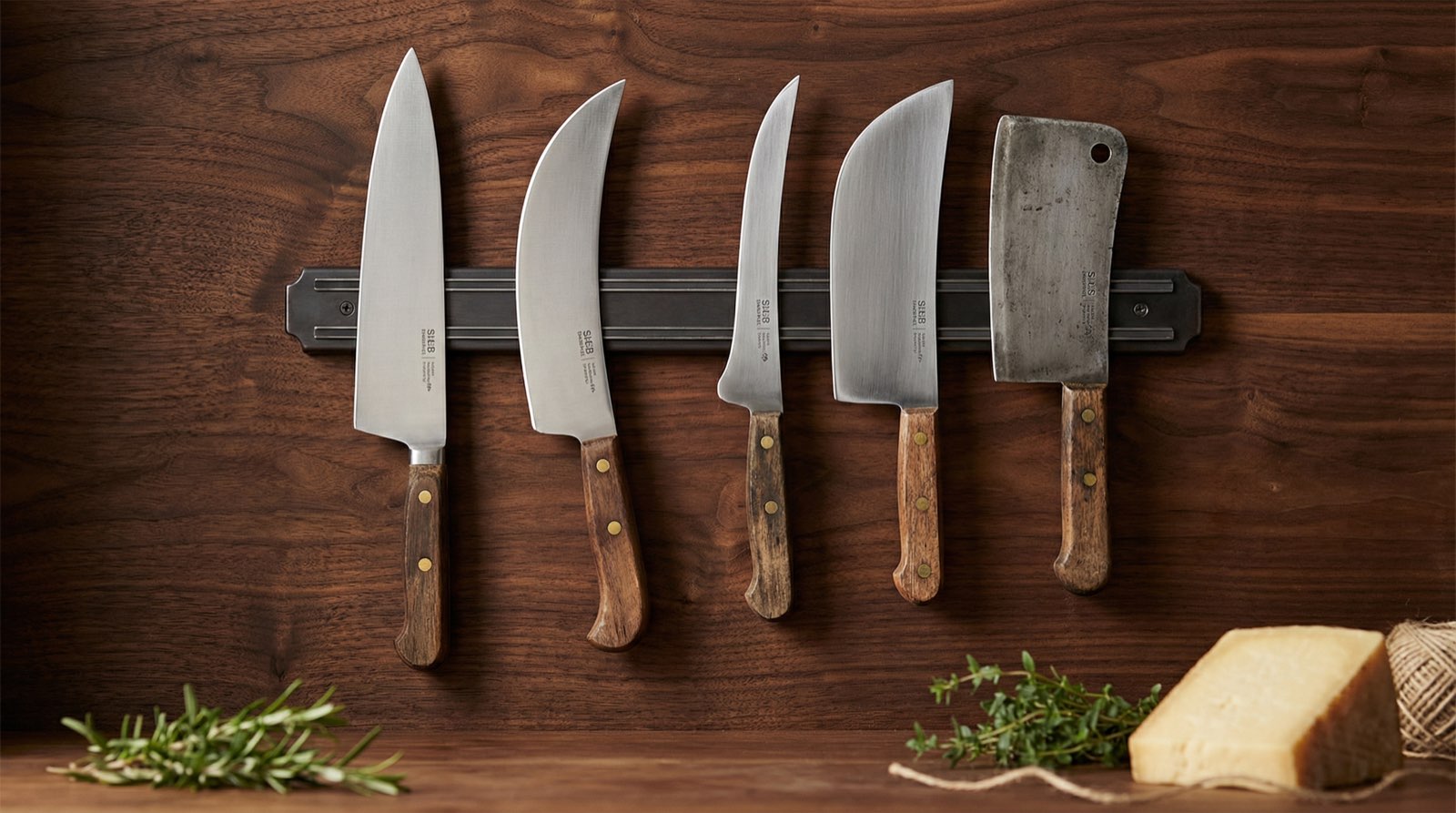
My grandfather used to say, "A butcher without the right knife is like a painter without a brush." After spending thirty years behind the block, I can tell you he was absolutely right. The difference between a mediocre butcher and a master often comes down to knife selection and technique—knowing which blade to reach for before you even touch the meat.
Most home cooks think a good chef's knife can handle all their meat-cutting needs. And for trimming a steak or carving a roast, that's true. But the moment you're breaking down a primal cut, fabricating chickens, or removing silverskin from a tenderloin, you need specialized tools designed for specific tasks. Let me walk you through every knife in a professional butcher's kit and teach you exactly when and how to use each one.
The Essential Butcher's Knife Set
A complete butcher shop maintains 8-12 different knife types, each optimized for specific cutting tasks. Here's what belongs in every serious meat cutter's arsenal:
1. Breaking Knife (Cimeter/Scimitar)
Blade length: 10-14 inches
Characteristics: Wide, curved blade with a rounded tip; designed for long, sweeping cuts
This is the workhorse of the butcher shop—the first knife I reach for when breaking down primals. The curved blade (called a "cimeter" because it resembles a scimitar sword) allows you to make long, continuous cuts through large pieces of meat with a single stroke. The curve lets you use a rocking motion that's easier on your wrist than straight push-cutting.
Primary uses:
- Breaking down beef quarters into primals (ribeye, chuck, round)
- Separating large muscle groups on pork and lamb
- Trimming fat caps on briskets and pork shoulders
- Removing skin from whole hog sides
- Any task requiring long, smooth cuts through large surfaces
Technique tip: Let the curve do the work. Start the cut with the heel of the blade near the handle, then draw the knife toward you in a smooth arc, using the full length of the edge. You should rarely need to saw—if you're sawing, your blade is dull or you're using the wrong knife.
2. Boning Knife (Stiff)
Blade length: 5-7 inches
Characteristics: Narrow, straight blade with minimal flex; extremely sharp pointed tip
The stiff boning knife is my go-to for precision work where I need control and can't afford the blade to bend. The narrow profile lets you work close to bones and in tight spaces, while the stiffness gives you the leverage to cut through connective tissue and cartilage.
Primary uses:
- Removing bones from beef primals (short ribs, ribeye deckle)
- Fabricating pork chops from bone-in loins
- Trimming silverskin and heavy connective tissue
- Cutting away knuckle bones and joints on lamb legs
- Separating chicken leg quarters at the joint
- Trimming around T-bones and porterhouse bones
Technique tip: Keep the blade close to the bone—you should hear the knife scraping against bone as you work. Use short, controlled strokes with the tip, angling the blade toward the bone to minimize meat waste. With practice, you'll learn to "feel" the bone through the blade.
3. Boning Knife (Flexible)
Blade length: 6-7 inches
Characteristics: Narrow blade with significant flex; sharp pointed tip
Many beginners don't understand why you'd want a flexible blade—doesn't that reduce control? The answer is that flexibility allows the blade to follow curves and contours that a stiff blade would cut through, wasting meat. A flexible boning knife bends around bones and follows natural seams between muscles.
Primary uses:
- Boning whole chickens and turkeys
- Removing ribs from pork loins without cutting into the loin muscle
- Following the curved bones in lamb racks and legs
- Filleting large fish (a butcher who works with whole animals often does fish too)
- Trimming around irregular bones like shoulder blades and hip bones
- Any boning task where the bone surface is curved or irregular
Technique tip: Apply gentle pressure and let the blade flex around bones. Don't force it—if you're pushing hard, you're doing it wrong. The flexibility is a feature, not a flaw. For poultry, you can often debone an entire chicken without cutting through any bones, just by following joints and using the blade's flex.
4. Butcher's Cleaver
Blade length: 7-8 inches
Weight: 2-3 pounds
Characteristics: Thick, heavy rectangular blade; designed for chopping through bones
This is the most misunderstood knife in the butcher shop. Beginners see cleavers in movies and think they're for hacking wildly at meat. In reality, a cleaver is a precision tool for controlled bone cutting. The weight does the work—you guide it, gravity drops it, and the mass carries it through bone.
Primary uses:
- Chopping through chicken backs and necks for stock
- Cutting spare ribs into individual bones
- Splitting whole chickens and ducks down the backbone
- Cutting pork shanks and beef marrow bones to length
- Breaking down large bones for stock (femurs, knuckles)
- Chopping through cartilage at joints (NOT recommended for hard bone—use a bandsaw)
Technique tip: The cleaver isn't an axe—don't swing it like you're chopping wood. Place the blade where you want to cut, raise it 6-8 inches, and let it drop with a firm but controlled motion. The weight alone will cut through chicken bones and cartilage. For harder bones, strike the spine of the cleaver with a meat mallet rather than swinging harder.
Important safety note: Never use a cleaver on hard beef or pork leg bones. You'll chip the blade or, worse, the knife will bounce and cause injury. Those jobs are for a bandsaw. Cleavers are for poultry, ribs, and softer bones only.
5. Fillet Knife
Blade length: 7-9 inches
Characteristics: Very thin, extremely flexible blade; razor-sharp edge
While primarily used for fish, a good fillet knife earns its place in a butcher shop for delicate meat fabrication tasks. The extreme flexibility and thin profile allow for precise cuts that would be impossible with thicker blades.
Primary uses:
- Removing skin from fish fillets and whole fish
- Trimming fat from the inside of thin cuts (minute steaks, scallopini)
- Separating silverskin from tenderloin without cutting into the meat
- Cleaning membrane from inside of ribs (for competition-style ribs)
- Detail work on delicate cuts like veal or lamb
Technique tip: Angle the blade nearly parallel to the work surface and use a gentle sawing motion. The blade should flex as you work—if it's not bending, you're cutting too deep. For silverskin removal, slide the blade under one end, angle it toward the silverskin (away from the meat), and pull the silverskin taut with your other hand while pushing the blade forward.
6. Butcher's Knife (French/Chef's Style)
Blade length: 10-14 inches
Characteristics: Wide, straight blade; less curve than a breaking knife; pointed tip
This is what most people picture when they think "butcher knife"—a large, intimidating blade that looks like an oversized chef's knife. It's less specialized than other butcher knives, making it a good all-purpose option for general cutting tasks.
Primary uses:
- Portioning steaks from trimmed strip loins and ribeyes
- Cutting stew meat and kabob cubes
- Slicing roasts and large cooked meats
- General-purpose cutting when you don't need a specialized blade
- Training apprentice butchers (less specialized, more forgiving)
Technique tip: Use it like a large chef's knife—rock the blade for chopping, use smooth slicing motions for portioning. This isn't the knife for breaking down primals or boning, but it's perfect for fabricating already-trimmed subprimals into retail cuts.
7. Skinning Knife
Blade length: 4-6 inches
Characteristics: Short, wide blade with an upswept tip; moderate flexibility
This specialized blade is designed for one primary purpose: removing skin and hide from carcasses. The short blade and upswept tip allow you to work between skin and flesh without puncturing the hide or cutting into the meat.
Primary uses:
- Skinning whole rabbits, lambs, and goats
- Removing skin from pork belly for skinless bacon
- Peeling skin from whole fish
- Removing heavy fat caps that include skin (pork shoulder)
Technique tip: Keep the blade angled toward the skin, not the meat. Use your free hand to pull the skin taut and away from the carcass as you cut. Short, scraping strokes work better than slicing motions. The goal is to separate, not cut through.
8. Steak Knife (Butcher's Steak Knife)
Blade length: 5-7 inches
Characteristics: Narrow, slightly flexible blade; rounded tip
Don't confuse this with the serrated steak knives you use at the dinner table. A butcher's steak knife is a specialized tool for slicing boneless steaks and chops from already-trimmed subprimals. It's designed for volume—making dozens of identical cuts quickly.
Primary uses:
- Portioning boneless strip steaks, ribeyes, and filets from trimmed loins
- Cutting pork chops from boneless pork loins
- Slicing roast beef and deli meats
- Any task requiring uniform, thin slices from boneless cuts
Technique tip: Use a smooth, continuous slicing motion with even pressure. Don't saw—let the sharp blade do the work. For consistent thickness, many butchers use a finger as a guide, keeping the blade against the knuckle of the hand holding the meat.
9. Honing Steel
Technically not a knife, but I'd never work a shift without one. A honing steel doesn't sharpen a blade (that's what a whetstone does)—it realigns the edge, straightening micro-bends that occur during cutting. I run my breaking knife and boning knives across the steel every 15-20 minutes during fabrication.
Technique tip: Hold the steel vertically with the tip resting on a cutting board. Place the knife's heel against the steel at a 15-20 degree angle, then draw the blade down and across the steel in a smooth arc, pulling toward yourself. Alternate sides, 4-5 strokes per side. You should hear a ringing sound—if it's silent, you're not making contact with the edge.
Knife Materials: What to Look For
Blade Steel
Professional butcher knives are typically made from high-carbon stainless steel or carbon steel. Here's what I recommend:
- High-carbon stainless steel: Best all-around choice. Holds an edge well, resists rust, easy to maintain. Look for German or Japanese steels (brands like Victorinox, F. Dick, Wüsthof).
- Carbon steel: Takes a sharper edge and is easier to sharpen, but rusts easily if not maintained. Requires oiling and careful drying after each use. Preferred by traditionalists and many old-school butchers.
- Avoid: Cheap stainless steel that won't hold an edge and ceramics that chip easily around bones.
Handle Materials
In a professional environment where knives get wet and greasy constantly, handle material matters:
- Polypropylene (Fibrox): Industry standard. Non-slip when wet, dishwasher safe, extremely durable. Not pretty, but functional.
- Wood: Traditional and comfortable, but requires more maintenance. Must be oiled, can crack or split with heavy use, harbors bacteria if not properly maintained. I reserve wood handles for my home knives.
- Avoid: Smooth metal or slick plastic handles that become dangerously slippery when wet or greasy.
Knife Maintenance: Keeping Your Edges Sharp
A dull knife is dangerous—it requires more pressure, increasing the chance of slipping. Here's how I maintain my knives:
Daily Maintenance
- Hone with a steel every 15-20 minutes during use
- Wash by hand immediately after use (never put butcher knives in a dishwasher)
- Dry completely before storing
- For carbon steel blades, wipe with food-grade mineral oil before storing overnight
Weekly Sharpening
- Use a whetstone (1000-3000 grit) or professional sharpening system
- Maintain a 15-20 degree angle for European knives, 12-15 degrees for Japanese knives
- Work from heel to tip in smooth, even strokes
- Test sharpness on paper—a sharp knife should slice through paper cleanly without tearing
Professional Sharpening
Every 2-3 months, I send my primary knives to a professional knife sharpener who uses a grinding wheel. This removes enough metal to restore the proper blade geometry, something hand sharpening can't always achieve.
Safety Principles
After thirty years, I still have all my fingers. Here's how:
- Never catch a falling knife — Step back and let it fall. A falling knife has no handle.
- Cut away from yourself — Always position the blade so that if it slips, it moves away from your body.
- Use a cut-resistant glove — On your non-knife hand, especially when boning or doing delicate work near your fingers.
- Maintain your edges — A dull knife requires dangerous amounts of pressure.
- Keep your workspace organized — Don't leave knives hidden under scraps or buried in the workspace.
- Announce when walking with a knife — In a shop with multiple people, always call out "knife behind you" or "sharp coming through."
- Store knives properly — Use a magnetic strip, knife block, or blade guards. Never loose in a drawer.
Building Your Kit: Prioritized Buying Guide
You don't need all twelve knife types on day one. Here's how I'd build a butcher's kit on a budget:
Essential Starter Kit ($150-250)
- 6-inch stiff boning knife (Victorinox Fibrox, $40) — The single most important knife
- 10-inch breaking knife (Victorinox cimeter, $50) — For breaking down primals
- Honing steel (10-12 inch, $30) — Essential for maintenance
- Butcher's cleaver (Dexter-Russell, $60) — For bone work
Intermediate Kit Addition ($100-150)
- 6-inch flexible boning knife ($40) — For poultry and curved bones
- 10-inch butcher's knife ($50) — All-purpose cutting
Advanced/Professional Addition ($150-300)
- 8-inch fillet knife ($50) — Delicate fabrication
- Skinning knife ($40) — If working with whole animals
- Professional sharpening system ($100+) — Long-term investment
Frequently Asked Questions
Can I use regular kitchen knives for butchering?
A good chef's knife can handle small tasks—trimming a steak, portioning a roast—but it's not designed for breaking down primals or boning. The blade geometry, length, and flexibility are wrong for these tasks. You'll struggle with efficiency and waste more meat. If you're only occasionally cutting meat at home, a chef's knife is fine. If you're buying quarters or primals, invest in proper butcher knives.
What's the difference between German and Japanese butcher knives?
German knives (Wüsthof, Victorinox, F. Dick) have thicker, more durable blades designed for heavy-duty work. They're more forgiving of abuse and easier to sharpen. Japanese knives (Masamoto, Global) are thinner, sharper, and more precise, but require better technique and more careful maintenance. For professional butchery, I prefer German-style knives for their durability. For delicate fabrication, Japanese knives excel.
How often should I sharpen my knives?
Honing (with a steel) should happen throughout every work session—every 15-20 minutes of cutting. Actual sharpening (removing metal to create a new edge) depends on use. In a busy shop, weekly sharpening is standard. At home, monthly is usually sufficient. The test: if your knife won't cleanly slice a tomato or paper, it needs sharpening.
Is it worth buying expensive knives?
Not necessarily. I've seen $30 Victorinox knives outperform $200 Japanese blades in daily shop use because they're more durable and easier to maintain. The expensive knives are sharper initially and feel nicer, but in butchery, durability and ease of maintenance often matter more than ultimate sharpness. Buy mid-range professional knives ($40-80 per knife) and spend the savings on professional sharpening services.
Can I put butcher knives in the dishwasher?
Never. The heat damages handles, the detergent dulls blades, and knives bouncing around can chip edges or damage other items. Always hand wash immediately after use, dry thoroughly, and store properly.
What's the best cutting surface for butcher knives?
Wood or high-density polyethylene (HDPE) cutting boards. Wood is traditional and slightly gentler on edges but requires more maintenance. HDPE (white plastic cutting boards) is professional kitchen standard—dishwasher safe, won't dull knives, and affordable. Avoid glass, marble, or ceramic—they destroy knife edges instantly.
Should I buy a knife set or individual knives?
Individual knives. Knife sets include blades you'll never use and are often lower quality than buying individual pieces from professional suppliers. Build your kit one knife at a time based on what you actually need. Start with a boning knife and breaking knife—those two will handle 80% of butchering tasks.
How do I choose between a stiff and flexible boning knife?
Start with a stiff 6-inch boning knife—it's more versatile. Add a flexible knife later when you're comfortable with basic boning technique and start working on poultry or following curved bones. The stiff knife forces you to learn proper technique; the flexible knife lets you get lazy. Master the stiff knife first.
What's the difference between a breaking knife and a butcher's knife?
A breaking knife (cimeter) has a curved blade optimized for long, sweeping cuts through large primals. A butcher's knife has a straighter blade better suited for portioning already-broken-down subprimals. If you can only buy one, get the breaking knife—it's more versatile for whole-animal butchery.
Elena Vasquez is a third-generation butcher who learned the trade from her grandfather in their family's butcher shop in San Antonio, Texas. She now runs her own whole-animal butchery and teaches butchering workshops focusing on traditional techniques and nose-to-tail utilization.
More Expert Guides
How to Trim a Brisket: The Complete Butcher's Guide
Proper brisket trimming is the difference between a backyard experiment and competition-quality results. Here is the professional technique for shaping a whole packer brisket before it ever touches the smoker.
14 min readHow to Butcher a Whole Chicken: Step-by-Step Guide
Breaking down a whole chicken yourself saves 40-50% compared to buying individual parts. Here is the professional technique for turning one bird into perfectly portioned pieces.
14 min readHome Butchering Safety Guide: Essential Protocols for Safe Meat Processing
Learn professional butchering safety protocols from a master butcher with 25+ years of experience. Essential guidance for anyone processing meat at home.