Butcher Shop Slang: What Your Butcher Really Means When They Talk Shop
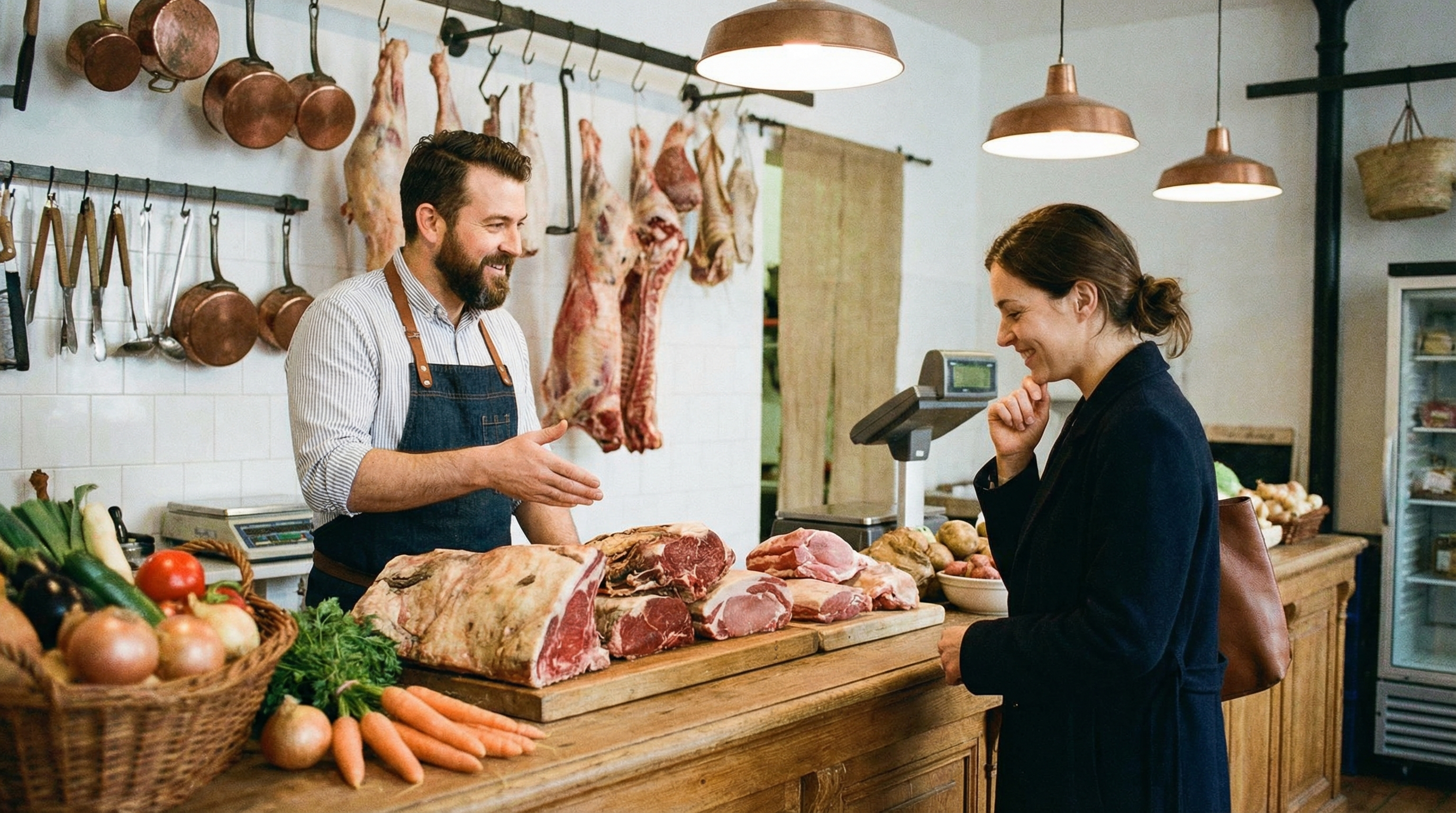
Butcher Shop Slang: What Your Butcher Really Means
I have spent over two decades behind the butcher counter, and I can tell you: butcher shops have their own language. Walk in and ask for "a couple ribeyes," and you might hear your butcher respond with phrases like "clean it up?" or "how thick — one finger or two?" If you have ever nodded along while wondering what they actually meant, this guide is for you.
This is not a technical glossary of primal cuts and fabrication methods (we have that covered here). This is the practical, conversational slang you hear across the counter — the shorthand butchers use with customers and each other on the shop floor. These are the phrases I use every single day, and understanding them will make you a better, more confident customer.
Note: While butcher slang varies regionally and shop-to-shop, the terms in this guide reflect common usage across professional US butcher shops. Technical meat industry standards are defined by the USDA Agricultural Marketing Service.
Counter Talk: Common Ordering Phrases
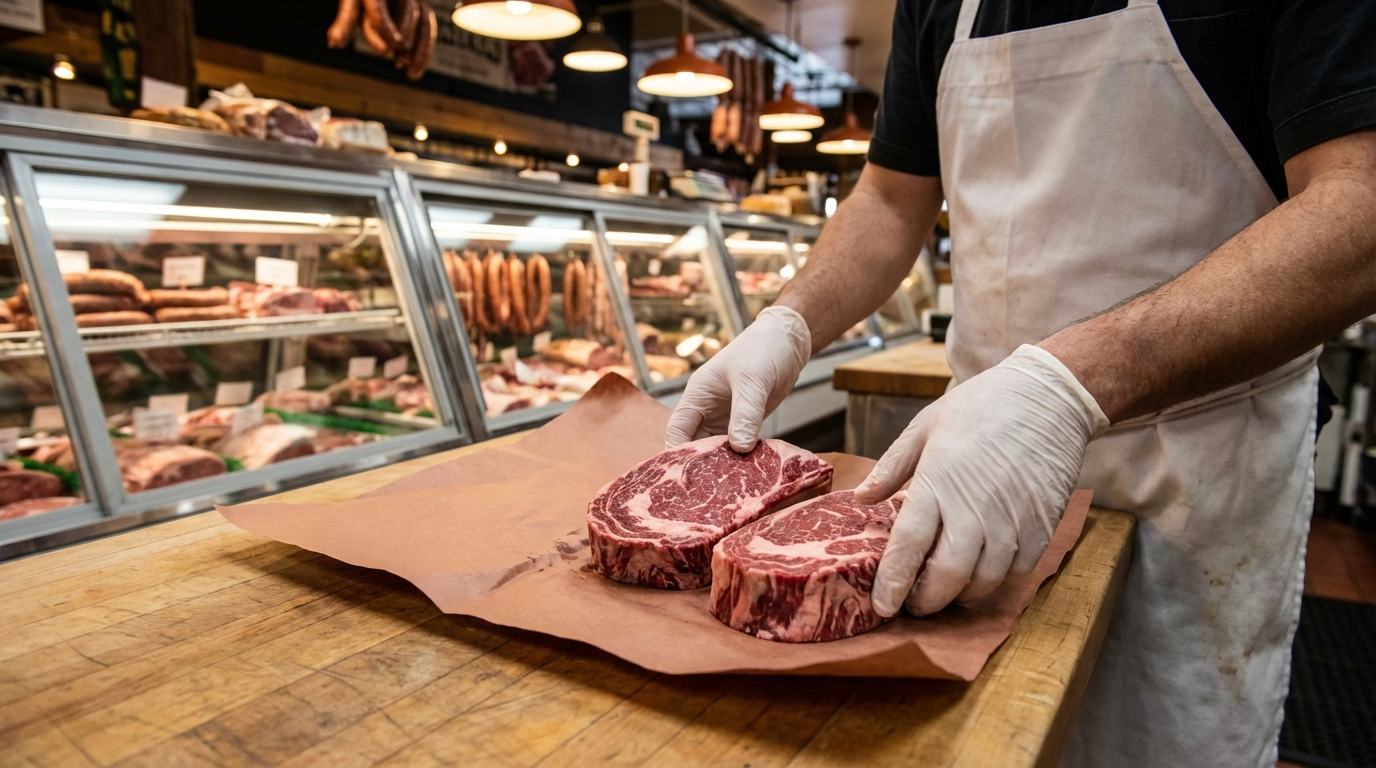
These are the phrases you will hear (and use) most often when ordering meat at a quality butcher counter.
"How thick?"
Your butcher is asking how thick you want your steaks cut. Most customers do not carry rulers, so butchers use finger-width measurements. "One-finger thick" is about 3/4 inch (good for quick-cooking cuts like flank or skirt). "Two-finger thick" is 1.5 inches (ideal for ribeyes and strips). "Three-finger thick" is about 2+ inches — what I call a "cowboy cut."
In my experience, most home cooks underestimate thickness. A 1/2-inch ribeye will overcook before it develops a proper crust. I always recommend two-finger minimum for premium steaks.
"Clean it up" or "trim it"
This means removing excess external fat, silverskin, or gristle before wrapping. If your butcher asks "clean it up?", they are offering to trim the cut to table-ready condition. Most customers say yes for steaks and roasts, but you might want to keep fat cap on a brisket or pork shoulder for smoking.
The phrase "leave it on" or "leave the cap" means you want that external fat intact.
"Bone-in or boneless?"
Straightforward question, but the answer affects price and cooking. Bone-in cuts (ribeye, porterhouse, pork chops) cost less per pound because you are paying for bone weight. They also cook slower and stay juicier. Boneless cuts cook faster and are easier to portion, but you lose the flavor contribution from marrow.
A veteran customer move: ask for "bone on the side" when ordering a boneless roast. You get the convenience of boneless prep with bones for stock. Not all shops will do it, but it never hurts to ask.
"Break it down"
This phrase has two meanings depending on context. At the counter, "break down a ribeye" or "break down a tenderloin" means cutting a whole subprimal into individual steaks. Behind the counter, it means fabricating a primal cut into smaller retail cuts (like breaking down a beef rib primal into ribeye steaks, short ribs, and ribeye cap).
If you ask a butcher to "break down" a whole ribeye for you, expect to wait 10-15 minutes while they portion it. Most shops appreciate advance notice for large breakdown requests.
"How many are you feeding?"
Butchers ask this to help you avoid over-ordering or under-ordering. The industry rule of thumb: 8 ounces raw weight per person for boneless cuts, 12 ounces for bone-in. That accounts for cooking shrinkage and gives most adults a satisfying portion without excess.
I have seen countless customers order "four ribeyes" for a party of eight and come back the next day disappointed. Always mention headcount.
Cut Requests Decoded
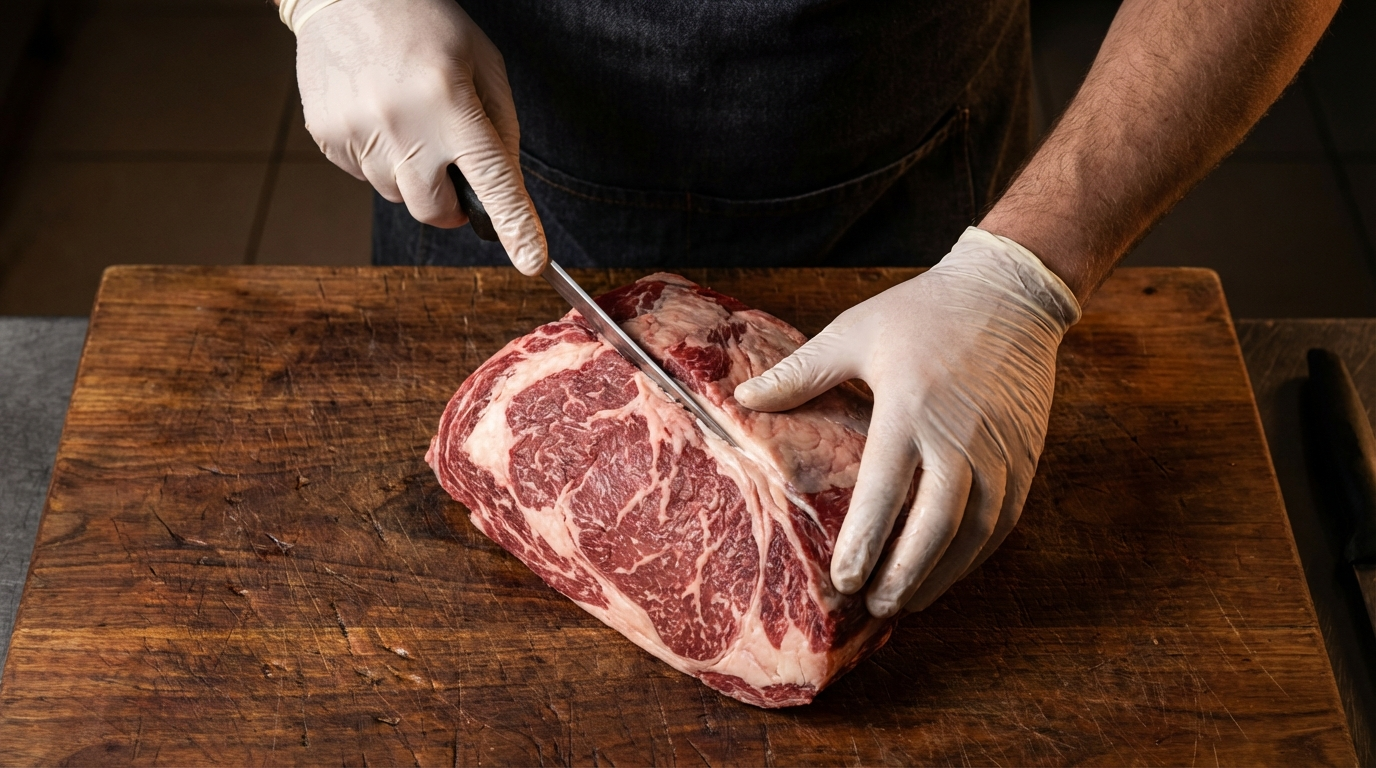
These phrases describe how you want the butcher to cut or prepare your meat — techniques that go beyond simple slicing.
"Butterfly it"
Butterflying means slicing a thick cut almost all the way through, then opening it like a book to create a thinner, wider piece. Common for pork chops, chicken breasts, and flank steaks. The result cooks faster and more evenly than a thick single piece.
When I butterfly a 2-inch pork chop, I am creating a ~1-inch piece that is twice as wide. Perfect for stuffing or fast grilling.
"Cube it" or "stew meat"
"Cube it" means cutting meat into uniform cubes, usually 1 to 1.5 inches. When a customer asks for "stew meat," I am pulling tougher cuts (chuck, round) and cubing them. These cuts have connective tissue that breaks down beautifully in slow braises.
Pro tip: if you see "stew meat" in the case, ask what cut it came from. Chuck-based stew meat is richer; round-based is leaner. Both work, but chuck is my preference for beef stew.
"French it" or "frenched"
Frenching is scraping meat and fat off the exposed rib bones to create a clean handle. You see this on frenched lamb racks and tomahawk ribeyes. It is purely aesthetic — the exposed bone looks elegant on a plate.
In my shop, frenching a rack of lamb adds 5 minutes and $2-3 to the price because it is meticulous handwork.
"Against the grain" or "with the grain"
This refers to how the butcher cuts relative to the muscle fiber direction. "Against the grain" means slicing perpendicular to the fibers, which shortens them and makes the meat more tender. "With the grain" leaves long fibers intact.
For cuts like flank steak or brisket, slicing against the grain is non-negotiable. I have seen customers complain about "tough" flank steak that was actually premium quality — they just sliced it wrong at home.
"Tie it up" or "truss it"
Tying or trussing means securing a roast or bird with kitchen twine so it cooks evenly. A tied roast holds its shape instead of splaying open in the oven. A trussed chicken cooks more uniformly with wings and legs tucked tight.
Most butchers tie roasts for free if you ask. It takes 30 seconds and makes a huge difference in cooking performance.
Thickness and Portion Lingo
Portion and thickness requests are where miscommunication happens most often. Here is how butchers talk about size.
"Finger measurements"
We covered this briefly, but it is worth expanding. Butchers use their fingers as universal rulers because they are always available. Here is the scale:
- Half-finger: 1/2 inch — thin steaks for fast cooking
- One-finger: 3/4 inch — standard breakfast steak
- Two-finger: 1.5 inches — ideal for ribeyes, strips, filets
- Three-finger: 2+ inches — cowboy cuts and showpiece steaks
If you want precision, bring a ruler or ask for measurements in inches. But in 20 years, I have found finger-widths are more intuitive for most customers.
"Standard cut" vs "custom cut"
A "standard cut" means whatever thickness the shop pre-cuts for the display case — usually 1 to 1.25 inches for steaks. A "custom cut" means you are requesting something thicker, thinner, or a specific weight.
Custom cuts take extra time. If the shop is slammed, expect to wait or call ahead.
"By weight" vs "by the piece"
Some cuts are sold by weight (per pound pricing) and some by the piece (flat price per steak). In my shop, I sell ribeyes by the piece and ground beef by weight. This prevents confusion at checkout.
If you are on a budget, ask: "What is the final price?" before the butcher wraps it. Reputable shops will always tell you the total before wrapping.
Quality and Grade Shorthand
Butchers use shorthand to describe quality levels without sounding like a USDA manual. Here is what we actually mean.
"Prime," "Choice," "Select"
These are official USDA grades based on marbling. Prime is top-tier (5%+ intramuscular fat), Choice is standard for quality butcher shops (3-4% marbling), and Select is lean grocery-store grade.
If a butcher says "this is Prime," they mean USDA-certified. If they say "Prime-level" or "Prime-quality," they mean it looks like Prime but might not be officially graded. Ask if the distinction matters to you (it usually does not for home cooking).
According to the USDA grading standards, only 3-5% of beef qualifies for Prime grade annually.
"Grass-fed" vs "grain-finished"
"Grass-fed" means the animal ate pasture forage its entire life. "Grain-finished" means it was grain-fed for the final 90-120 days to increase marbling. Both can be high quality, but grain-finished is more marbled and milder-flavored.
In my experience, customers who say they want "grass-fed" sometimes actually want "pasture-raised, grain-finished" — humanely raised with good marbling. Clarify what you are optimizing for (ethics, flavor, leanness).
"Dry-aged" vs "wet-aged"
"Dry-aged" means the meat was hung in a controlled environment for 21-45+ days, concentrating flavor and tenderizing through enzymatic breakdown. "Wet-aged" means it was vacuum-sealed and aged in its own juices (less flavor development, but tenderizes).
Dry-aged beef costs 20-40% more because of moisture loss. If your butcher says "we age it in-house," ask if it is dry or wet. The difference in flavor is dramatic.
Preparation and Fabrication Terms
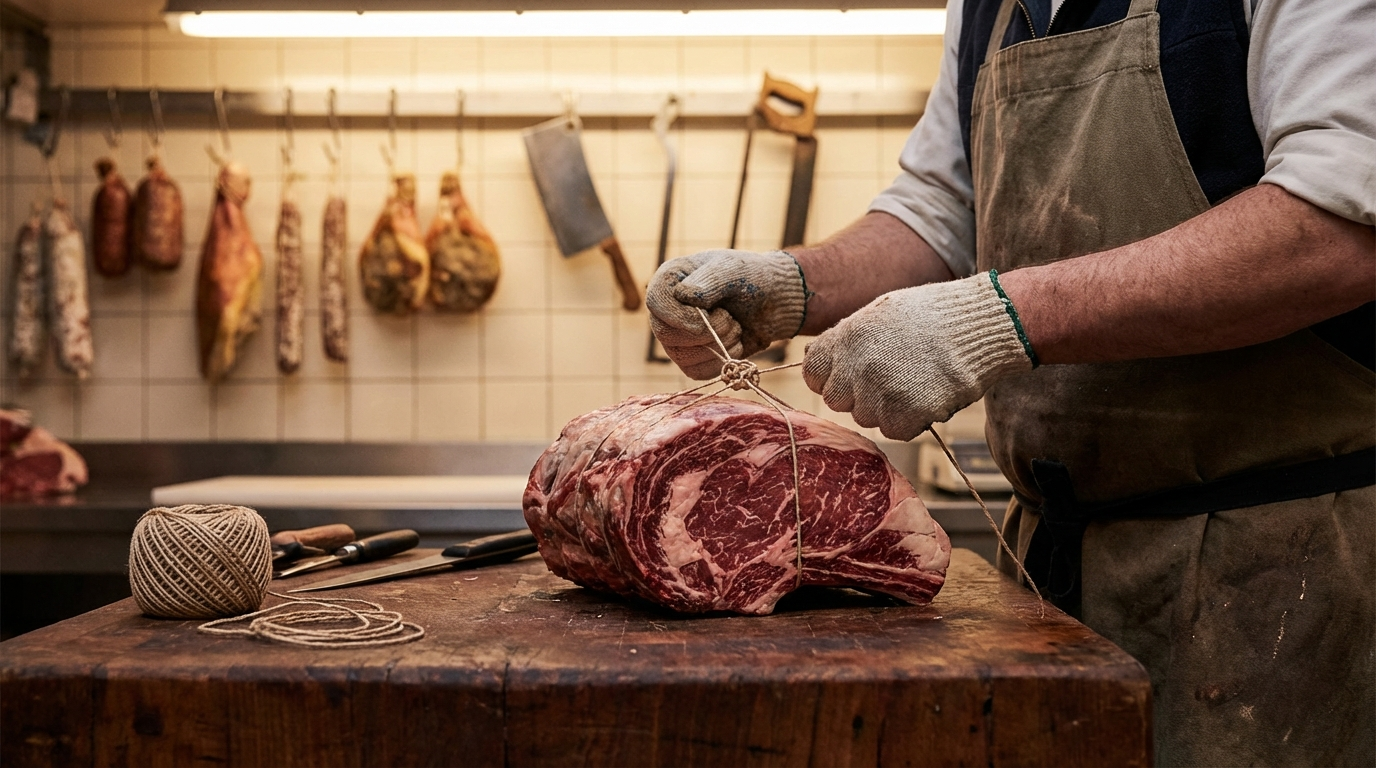
These are the terms butchers use when prepping meat for you — the final touches before wrapping.
"Debone it" or "pull the bone"
Exactly what it sounds like: removing bones from a cut. "Debone a ribeye" = remove the rib bone. "Pull the bone on a pork chop" = boneless chop.
Some shops charge a small fee ($0.50-1.00/lb) for deboning because it is skilled knife work. The bone is usually yours if you ask for it.
"Cap on" or "cap off"
This refers to the fat cap on cuts like brisket, pork shoulder, and ribeye. "Cap on" means leaving the external fat layer intact (better for smoking or slow roasting). "Cap off" means trimming it away (better for quick grilling).
Brisket pitmasters always say "cap on." Grill cooks usually prefer "cap off" for steaks. Tell your butcher your cooking method and they will advise.
"Score it"
Scoring means making shallow cuts (usually crosshatch pattern) on the fat cap or skin. This helps fat render during cooking and prevents curling. Common on pork belly, duck breast, and lamb racks.
I score pork belly 1/4-inch deep in a diamond pattern. Any deeper and you cut into the meat; any shallower and it does not render properly.
"Grind it" or "run it through"
"Grind it" or "run it through" means putting meat through a grinder. You can request "coarse grind" (larger holes, chunkier texture for burgers) or "fine grind" (smaller holes, smoother texture for meatballs or sausage).
Pro move: ask your butcher to grind a specific cut for you — "grind a chuck roast for burgers" beats mystery "ground beef" every time.
"Portion control" or "PC"
"Portion control" (often shortened to "PC") means cutting meat into consistent, identical sizes. Restaurants order "8 oz PC filets" or "6 oz PC chicken breasts." For home cooks, it means asking the butcher to cut steaks to a specific weight.
If you are meal-prepping or hosting a dinner party, PC cuts ensure everyone gets the same portion and everything cooks evenly.
Behind-the-Counter Shop Floor Slang
These are phrases butchers use with each other — the internal shorthand you might overhear while waiting at the counter.
"Run a rib" or "run a loin"
This means breaking down a whole subprimal into steaks. "Run a rib" = cut a whole ribeye into individual ribeye steaks. "Run a loin" = portion a strip loin.
If you hear this, it means the shop is cutting fresh steaks — usually a good sign of quality and turnover.
"Flip the case"
"Flip the case" means rotating or restocking the display case. Butchers do this multiple times daily to keep cuts looking fresh and ensure older inventory sells first (FIFO: first in, first out).
If you walk in mid-morning and see empty spots, ask if they are flipping the case. You might get first pick of fresh-cut steaks.
"Bench work" or "on the block"
"Bench work" or "on the block" means hands-on cutting and fabrication. When a butcher says "I have got to get back on the block," they mean they need to return to active cutting work.
The "block" refers to the butcher block (large wooden cutting surface) — the heart of any butcher shop.
"Pull from the cooler"
"Pull from the cooler" means retrieving a specific cut from the walk-in refrigerator. If you request something not in the case, the butcher might say "let me pull one from the back."
This is normal. It does not mean the meat is old — it means it is stored properly in climate-controlled cold storage rather than sitting in the display case.
"Hang time"
"Hang time" refers to how long a carcass or primal cut was aged before butchering. "21 days hang time" means it was aged for 21 days. More hang time = more tenderization and flavor concentration (up to a point).
If a butcher mentions hang time unprompted, they are proud of their aging program. Ask questions.
Conversational Pro Moves: How to Order Like a Regular
Now that you understand the slang, here is how to use it to get better service and better meat.
Be specific about cooking method
Instead of saying "I need ribeyes," say: "I need two ribeyes for grilling, two-finger thick, clean them up." This tells your butcher everything: portion, thickness, trim preference, and cooking method. They can adjust recommendations accordingly.
Ask what came in fresh
A simple question — "What came in fresh today?" or "What are you excited about this week?" — signals that you care about quality. Good butchers love talking about their best product.
In 20 years, I have never met a butcher who did not appreciate a customer who asked this question.
Request specific cuts by name
Learn 5-10 cut names beyond "steak" and "roast." Say "hanger steak," "flat iron," "Denver cut," or "tri-tip." This signals experience and often prompts butchers to show you premium cuts they do not advertise.
According to the Beef Checkoff cut database, there are 50+ named beef cuts — but most consumers only know 8-10. Expanding your vocabulary expands your options.
Build relationships
Butcher shops thrive on regulars. If you find a shop you like, go weekly and ask for the same butcher. They will remember your preferences, set aside special cuts, and give you heads-up on sales.
I have regulars I have served for 15+ years. They text me the day before Thanksgiving and I pull their turkey early. That is the power of a relationship.
Final Thoughts: Confidence at the Counter
Understanding butcher slang is not about sounding smart — it is about getting exactly what you want and building trust with the people who handle your food. The more specific and clear your requests, the better the result.
Next time you walk into a butcher shop, try one phrase from this guide. Ask for "two-finger thick" instead of "thick." Request "cap on" for your brisket. Ask what they are "running today." You will notice the difference immediately — better service, better cuts, better meals.
The best butchers are educators and craftspeople. When you speak their language, they will teach you things you will never find online.
Frequently Asked Questions
What does "two-finger thick" mean when ordering steaks?
Two-finger thick means approximately 1.5 inches — the width of two fingers held side-by-side. This is the ideal thickness for premium steaks like ribeyes and strip steaks, allowing proper crust development without overcooking the interior.
What is the difference between "clean it up" and "leave the cap"?
"Clean it up" means trimming away excess external fat and silverskin for a table-ready cut. "Leave the cap" means keeping the fat layer intact, which is preferred for smoking brisket or slow-roasting pork shoulder.
How do I ask for custom thickness at a butcher shop?
Use finger measurements (one-finger, two-finger, three-finger) or specify inches (1 inch, 1.5 inches, 2 inches). Most butchers prefer finger measurements because they are universal and intuitive.
What does it mean when a butcher says they will "break down a ribeye"?
Breaking down a ribeye means cutting a whole ribeye subprimal (10-15 lbs) into individual steaks. This takes 10-15 minutes, so most shops appreciate advance notice for large breakdown requests.
Should I ask for bone-in or boneless cuts?
Bone-in cuts cost less per pound, cook slower, and stay juicier due to bone insulation. Boneless cuts are easier to portion and cook faster. For roasts, you can request "bone on the side" to get both benefits — boneless cooking convenience plus bones for stock.
What is the difference between dry-aged and wet-aged beef?
Dry-aged beef is hung in controlled conditions for 21-45+ days, concentrating flavor and tenderizing through moisture loss. Wet-aged beef is vacuum-sealed and aged in its juices, which tenderizes but develops less intense flavor. Dry-aged costs 20-40% more due to shrinkage.
More Expert Guides
How to Cut Beef Short Ribs: English-Cut vs Flanken-Cut Techniques
Short ribs are one of the most versatile and flavorful cuts in the beef carcass, but how you cut them determines their final use. The difference between English-cut and flanken-cut comes down to knife angle and intended cooking method.
16 min readHow to Set Up a Home Butcher Shop: Complete Space, Equipment & Workflow Guide
Setting up a dedicated home butcher shop transforms meat processing from a messy kitchen chore into efficient, professional-quality work. Here is everything you need to design your space, choose equipment, and establish safe workflows.
11 min readHow to Wrap and Package Meat Like a Professional Butcher
Proper meat wrapping is just as important as proper cutting. A perfectly trimmed ribeye or pork chop loses quality fast if wrapped poorly. After three decades wrapping thousands of pounds of meat, I can tell you: technique matters more than materials.