How to Become a Butcher: Career Guide & Training Path
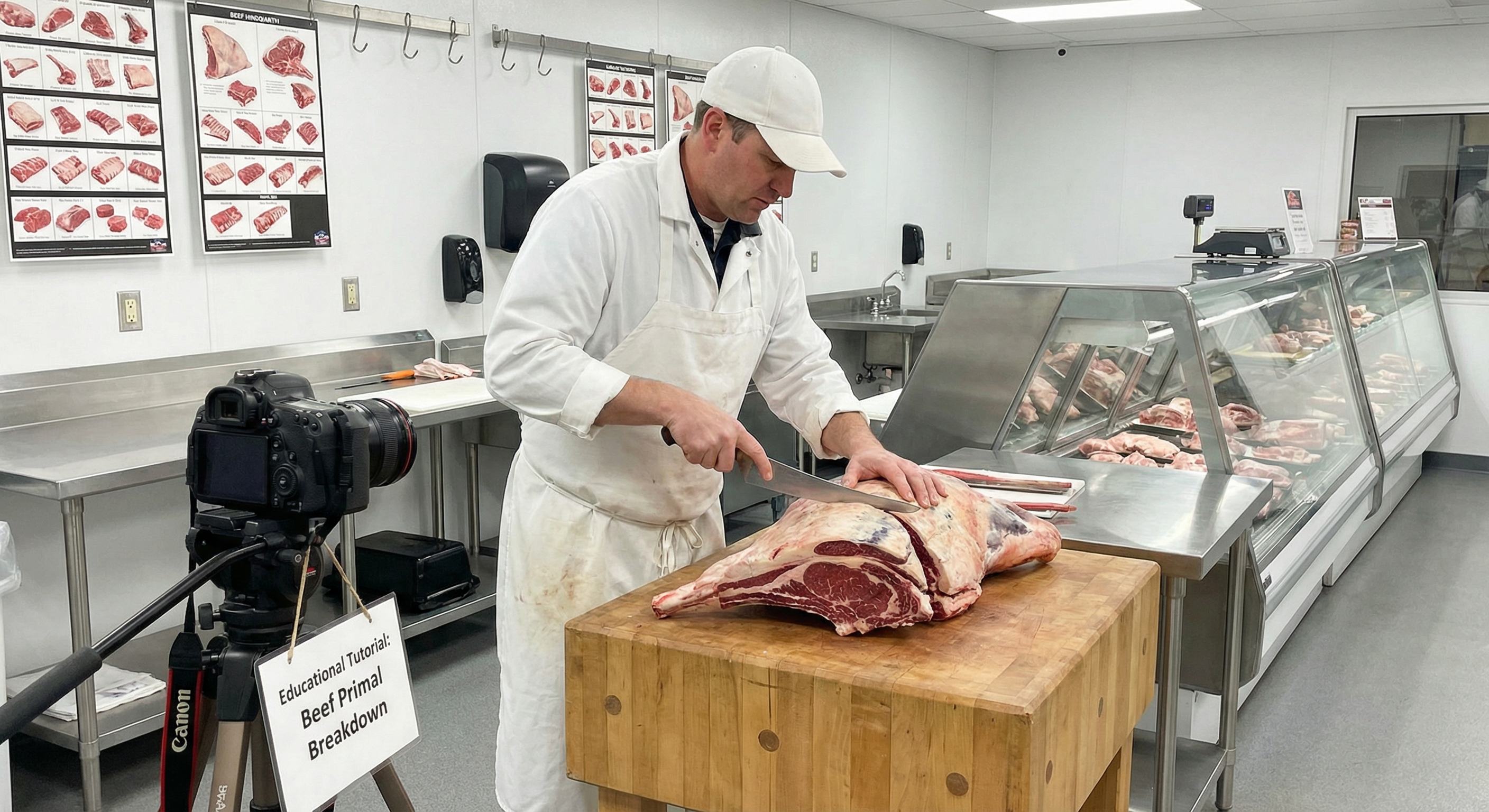
I've spent over two decades training apprentice butchers, and I still remember my own first day behind the block — nervous hands gripping a boning knife, wondering if I'd ever develop the speed and precision I saw in my mentor. Today, I run training programs that have helped hundreds of people start careers in this craft. The path isn't what most people expect, but for those with the right temperament, butchery offers something rare: a skilled trade with genuine job security, creative satisfaction, and a direct connection to one of humanity's oldest food traditions.
If you're considering how to become a butcher, this guide covers everything: the realistic skill requirements, the multiple training paths available, certification options, salary expectations, and career advancement opportunities. I'll also tell you the things most career guides leave out — like what the work is actually like day-to-day, and how to know if this trade is right for you.
What Does a Butcher Actually Do?
The word "butcher" covers a wide range of specializations, from the person breaking down whole carcasses at a processing plant to the specialist hand-cutting wagyu steaks at a high-end retail shop. Before committing to training, understand what you're getting into.
Core Responsibilities
- Primal and subprimal breakdown: Converting carcasses or large cuts into retail portions
- Portion cutting: Creating consistent steaks, roasts, chops, and other retail cuts
- Trimming and preparation: Removing silverskin, excess fat, and preparing cuts for sale
- Grinding and processing: Making ground meat, sausages, and value-added products
- Customer service: Advising customers on cuts, cooking methods, and portions
- Inventory and ordering: Managing stock, minimizing waste, maximizing yield
- Food safety compliance: Following HACCP protocols, temperature monitoring, sanitation
Work Environment Realities
Butcher shops and processing facilities are cold — typically 35-45°F. You'll be on your feet 8-10 hours a day, often starting before dawn. The work is physically demanding: lifting 50+ pound primals, repetitive cutting motions, constant standing. Hands are frequently cold and wet. Cuts, nicks, and sore muscles are part of the learning curve.
That said, many butchers find the work deeply satisfying. There's a meditative quality to skilled knife work, a creative element to merchandising a case, and genuine pride in helping customers find exactly what they need. If you enjoy working with your hands and have patience for developing craft skills, the environment becomes comfortable rather than challenging.
Do You Need Formal Education?
Here's the truth most people don't tell you: formal education is optional for becoming a butcher. Unlike careers requiring degrees, butchery values demonstrated skill over credentials. However, formal training can significantly accelerate your learning curve and open doors to advanced positions.
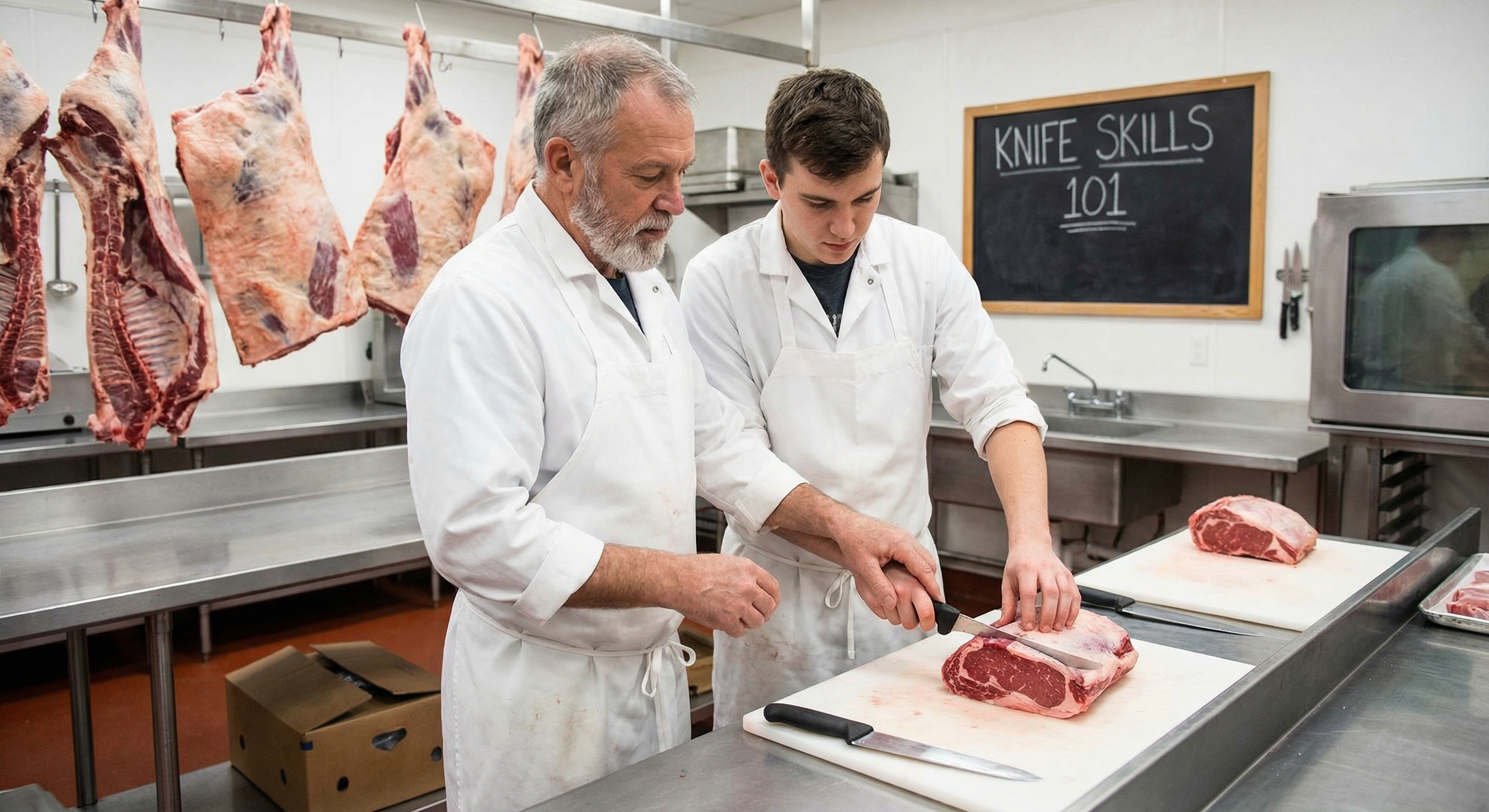
Path 1: Traditional Apprenticeship (Recommended)
The time-tested route. You learn on the job under experienced butchers, starting with cleaning and basic tasks, gradually earning your way to the block. This is how I learned, and I still believe it produces the most well-rounded butchers.
Pros:
- You earn while you learn (entry-level pay, but still income)
- Real-world skills from day one
- Mentorship from experienced professionals
- Often leads directly to permanent employment
Cons:
- Progress depends heavily on your shop's willingness to teach
- May take 2-4 years to develop full proficiency
- Quality varies enormously between shops
How to find apprenticeships: Walk into local butcher shops, meat departments, and processing facilities. Ask if they hire apprentices or entry-level cutters. Many shops don't advertise these positions — they fill them through walk-ins and referrals. Showing genuine interest and willingness to start at the bottom goes a long way.
Path 2: Culinary School with Meat Focus
Several culinary programs offer meat fabrication as a specialty. The Culinary Institute of America, Johnson & Wales, and various community colleges have programs covering butchery fundamentals.
Pros:
- Structured curriculum covering theory and practice
- Exposure to multiple protein types (beef, pork, lamb, poultry)
- Food safety certification often included
- Networking with industry professionals
Cons:
- Expensive ($20,000-$50,000+ for full programs)
- May focus more on restaurant applications than retail
- Still need hands-on experience after graduation
Path 3: Dedicated Butchery Schools
Intensive programs focused specifically on meat cutting have emerged in recent years. Programs like Fleisher's Craft Butchery courses, The Butcher's Guild workshops, and regional meat science programs at agricultural universities offer concentrated training.
Pros:
- Intensive, focused curriculum (often 1-12 weeks)
- Taught by working butchers
- Often includes whole-animal breakdown
- Strong industry connections
Cons:
- Expensive for the duration ($2,000-$10,000 for short courses)
- Limited availability (may require travel)
- Provides foundation, not mastery
Path 4: Grocery Store Entry Level
Major grocery chains (Kroger, Safeway, Whole Foods, Costco) hire entry-level meat department employees and provide on-the-job training. This is often the most accessible starting point for people without connections to traditional butcher shops.
Pros:
- Low barrier to entry
- Structured corporate training programs
- Benefits and stable hours
- Clear advancement paths (wrapper → cutter → journeyman → manager)
Cons:
- May be limited to pre-packaged or "case ready" meat
- Less whole-animal breakdown experience
- Corporate environment vs. craft shop culture
Essential Skills to Develop
Knife Skills
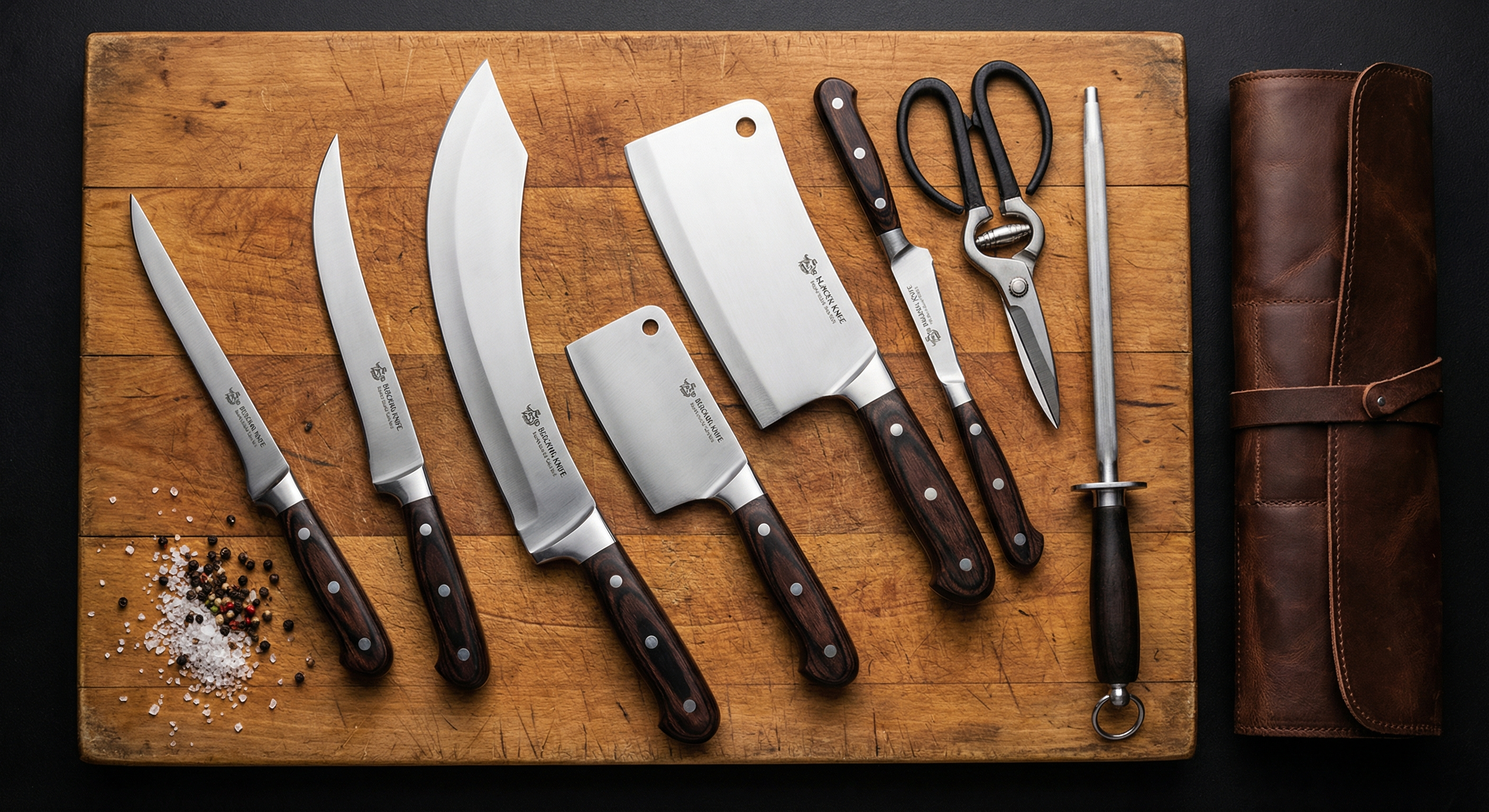
Everything begins here. A butcher's knife is an extension of their hand, and developing proper technique prevents injury while maximizing efficiency. Key knives every butcher masters:
- Boning knife (5-7"): The workhorse for separating meat from bone. Flexible blade follows contours.
- Breaking knife (8-10"): Heavier blade for cutting through cartilage and separating joints.
- Cimeter/scimitar (10-14"): Long curved blade for portioning steaks and trimming large cuts.
- Cleaver: For splitting bones and heavy-duty work.
Expect to spend your first 6-12 months primarily developing knife skills. Speed comes with repetition — a seasoned butcher can break down a beef loin in minutes while an apprentice takes an hour. Don't rush it. Precision first, speed follows.
Anatomy Knowledge
Understanding animal anatomy separates butchers from people who simply cut meat. Knowing where muscles attach, how they move, and what they're used for tells you how to cut them for optimal tenderness and how to explain cooking methods to customers.
Start with beef — the most complex and highest-value protein. Learn the eight primal cuts and their subprimals. Understand the difference between working muscles (tougher, need braising) and supporting muscles (tender, ideal for quick cooking). This knowledge transfers to pork, lamb, and other species.
Food Safety
Non-negotiable. Meat is a high-risk food for bacterial growth. Every butcher must understand:
- Temperature danger zone (40-140°F) and why it matters
- HACCP principles (Hazard Analysis Critical Control Points)
- Cross-contamination prevention
- Proper sanitation and cleaning procedures
- Dating, rotation, and storage protocols
Most employers require ServSafe or equivalent food handler certification. Consider getting certified before applying for positions — it demonstrates seriousness and eliminates one training step.
Customer Service
In retail settings, explaining cuts, recommending cooking methods, and advising on quantities is half the job. Customers increasingly want to know where their meat comes from, how it was raised, and how to prepare it. The best butchers are educators as much as craftspeople.
Certifications and Credentials
While no license is required to work as a butcher in most states, professional certifications can boost your credibility and career advancement.
American Meat Science Association (AMSA)
Offers educational resources and hosts events connecting meat industry professionals. Their certifications focus on meat science and quality evaluation.
North American Meat Institute (NAMI)
Provides food safety certifications and processing facility training. Particularly relevant for those interested in processing plant careers.
USDA Meat Grading Certification
For those interested in working as official graders evaluating carcass quality. Requires passing exams and working under supervision before becoming certified.
State-Specific Certifications
Some states require meat handlers to obtain specific licenses, particularly for processing facilities. Check your state's Department of Agriculture requirements.
Salary Expectations
Butcher compensation varies significantly based on location, employer type, and experience level. Here's a realistic breakdown:
| Position | Annual Salary Range | Notes |
|---|---|---|
| Entry-level wrapper/trimmer | $28,000-$35,000 | Starting position, learning basic skills |
| Apprentice cutter | $32,000-$42,000 | 1-2 years experience, developing knife skills |
| Journeyman butcher | $40,000-$55,000 | Fully proficient, can work independently |
| Senior/Master butcher | $50,000-$70,000 | Expert skills, often trains others |
| Meat department manager (grocery) | $55,000-$80,000 | Supervisory role with P&L responsibility |
| Specialty shop owner/partner | $70,000-$150,000+ | Highly variable based on business success |
Urban areas and high-end specialty shops tend to pay more. Union positions (common in some grocery chains) offer better benefits and job protection. Processing facility positions often include overtime opportunities that significantly boost annual earnings.
Career Advancement Paths
Retail Management
Move from cutter to supervisor to department manager. Grocery chains have structured advancement programs. Managing a meat department involves ordering, scheduling, merchandising, and P&L responsibility — good preparation for eventual ownership.
Specialty Retail
High-end butcher shops, whole-animal butcheries, and farm-to-table operations seek skilled craftspeople. These positions often pay premium wages and offer creative satisfaction working with specialty products like Japanese A5 wagyu or heritage breed pork.
Wholesale/Processing
Work in meat processing facilities breaking down carcasses into primals and subprimals. Higher volume, often union positions with good benefits. Can advance to supervisor, quality control, or plant management.
Culinary/Restaurant
Many butchers transition to restaurant work as protein specialists or executive chefs. Whole-animal butchery skills are increasingly valued in farm-to-table restaurants.
Education and Consulting
Experienced butchers can teach at culinary schools, run workshops, write about the craft, or consult for restaurants and retailers on meat programs.
Ownership
Opening your own butcher shop is the dream for many. Requires business skills beyond butchery — financial management, marketing, real estate, staff management. Start-up costs range from $100,000 to $500,000+ depending on location and scale.
Is Butchery Right for You?
After training hundreds of apprentices, I can usually tell within a few weeks who will thrive in this trade. Ask yourself:
You're Probably a Good Fit If:
- You enjoy working with your hands and developing physical skills
- You have patience for repetitive practice to build proficiency
- You're comfortable on your feet for long shifts
- You find satisfaction in tangible results (a perfectly trimmed steak, a clean breakdown)
- You're interested in food, cooking, and helping people eat well
- You can tolerate cold environments and early mornings
- You're detail-oriented (consistency matters in portioning)
You're Probably Not a Good Fit If:
- You're squeamish about handling raw meat or seeing animal carcasses
- You expect to sit at a desk or work from home
- You're impatient with the time required to develop craft skills
- You're not willing to start at the bottom and work your way up
- You have physical limitations that prevent lifting or standing
Getting Started: Action Steps
- Visit local butcher shops — Talk to working butchers about their path. Ask if they hire apprentices. Get a realistic sense of the work.
- Get food handler certification — ServSafe or your state equivalent. Shows initiative and checks a box for employers.
- Start watching and learning — YouTube has excellent butchery tutorials. Understanding basic anatomy and cuts before you start gives you a head start.
- Apply broadly — Grocery stores, processing plants, specialty shops, restaurant meat programs. The goal is getting your first position, wherever that is.
- Be patient — Expect 3-5 years to develop full proficiency. The craft rewards persistence.
Butchery isn't just a job — it's a craft with a lineage stretching back thousands of years. In an age of automation and abstraction, there's something deeply satisfying about skilled physical work that directly feeds people. If this guide resonates with you, take the first step. Walk into a butcher shop. Ask questions. Start the journey.
Frequently Asked Questions
How long does it take to become a butcher?
Basic competency takes 6-12 months of hands-on training. Full proficiency as a journeyman butcher typically requires 2-4 years of experience. Mastery — the ability to efficiently break down any animal and train others — takes 5-10 years or more.
Do you need a degree to become a butcher?
No degree is required. Most butchers learn through apprenticeship, on-the-job training, or short intensive courses. However, culinary school or meat science programs can accelerate learning and open doors to advanced positions.
What is the average salary for a butcher?
Entry-level positions start around $28,000-$35,000 annually. Experienced journeyman butchers earn $40,000-$55,000. Senior butchers, managers, and specialists can earn $55,000-$80,000 or more. Location, employer type, and specialization significantly impact earnings.
Is butchery a physically demanding job?
Yes. Butchers stand for 8-10 hours, work in cold environments (35-45°F), lift heavy primals (50+ lbs), and perform repetitive cutting motions. Good physical condition and stamina are essential. Proper ergonomics and knife technique help prevent injury.
What certifications do butchers need?
No specific license is required in most states, though food handler certification (ServSafe or equivalent) is typically expected. Optional professional certifications from AMSA or NAMI can boost credentials. Some processing facilities require USDA-specific training.
Can you become a butcher with no experience?
Absolutely. Every butcher started somewhere. Entry-level positions as wrappers, trimmers, or general meat department workers require no prior experience. Apprenticeship programs specifically train people from zero. Enthusiasm and willingness to learn matter more than experience.
More Expert Guides
How to Trim a Brisket: The Complete Butcher's Guide
Proper brisket trimming is the difference between a backyard experiment and competition-quality results. Here is the professional technique for shaping a whole packer brisket before it ever touches the smoker.
14 min readHow to Butcher a Whole Chicken: Step-by-Step Guide
Breaking down a whole chicken yourself saves 40-50% compared to buying individual parts. Here is the professional technique for turning one bird into perfectly portioned pieces.
14 min readHome Butchering Safety Guide: Essential Protocols for Safe Meat Processing
Learn professional butchering safety protocols from a master butcher with 25+ years of experience. Essential guidance for anyone processing meat at home.