How to Break Down a Beef Chuck: Complete Butcher's Guide to Every Sub-Primal
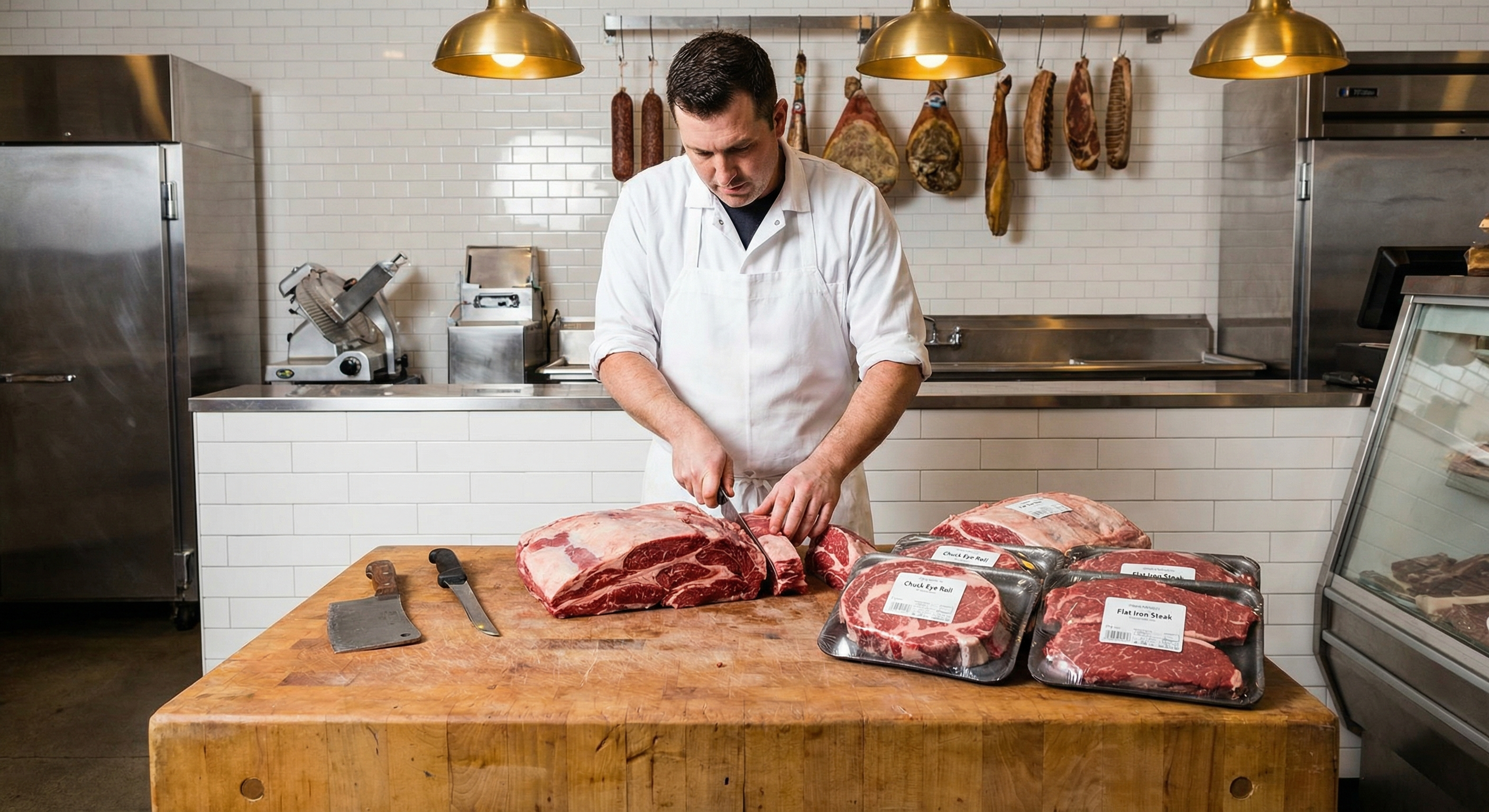
The beef chuck accounts for roughly 26 percent of the entire carcass weight, making it the single largest primal cut on the animal. It comes from the shoulder region — everything from the first through fifth ribs and extending down through the shoulder blade, arm, and neck. Most home cooks only encounter chuck as pre-packaged ground beef or generic "chuck roast" from the grocery store. But inside that massive primal are over a dozen distinct sub-primals and individual cuts, each with different textures, fat content, and ideal cooking methods.
Breaking down a whole chuck yourself gives you access to cuts that rarely appear in retail cases: the flat iron steak, the teres major (also called the petite tender or shoulder tender), the chuck eye roll that produces steaks nearly identical to ribeyes, and the Denver steak that has become a restaurant favorite. You also get precise control over your trim, your portion sizes, and the quality of your ground beef blend.
This guide walks through the complete breakdown of a bone-in beef chuck primal, from the first separation cuts through final steak and roast portioning.
Understanding Chuck Anatomy
Before making any cuts, you need to understand the skeletal and muscular structure of the chuck. The bone structure includes:
- Rib bones (1st through 5th): These curve along the back of the chuck and are removed early in the breakdown. The meat between and around these ribs becomes short ribs and rib meat.
- Scapula (shoulder blade): A large, flat bone with a prominent ridge running across its face. This bone sits in the center of the chuck and divides the upper chuck from the lower portions. The flat iron and other blade cuts surround this bone.
- Humerus (arm bone): The round arm bone that runs through the lower portion of the chuck. Cross-cuts through this bone produce arm roasts and arm steaks.
- Cervical vertebrae (neck bones): If the chuck includes the neck section, these bones run along the top edge.
- Atlas joint: The connection point between the neck and the first vertebra, which determines where the chuck was separated from the rib primal.
The major muscle groups within the chuck include the infraspinatus (flat iron), supraspinatus (top blade), teres major (petite tender), serratus ventralis (Denver steak), complexus, splenius, and rhomboideus in the neck region, and the triceps brachii and biceps brachii in the arm section. Each has distinct grain direction and connective tissue characteristics that determine how it should be cut and cooked.
Tools and Setup
- Boning knife (6 inch, stiff): Your primary tool for seam cutting and following bone contours. A stiff blade gives better control than a flexible fillet knife when working around the scapula.
- Breaking knife or cimeter (10-12 inch): For the initial large separation cuts and trimming large surfaces.
- Bone saw or band saw: Essential for cutting through rib bones and the arm bone. A hand bone saw works but a band saw saves significant time and effort.
- Steel or honing rod: You will touch up your edge multiple times during this breakdown. Chuck connective tissue dulls knives fast.
- Large cutting surface: A whole chuck primal weighs 80 to 100 pounds. You need a table or cutting board that can handle the size and weight.
- Meat hooks (optional): Useful for lifting and repositioning the primal during early breakdown stages.
- Sheet trays and bus tubs: For organizing sub-primals, trim, and bone as you work.
Work with the chuck cold — ideally between 32 and 38 degrees Fahrenheit. Cold fat and connective tissue are firm and visible, making seam cuts cleaner and more precise. If the chuck has been frozen, thaw it completely in the refrigerator before breaking it down. Partially frozen sections will mask the seam lines you need to follow.
Step 1: Remove the Ribs
Place the chuck on your table with the bone side up and the rib bones facing you. Your first goal is to remove the back ribs and feather bones from the top of the chuck.
Using your boning knife, start at the chine bone (where the vertebrae were split when the carcass was halved) and cut along the tops of the rib bones. Follow the curve of each rib, keeping your blade tight against the bone to maximize the meat you leave on the chuck. Work from the 5th rib toward the 1st rib, pulling the rib section away as you cut.
Once the rib bones are free, you have two things: a rack of beef back ribs (excellent for braising or smoking) and the boneless top of the chuck. Set the ribs aside.
If you want short ribs, make your rib removal cut higher — leave 3 to 4 inches of meat on the rib bones instead of cutting tight. This gives you English-style short ribs that you can crosscut to any length.
Step 2: Separate the Clod from the Chuck Roll
With the ribs removed, flip the chuck so the exterior fat side faces up. You can now see and feel the natural seam between the chuck roll (the upper portion attached to where the ribs were) and the shoulder clod (the lower, arm-side portion).
Find the natural seam — it runs roughly horizontally across the chuck, following the bottom edge of the scapula. Insert your knife into this seam and follow it, using long, smooth strokes. You are seam cutting here, not forcing your way through muscle. The connective tissue between these two sections will separate with minimal resistance if you are in the right plane.
The shoulder clod will pull away from the chuck roll as you cut. It is a large, roughly triangrical piece that includes the arm bone (humerus) and several muscles surrounding it.
Step 3: Break Down the Chuck Roll
The chuck roll is the premium portion of the chuck. It contains the chuck eye (the continuation of the same longissimus dorsi muscle that forms the ribeye), the complexus, and surrounding muscles.
Remove the Scapula
The shoulder blade bone is embedded in the chuck roll. You need to remove it to access the blade cuts. Feel for the ridge (spine) of the scapula — it creates an obvious raised line you can trace with your fingers.
Starting at one end of the scapula, insert your boning knife along the flat surface of the bone. Work your blade along the bone surface, peeling the meat away. When you reach the ridge, cut along both sides of it. The ridge is thin and sharp — go slowly to avoid leaving meat on the bone or cutting through into the wrong muscle.
Flip the chuck roll and repeat on the other side of the scapula. The bone should lift out cleanly, with minimal meat attached. If you find large chunks of meat still on the bone, you went off-plane — scrape them off and add them to your trim pile.
Separate the Flat Iron
With the scapula removed, you can now see the infraspinatus muscle — the flat iron. It is a flat, rectangular muscle that was sitting directly on top of the shoulder blade. A thick band of connective tissue (the gristle seam) runs through its center, dividing it into a top and bottom half.
The traditional flat iron steak is made by separating this muscle from the surrounding meat and then splitting it along that center gristle seam, producing two flat steaks. The gristle seam does not break down during cooking, so it must be removed.
Trim the exterior of the infraspinatus, removing the heavy silver skin and surface fat. Then lay it flat and cut horizontally through the center, following the gristle seam. You will feel the knife slide along the tough connective tissue. You end up with two flat iron steaks (or portions for multiple steaks) and a thin sheet of gristle that goes to trim.
A whole flat iron typically weighs 2 to 3 pounds and produces steaks that are remarkably tender — second only to the tenderloin in tenderness rankings, with significantly more beef flavor.
Isolate the Chuck Eye Roll
The chuck eye roll is the continuation of the ribeye muscle into the shoulder. It sits along the top of where the rib bones were attached. Separate it from the surrounding muscles by following the natural seams.
You can identify the chuck eye roll by looking at the cut face where the chuck was separated from the rib primal. The ribeye muscle (longissimus dorsi) is the large, round, well-marbled muscle in the center. Follow that muscle forward through the chuck, seam-cutting it away from the complexus above and the serratus ventralis below.
The first 2 to 3 inches of the chuck eye roll (closest to where it was separated from the rib primal) can be cut into chuck eye steaks — sometimes called "poor man's ribeyes" because they have similar marbling and tenderness. The further forward you go, the more connective tissue appears and the better suited the meat becomes for roasting or braising.
Extract the Denver Steak
The Denver steak comes from the serratus ventralis muscle, which sits underneath the chuck eye roll. It is a relatively newly popularized cut — identified through muscle profiling research as one of the most tender muscles in the chuck after the flat iron.
Once you have removed the chuck eye roll, the serratus ventralis is the large, flat muscle exposed below it. Seam it out from the surrounding connective tissue. Trim the heavy silverskin from the exterior but leave the internal marbling intact. Cut steaks across the grain, about 1 to 1.5 inches thick.
Denver steaks have excellent marbling (often comparable to a New York strip), a pronounced beefy flavor, and enough tenderness for direct grilling. They have become a staple on restaurant menus where value pricing matters.
Step 4: Break Down the Shoulder Clod
The shoulder clod is the lower portion of the chuck that includes the arm bone. It is less tender overall than the chuck roll cuts but contains one hidden gem — the teres major.
Remove the Arm Bone
Locate the humerus bone running through the center of the clod. Using your boning knife, cut along the bone surface to free the surrounding muscles. At the joint end (where it connected to the scapula, which you already removed), cut through the remaining cartilage and connective tissue. Pull the arm bone free.
With the bone removed, you can see the individual muscles of the clod more clearly.
Find the Teres Major (Petite Tender)
The teres major is a small, cylindrical muscle — roughly the size and shape of a pork tenderloin — tucked against the inside of the shoulder blade area. It is the third most tender muscle on the entire animal (after the psoas major tenderloin and the infraspinatus flat iron).
Seam it out carefully. It separates cleanly from the surrounding muscles with minimal knife work if you follow the connective tissue boundaries. A whole teres major weighs only about 8 to 12 ounces, so there are two per animal (one per side). Trim the exterior silverskin and you have a small roast or medallion-cut steaks that are exceptionally tender.
Portion the Remaining Clod
After removing the teres major, the remaining clod muscles are best suited for:
- Shoulder roasts (clod heart): The large center muscle (triceps brachii) makes an excellent pot roast. It has a uniform shape that cooks evenly and enough connective tissue to benefit from braising.
- Stew meat: The smaller muscles and trimmings from the clod are perfect for cutting into 1.5-inch cubes for stew. The mix of lean and slightly fatty pieces creates a well-rounded braise.
- Ground beef: Any remaining trim from the clod goes to your grinding pile. Chuck trim typically has a lean-to-fat ratio around 80/20, which is ideal for burgers.
Step 5: Process the Neck
If your chuck primal includes the neck section, it sits at the front end opposite the rib separation. Neck meat is extremely rich in connective tissue and collagen, making it one of the best braising cuts on the animal.
Remove the cervical vertebrae by cutting along the bone surfaces. The meat pulls away in irregular chunks — do not try to make it pretty. Neck meat is destined for long, slow cooking where its heavy collagen converts to gelatin, producing incredibly rich, silky braised dishes.
Neck bones themselves are excellent for making beef stock. The collagen-rich connective tissue around the bones produces a stock with exceptional body.
Step 6: Final Trim and Organization
By this point you should have the following from your whole chuck breakdown:
- Flat iron steaks: 2-3 pounds
- Chuck eye roll: 5-8 pounds (for steaks and roasts)
- Denver steaks: 2-4 pounds
- Teres major (petite tender): 8-12 ounces per side
- Back ribs or short ribs: 5-8 pounds
- Shoulder clod roast: 8-12 pounds
- Neck meat: 3-5 pounds (if included)
- Stew meat: 3-5 pounds
- Grinding trim: 10-15 pounds
- Bones: Scapula, arm bone, rib bones, neck bones — all excellent for stock
- Fat trim: For rendering into tallow or adding to lean ground blends
Do a final pass over each sub-primal and cut. Remove any remaining silverskin, heavy connective tissue, or blood spots from the surfaces of steaks and roasts. Fat that you want to keep for flavor should be trimmed to a uniform thickness — typically a quarter inch on roasts and steaks.
Storage and Yield Expectations
From a 90-pound bone-in chuck primal, expect approximately:
- Retail cuts (steaks and roasts): 45-50 pounds (50-55%)
- Grinding trim: 15-20 pounds (17-22%)
- Bone: 12-15 pounds (13-17%)
- Fat trim and waste: 10-15 pounds (11-17%)
Vacuum seal steaks and roasts individually or in meal-sized portions. Label everything with the cut name and date. Properly vacuum-sealed beef keeps well in the freezer for 12 to 18 months without significant quality loss.
The bones should be roasted at 400 degrees Fahrenheit until deeply browned, then simmered for 12 to 24 hours for stock. Chuck bones, particularly the scapula and neck bones, produce some of the richest, most collagen-heavy stock from any part of the animal.
Common Mistakes
- Cutting through muscles instead of seam cutting: The chuck rewards patience. Almost every sub-primal separates cleanly along connective tissue seams. If you are forcing your knife through muscle fiber, you are in the wrong plane. Stop, feel for the seam, and redirect.
- Leaving meat on the scapula: The shoulder blade has a complex shape with a prominent ridge. Take your time working around it. Scrape the bone surfaces clean — every ounce left on the bone is yield lost.
- Discarding the teres major: This small muscle is easy to miss or accidentally include with general trim. Learn to identify it by location and shape — it is a genuine premium cut hiding inside a budget primal.
- Ignoring grain direction: Each muscle in the chuck has its own grain direction. When cutting steaks, always cut across the grain. The flat iron, Denver, and chuck eye all have different grain orientations — pay attention when you switch from one cut to the next.
- Working with warm meat: As the chuck sits out and warms up, fat softens and seams become harder to see and follow. If your workspace is warm, work in sections — keep the portions you are not actively cutting in the refrigerator.
Breaking down a whole beef chuck is one of the most rewarding butchery skills you can develop. The sheer variety of cuts — from tender flat iron steaks to rich braising cuts to perfectly marbled ground beef — means a single primal can stock your freezer with weeks of different meals. Once you understand the anatomy and practice the seam-cutting technique, the entire breakdown takes 30 to 45 minutes. The savings over buying individual retail cuts typically run 40 to 60 percent, and the quality of your custom-portioned cuts will surpass anything available in a standard grocery case.
More Expert Guides
How to Trim a Brisket: The Complete Butcher's Guide
Proper brisket trimming is the difference between a backyard experiment and competition-quality results. Here is the professional technique for shaping a whole packer brisket before it ever touches the smoker.
14 min readHow to Butcher a Whole Chicken: Step-by-Step Guide
Breaking down a whole chicken yourself saves 40-50% compared to buying individual parts. Here is the professional technique for turning one bird into perfectly portioned pieces.
14 min readHome Butchering Safety Guide: Essential Protocols for Safe Meat Processing
Learn professional butchering safety protocols from a master butcher with 25+ years of experience. Essential guidance for anyone processing meat at home.