How to Break Down a Beef Rib Primal: Complete Butcher's Guide
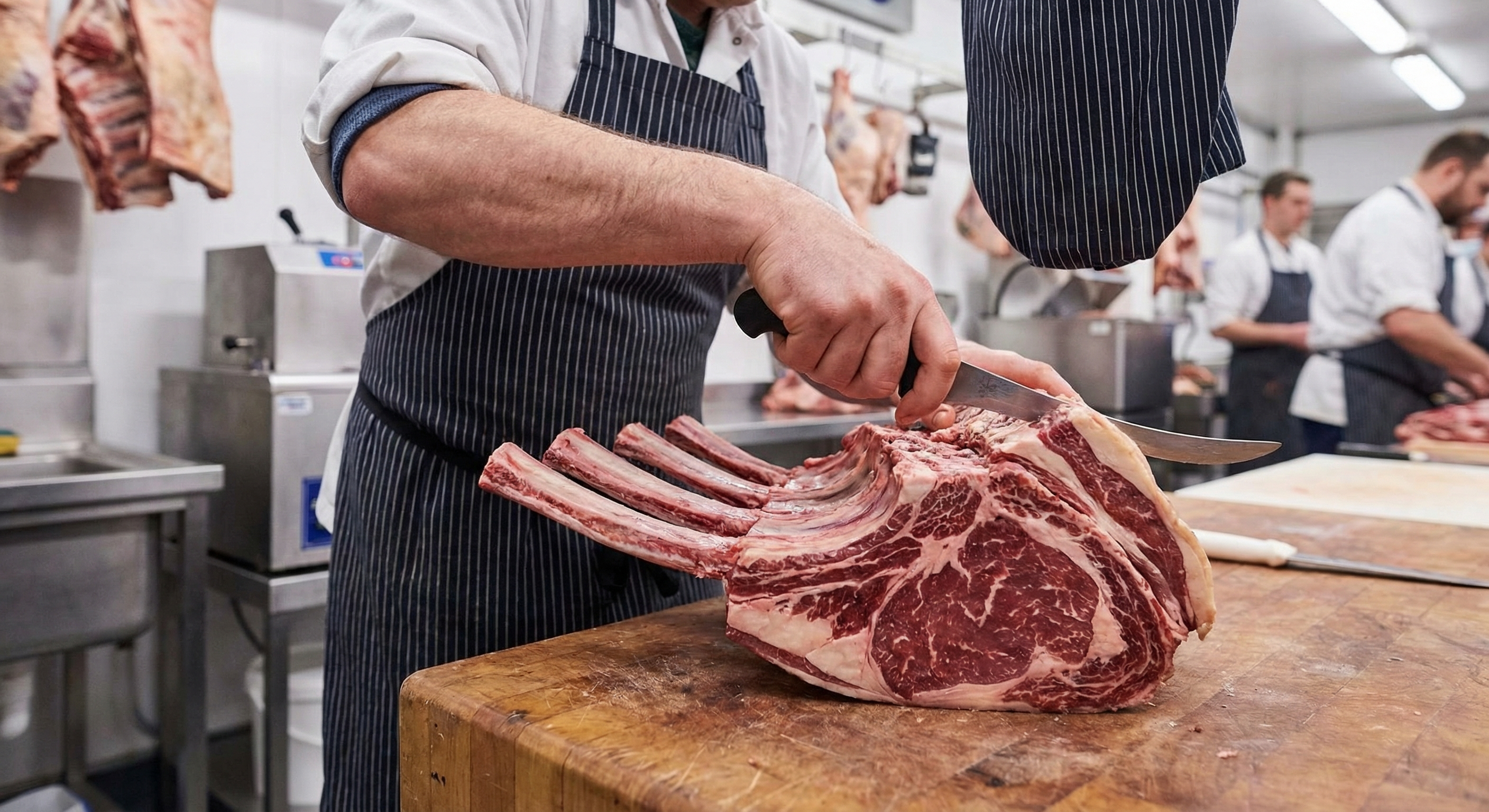
The beef rib primal spans ribs 6 through 12 and accounts for roughly 9 to 11 percent of the total carcass weight. It sits between the chuck primal (shoulder) and the loin primal (back), and it contains what many butchers consider the single best eating muscle on the animal — the ribeye. But the rib primal offers far more than just steaks. Handled properly, a whole bone-in rib section yields ribeye steaks or standing rib roasts, back ribs for smoking or braising, short ribs with deep beefy flavor, and the coveted spinalis dorsi (rib cap) that serious beef lovers consider the finest cut that exists.
Buying a whole rib primal and breaking it down yourself typically saves 30 to 40 percent compared to purchasing individual cuts at retail. A whole Choice-grade bone-in rib primal runs roughly $8 to $12 per pound at wholesale or warehouse clubs, while individual ribeye steaks from the same grade sell for $16 to $24 per pound. On a 30-pound primal, that difference adds up fast.
This guide walks through the complete breakdown of a bone-in beef rib primal, from initial assessment through final steak portioning.
Anatomy of the Rib Primal
Before making any cuts, understand what you are working with. The rib primal contains several distinct structures:
Bone Structure
- Rib bones (6th through 12th): Seven curved bones that arc from the spine downward along the side of the animal. The bones become progressively shorter and thinner as you move from the chuck end (6th rib) toward the loin end (12th rib).
- Chine bone: The section of vertebral column running along the top of the primal. On a properly split carcass, the chine is halved lengthwise. It must be removed for steak portioning.
- Feather bones: Small, flat bones projecting from the vertebrae between the ribs. They sit between the chine and the main rib bones and need to be removed during breakdown.
Major Muscles
- Longissimus dorsi (ribeye eye): The large, central muscle that runs the full length of the primal. This is the main "eye" of the ribeye steak — well-marbled, tender, and rich in beefy flavor. It increases in diameter from the chuck end to the loin end.
- Spinalis dorsi (rib cap): The crescent-shaped muscle that wraps around the outer edge of the longissimus. Widely considered the most flavorful and tender muscle on the entire animal. It is most prominent at the chuck end (ribs 6-9) and tapers significantly toward the loin end.
- Complexus: A smaller muscle present at the chuck end of the primal, sitting on top of the longissimus. It adds texture variation to chuck-end ribeye steaks.
- Longissimus costarum (lip): The thin muscle attached to the outer side of the ribs, below the main eye. This is the "lip" that extends below the ribeye on bone-in steaks.
- Intercostal muscles: Small muscles between the rib bones. On short ribs, these are the eating muscles.
Fat Layers
- External fat cap: A thick layer of subcutaneous fat covering the outer surface of the primal. Thickness varies from half an inch to over two inches depending on the animal.
- Intermuscular fat: Fat deposits between muscle groups, particularly between the spinalis and the longissimus and around the rib bones.
- Intramuscular fat (marbling): The white flecks within the lean muscle. Higher marbling grades (Choice, Prime) have significantly more intramuscular fat, which translates directly to flavor and tenderness.
Tools You Need
Breaking down a rib primal requires a specific set of tools. Having the right equipment makes the work significantly easier and produces cleaner results.
- Boning knife (6-inch, stiff): Your primary tool for following bone contours, removing the chine, and separating muscles. A stiff blade gives better control than a flexible blade when working against bone. The Victorinox Fibrox Pro 6-inch is the industry standard.
- Breaking knife or cimeter (10-12 inch): For portioning steaks and making the initial large separation cuts through the meat. The curved blade allows single-stroke cuts through thick muscle.
- Bone saw (hand or band saw): Essential for cutting through the chine bone and rib bones. A hand bone saw works but requires significantly more effort than a band saw. If you break down primals regularly, a tabletop meat band saw pays for itself in time and consistency.
- Honing steel: You will need to touch up your knife edges multiple times during this breakdown. Rib bones and connective tissue dull blades quickly.
- Large cutting board (24 x 36 inches minimum): A whole rib primal weighs 25 to 40 pounds and is over two feet long. You need space to work.
- Kitchen scale: For consistent steak portioning.
- Sheet trays: For organizing finished cuts, bones, and trim as you work.
Step 1: Remove the Chine Bone
The chine bone — the split vertebral column — runs along the top of the primal and must come off first. It is the most physically demanding step of the breakdown and the one most likely to require a saw.
Place the rib primal bone-side up on your cutting board. Locate the chine bone running along the top edge where the rib bones connect to the spine.
Using a bone saw:
- Position your saw where the rib bones meet the chine bone. You want to cut through the rib bones at their attachment point to the spine, not through the vertebral body itself.
- Saw in a straight line along the length of the primal, cutting through each rib bone where it meets the chine.
- Once the saw cut is complete, flip the primal over and use your boning knife to cut through any remaining meat and connective tissue holding the chine to the primal.
- The chine bone should lift away cleanly. Set it aside — it makes excellent stock.
Using a boning knife only (no saw): If you do not have a bone saw, you can work your boning knife between the rib bones and the chine, cutting the cartilaginous connections. This requires patience and a very sharp knife. Work from one end to the other, cutting between each rib and the vertebra. It takes longer but produces the same result.
Step 2: Remove the Feather Bones
With the chine removed, you may see small, flat feather bones still attached between where the ribs met the spine. These thin bones are embedded in connective tissue along the top of the primal.
Using your boning knife, slide the blade under each feather bone and cut it free. They are small and relatively easy to remove once you locate them. Run your fingers along the top of the primal to feel for any remaining bone fragments. All bone should be removed from this area before proceeding.
Step 3: Decide Your Breakdown Strategy
At this point, you have a bone-in rib section with the chine removed. How you proceed depends on what you want to produce. The three most common strategies are:
Option A: Standing Rib Roast (Bone-In)
Leave the rib bones attached and portion the primal into roasts of 2 to 4 ribs each. A 3-rib roast (ribs 10-12, the loin end) is the classic holiday prime rib. Trim the fat cap to a quarter inch, french the rib bone ends if desired, and tie between the bones for even cooking.
Option B: Bone-In Ribeye Steaks
Leave the rib bones attached and cut between each rib to produce individual bone-in ribeye steaks. Each steak gets one rib bone. This produces the classic bone-in ribeye (also called a cowboy steak, or a tomahawk if the bone is frenched long).
Option C: Boneless Ribeye Steaks + Back Ribs (Most Common)
Remove the rib bones entirely, producing a boneless ribeye roll for steaks and a full rack of back ribs as a separate product. This is the most versatile and economical approach. The rest of this guide follows this path.
Step 4: Remove the Back Ribs
Flip the primal so the bone side faces up. You want to separate the rib bones from the meat while leaving as much meat on the ribeye as possible.
- Starting at the loin end (thinnest ribs), insert your boning knife between the rib bones and the meat. Position the blade flat against the underside of the rib bones.
- Using short, scraping strokes, work the blade along the curve of each rib bone. Keep the knife pressed firmly against the bone — every millimeter you drift away from the bone is meat you are leaving on the ribs instead of the ribeye.
- Work systematically from rib to rib, peeling the rib section away from the meat as you go. The intercostal muscles between the ribs will separate cleanly if you stay on the bone surface.
- As you approach the chuck end (thickest ribs, ribs 6-7), the meat is thicker and the bones curve more aggressively. Slow down and follow each bone contour carefully.
- Once the entire rib rack separates, you should have two pieces: a boneless ribeye roll and a full seven-bone rack of back ribs.
The back ribs will have a thin layer of intercostal meat between the bones. This is normal — back ribs are not the meatiest cut, but they are excellent smoked low and slow or braised until tender. Season them generously and cook at 225 to 250 degrees Fahrenheit for 3 to 4 hours.
Step 5: Trim the Boneless Ribeye Roll
You now have a boneless ribeye roll — a long cylinder of meat with an external fat cap and potentially some rough edges from the rib removal.
Trim the Fat Cap
The external fat cap protects the meat during aging and transport, but for steak preparation you want to trim it to approximately a quarter inch thickness. Using your breaking knife, make long, smooth strokes along the surface, shaving away excess fat while leaving a uniform layer. Do not discard the trim — it renders beautifully for cooking or can be added to ground beef blends.
Clean the Edges
Examine both ends of the roll — the chuck end (larger, with the complexus muscle visible) and the loin end (smaller, more uniform). Trim any dried surfaces, ragged edges, or excessive connective tissue. These trimmings make excellent stir-fry meat or grind.
Remove Silver Skin
On the underside of the roll (where the ribs were removed), you may find patches of silver skin — the tough, shiny connective tissue that does not break down during cooking. Slide your boning knife under the silver skin, angle the blade slightly upward, and pull the membrane while cutting forward to strip it off.
Step 6: Separate the Rib Cap (Optional)
The spinalis dorsi — the rib cap — is the crescent-shaped muscle that wraps around the outer edge of the ribeye eye. Many butchers and chefs consider it the single best piece of meat on the entire animal. It is intensely marbled, buttery tender, and explosively flavorful.
You have two choices:
Leave It Attached
For traditional ribeye steaks, the cap stays attached. Each steak has the eye in the center with the cap curving around one side, connected by a seam of fat. This is how most people expect a ribeye to look.
Remove It Separately
For maximum versatility, separate the cap from the eye:
- Identify the natural seam between the spinalis and the longissimus. It appears as a visible line of fat and connective tissue running the length of the roll.
- Using your boning knife, make an initial incision into this seam at one end.
- Follow the natural separation, angling your knife slightly toward the eye muscle — give the cap the benefit of the doubt on any borderline meat.
- Work slowly and steadily. The fascia between the muscles will guide your knife if you stay in the right plane.
- The entire cap should come off as one long, flat piece.
The separated rib cap can be:
- Rolled and tied into a spinalis roast — sear on all sides, then roast to medium-rare. Extraordinary.
- Cut into individual rib cap steaks — each one is 6 to 10 ounces of the best beef you will ever eat.
- Grilled whole as a flat steak — cook hot and fast, then slice against the grain.
Step 7: Portion into Steaks
Whether you kept the cap attached or removed it, you now portion the ribeye roll (or the eye and cap separately) into steaks.
Choosing Thickness
- 1 inch (12-14 oz): Good for quick pan-searing or grilling. Cooks fast but offers less margin for error on doneness.
- 1.5 inches (16-20 oz): The sweet spot for most home cooks. Thick enough for a good crust-to-interior ratio. Excellent for reverse searing.
- 2 inches (22-28 oz): Restaurant-style thick cut. Best for reverse sear, sous vide, or sharing. Dramatic presentation.
Cutting Technique
- Position the roll with the grain running left to right. You will cut perpendicular to the grain.
- Measure your desired thickness from one end.
- Position your breaking knife at the mark, blade perpendicular to the board.
- In one smooth drawing motion, pull the blade through the meat from heel to tip. Do not saw back and forth — a single stroke produces a clean face that sears evenly.
- Weigh each steak. Adjust your thickness slightly as you go to maintain consistent portions.
Working Through the Roll
As you move from the chuck end to the loin end, the character of the steaks changes:
- Chuck-end steaks (ribs 6-8): Larger diameter, more cap and complexus muscle, slightly more connective tissue. These have the most rib cap and often the most flavor. Some butchers consider these the best eating steaks from the primal.
- Center steaks (ribs 9-10): Classic ribeye shape. Good balance of eye and cap. The most photogenic and consistent steaks.
- Loin-end steaks (ribs 11-12): Smaller, rounder, with minimal cap. These transition toward strip steak in character. Slightly leaner and more uniform.
A typical 30-pound bone-in rib primal will yield:
- 12 to 16 boneless ribeye steaks at 1.5-inch thickness (depending on cap separation)
- 1 full rack of back ribs (approximately 3 to 4 pounds)
- 1 to 2 pounds of fat trim (for rendering or grinding)
- 1 to 2 pounds of meat trimmings (for stir-fry, grind, or stew)
- Chine bone and feather bones (for stock)
Step 8: Extracting Short Ribs (Alternative Approach)
If you want short ribs from your rib primal, you need to plan for them before removing the back ribs in Step 4. Short ribs come from the plate end — the lower portion of the rib section below the ribeye.
Before separating the ribs from the ribeye, cut across the ribs 3 to 4 inches below the eye muscle. This separates a strip of bone and meat from the bottom of the primal. Cut between each rib to produce individual English-style short ribs, or cut across the bones for flanken-style (Korean BBQ) short ribs.
This approach reduces the length of your back ribs but gives you a separate product. Short ribs from the rib primal are some of the best — well-marbled and deeply flavored.
Storage and Aging
Immediate Use (3-5 Days)
Wrap steaks individually in butcher paper and refrigerate. Pat dry before seasoning and cooking.
Freezer Storage (6-12 Months)
Vacuum seal individual steaks for the longest freezer life. Label with the date and cut name. Thaw in the refrigerator overnight before cooking.
Dry Aging Before Breakdown
For the best results, dry-age the whole rib primal before breaking it down. Place the unwrapped primal on a rack in a dedicated refrigerator at 34 to 38 degrees Fahrenheit with a small fan for air circulation. Age for 21 to 45 days. The exterior will form a dark, dried bark that you trim away before portioning, revealing intensely concentrated, nutty, beefy flavor underneath. Expect 15 to 25 percent weight loss from moisture evaporation.
Yield Expectations
From a 30-pound bone-in rib primal:
| Component | Weight | Percentage |
|---|---|---|
| Boneless ribeye steaks | 18-22 lbs | 60-73% |
| Back ribs | 3-4 lbs | 10-13% |
| Chine + feather bones | 2-3 lbs | 7-10% |
| Fat trim | 2-3 lbs | 7-10% |
| Meat trim | 1-2 lbs | 3-7% |
USDA Prime primals with heavier marbling may yield slightly less due to more intermuscular fat, but the eating quality more than justifies the difference. The ribeye steaks from a well-marbled rib primal are extraordinary — rich, juicy, and deeply satisfying in a way that leaner grades simply cannot match.
Troubleshooting Common Issues
Too Much Meat Left on the Ribs
This happens when your knife drifts away from the bone surface during rib removal. Stay pressed against the bone at all times. If you realize mid-cut that you are too far into the meat, stop and reposition your blade against the bone before continuing.
Uneven Steak Thickness
Your knife angle changed during the cut. Keep the blade perfectly perpendicular to the cutting board. Use a single smooth stroke rather than multiple passes. If a steak comes out uneven, trim the thicker side rather than trying to re-cut.
Difficulty Separating the Rib Cap
The seam between the spinalis and longissimus is not always perfectly obvious, especially at the loin end where the cap tapers thin. Look for the change in grain direction and the line of fat between the two muscles. When uncertain, cut slightly into the eye — it is larger and can spare a few grams more easily than the cap.
Bones Splintering During Saw Cuts
This usually means the blade is dull or you are applying too much pressure. Let the saw do the work with light, steady pressure. Replace saw blades regularly — a dull saw blade creates dangerous bone shards.
What to Do with Every Part
Nothing goes to waste in proper butchery:
- Ribeye steaks: Grill, pan-sear, reverse sear, or sous vide. Season with salt and pepper. Let the beef speak.
- Rib cap: The finest eating on the animal. Treat it with respect — simple seasoning, high heat.
- Back ribs: Smoke at 225 degrees for 3 to 4 hours, or braise in liquid for 2 to 3 hours until tender.
- Short ribs: Braise for 3 to 4 hours for English-style, or grill hot and fast for flanken-style.
- Fat trim: Render into tallow for cooking, or grind into burger blends for juiciness.
- Meat trim: Stir-fry, kebabs, beef tips, or add to your grind pile.
- Bones (chine, ribs, feathers): Roast at 400 degrees for 45 minutes, then simmer for 12 to 24 hours for rich beef stock.
Breaking down a whole beef rib primal connects you to the craft in a way that buying pre-cut steaks never can. You understand the anatomy, you control the portions, and you transform a primal cut into exactly what you want on your plate. For premium beef that makes this process truly worthwhile, source your rib primal from a purveyor that prioritizes quality — American wagyu from The Meatery showcases what exceptional marbling does to a ribeye, and a whole primal is the best way to experience the full range of what the rib section offers.
Frequently Asked Questions
How much does a whole beef rib primal weigh?
A whole bone-in beef rib primal typically weighs 25 to 40 pounds, depending on the size of the animal and how the processor separated the primals. Choice grade primals tend to fall in the 28-35 pound range. The weight includes rib bones, chine bone, fat cap, and all associated muscles.
How many ribeye steaks can I get from a whole rib primal?
A typical 30-pound bone-in rib primal yields 12 to 16 boneless ribeye steaks at 1.5-inch thickness, plus a full rack of back ribs, fat trim for rendering, and bones for stock. Exact count depends on your preferred steak thickness and how much trim you remove.
What is the difference between back ribs and short ribs from the rib primal?
Back ribs come from the upper portion of the rib bones closest to the spine, after the ribeye is removed. They have less meat between the bones. Short ribs come from the lower plate section of the rib bones and have significantly more meat and marbling. Both are excellent when cooked low and slow.
Should I remove the rib cap (spinalis) or leave it attached?
For traditional ribeye steaks, leave the cap attached — it adds incredible flavor and texture contrast. Remove it only if you specifically want to prepare it as a separate cut (spinalis roast or rib cap steaks) for a special occasion. The cap is most prominent on chuck-end steaks (ribs 6-9).
How much money do I save by breaking down a whole rib primal myself?
Typically 30-40% compared to buying individual ribeye steaks. A whole Choice-grade bone-in rib primal costs roughly $8-12 per pound, while individual Choice ribeye steaks retail for $16-24 per pound. On a 30-pound primal, you can save $150-300 while also getting back ribs and bones as bonus products.
Do I need a band saw to break down a rib primal?
A band saw makes the chine bone removal significantly easier, but it is not strictly required. A hand bone saw ($30-50) handles the job with more effort. Alternatively, you can ask your butcher to remove the chine bone when you purchase the primal, then do the remaining breakdown with just knives.
More Expert Guides
How to Trim a Brisket: The Complete Butcher's Guide
Proper brisket trimming is the difference between a backyard experiment and competition-quality results. Here is the professional technique for shaping a whole packer brisket before it ever touches the smoker.
14 min readHow to Butcher a Whole Chicken: Step-by-Step Guide
Breaking down a whole chicken yourself saves 40-50% compared to buying individual parts. Here is the professional technique for turning one bird into perfectly portioned pieces.
14 min readHome Butchering Safety Guide: Essential Protocols for Safe Meat Processing
Learn professional butchering safety protocols from a master butcher with 25+ years of experience. Essential guidance for anyone processing meat at home.