How to Break Down a Whole Lamb: Complete Butchery Guide
How to Break Down a Whole Lamb: Complete Butchery Guide
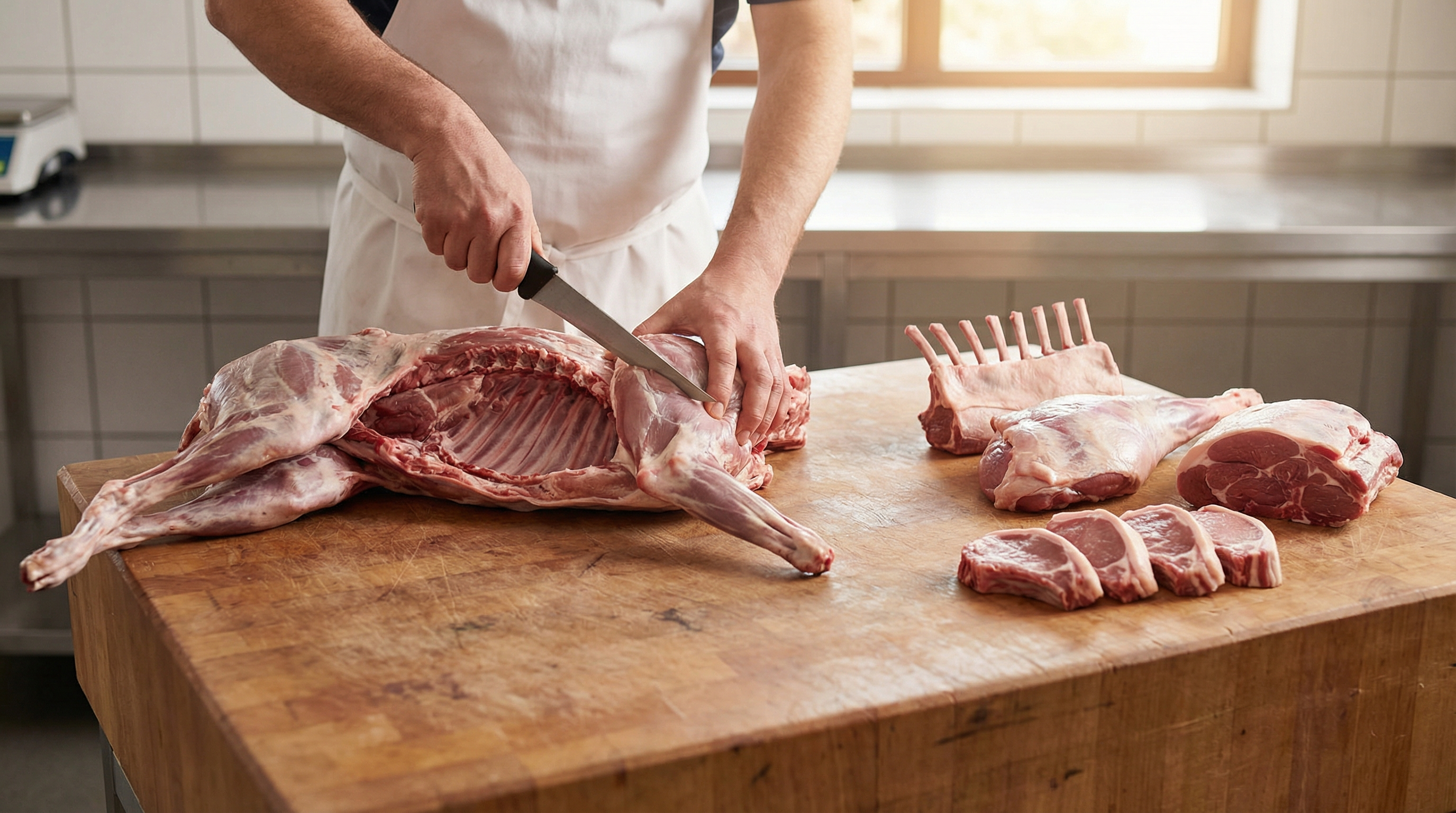
If there is one animal that every aspiring butcher should learn to break down first, it is the lamb. In my training in Buenos Aires and later in the Basque Country, lamb was always the teaching animal — smaller and more forgiving than beef, with clear anatomical landmarks that make every cut logical once you understand the structure.
A whole lamb typically weighs 40 to 70 pounds, depending on breed and age. That is manageable for one person with a sturdy table and sharp knives. The muscle groups are well-defined, the bones are relatively soft, and the finished cuts are extraordinarily versatile — from elegant frenched rack to rustic braised shanks. Breaking down a whole lamb also saves you 30 to 50 percent compared to buying individual cuts from the butcher case.
This guide walks you through the complete process: from receiving the carcass to packaging your finished cuts. By the end, you will have shoulders for braising, racks for roasting, loins for grilling, legs for special occasions, and trim for grinding into merguez or kofta.
What You Need Before You Start
Preparation is everything. Set up your workspace completely before the lamb comes out of the cooler.
Essential Knives
- 10-inch breaking knife (cimeter): Your primary tool for separating primals and portioning large cuts. The curved blade provides leverage for long, smooth strokes.
- 6-inch boning knife (semi-flexible): For working around joints, separating muscles from bone, and detail work. Semi-flexible gives you the best balance of control and maneuverability.
- Utility knife (5-6 inches): For trimming, cleaning, and any detail work where the boning knife feels too large.
- Hand bone saw: For cutting through the spine and any bones your knife cannot handle. A 22-inch butcher saw with replaceable blades is ideal.
For comprehensive knife selection guidance, see our Essential Butcher Knife Guide. Keep a honing steel nearby and use it every 10 to 15 minutes throughout the process.
Equipment
- Large cutting surface: Minimum 24 by 18 inches, ideally larger. HDPE or end-grain butcher block.
- Sheet pans or trays: For organizing finished cuts as you work.
- Vacuum sealer or butcher paper: For wrapping and storing your finished cuts.
- Kitchen scale: For portioning and recording yields.
- Cut-resistant glove: For your non-knife hand. Non-negotiable.
- Clean towels: Several. You will go through them.
Workspace Setup
Organize your station into zones: the whole carcass on one side, your cutting area in the center, and sheet pans for finished cuts on the other side. Have a waste container nearby for bones and trim you will not keep. Keep your workspace cold — if your room is above 65 degrees Fahrenheit, work quickly and return cuts to the refrigerator between stages.
Understanding Lamb Anatomy
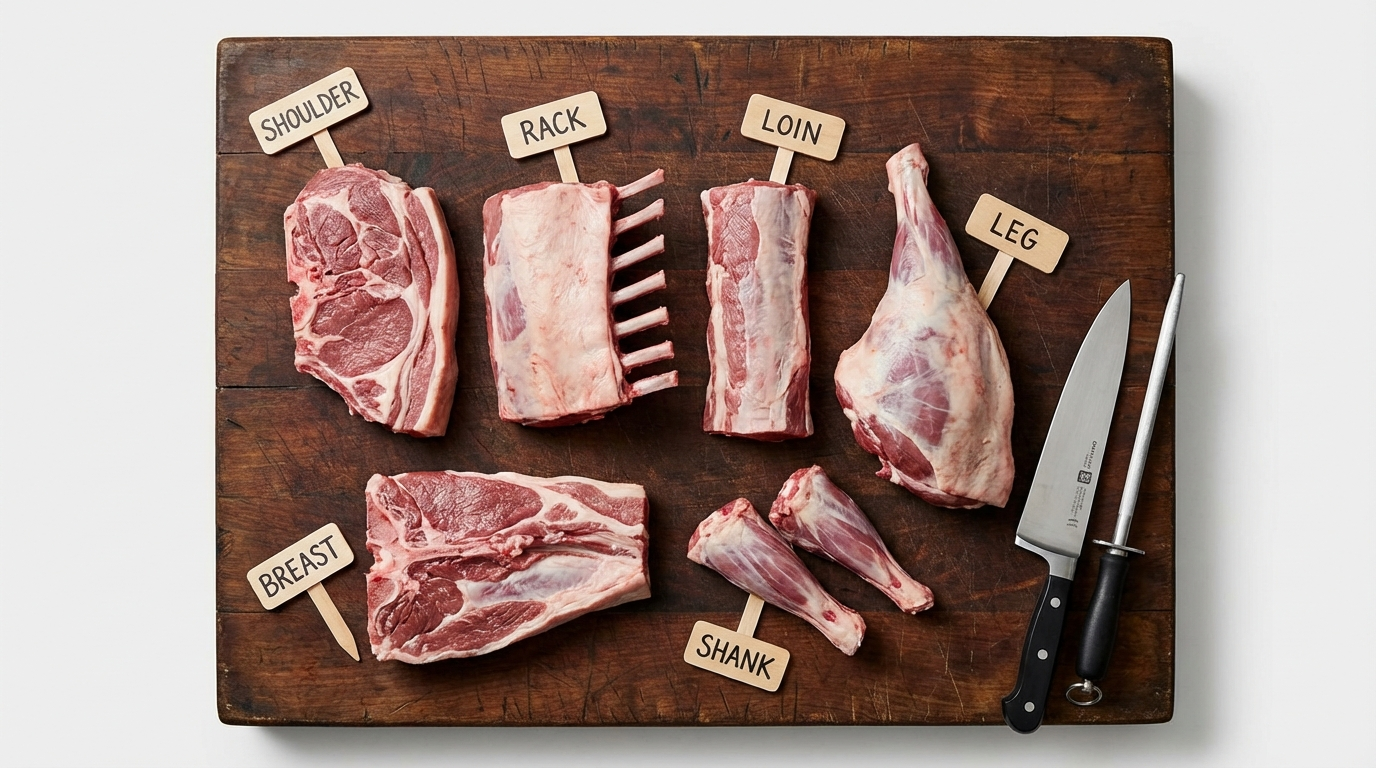
A lamb carcass divides into five primal sections, each yielding distinct retail cuts:
- Shoulder (front quarter): Contains the blade and arm. Working muscles with excellent flavor but more connective tissue. Best for braising, stewing, and grinding. Yields bone-in shoulder roast, blade chops, arm chops, and stew meat.
- Rack (rib section): Ribs 1 through 8. The most elegant primal — tender, well-marbled, and beautifully structured. Yields frenched rack of lamb, rib chops, and the coveted rib cap.
- Loin: Behind the rack, running along the spine. The tenderest section. Yields loin chops (the lamb equivalent of T-bones), boneless loin roast, and the small but exquisite tenderloin.
- Leg (hind quarter): The largest primal. Lean, flavorful muscle ideal for roasting whole or broken into component muscles. Yields bone-in leg roast, boneless butterflied leg, and leg steaks.
- Breast and shank: The underside and lower legs. Tougher cuts with rich flavor. Breast is excellent braised or stuffed. Shanks are the classic osso buco of the lamb world.
Unlike beef, where you work with one side at a time, a whole lamb is typically processed as a complete carcass. This means you get two of everything — two shoulders, two racks, two legs — which is perfect for comparing your cuts and improving consistency.
Step 1: Remove the Shoulders
The shoulders come off first because they are attached only by muscle — no skeletal connection to the rib cage. This makes them the easiest primal to separate.
- Position the carcass on its back with the breast facing up.
- Locate the natural seam between the shoulder blade and the rib cage. Run your hand along the side of the carcass — you will feel the flat shoulder blade sitting against the ribs.
- Lift the front leg away from the body to expose the armpit area. You will see the natural separation between the shoulder muscles and the body wall.
- Begin cutting along this natural seam with your boning knife. Start underneath, following the curve of the rib cage. The knife should glide between the shoulder blade and the ribs with minimal resistance.
- Continue upward along the spine side, cutting through the muscle attachments between the shoulder blade and the backbone. Pull the shoulder away as you cut — gravity and tension will reveal the separation plane.
- Complete the separation by cutting through the remaining neck muscles at the front. The entire shoulder should come away as one piece.
Repeat on the other side. You now have two whole shoulders, each weighing roughly 5 to 8 pounds depending on the size of the lamb.
Breaking Down the Shoulder Further
Each whole shoulder can be left intact for a dramatic bone-in roast, or broken down further:
- Blade chops: Saw across the shoulder blade to create chops similar to pork blade steaks.
- Arm chops: Cut cross-sections through the arm portion for round, bone-in chops.
- Boneless shoulder: Remove the blade bone and arm bone for a boneless roast that can be rolled and tied, or cut into cubes for stew and kebabs.
- Ground lamb: Shoulder trim with its ideal fat-to-lean ratio (around 20 percent fat) makes the best ground lamb for burgers, kofta, or merguez sausage.
Step 2: Separate the Hind Legs
With the shoulders removed, turn your attention to the back of the carcass. The legs connect to the spine at the hip joint — unlike the shoulders, this is a skeletal connection that requires either sawing through the pelvis or cutting through the hip joint.
- Locate the hip joint. Feel for the ball-and-socket joint where the femur meets the pelvis. It sits roughly where the loin meets the leg, identifiable by pressing with your thumb.
- Cut along the backbone using your breaking knife, separating the loin meat from the leg at the natural division point. This is approximately one vertebra behind the hip bone.
- Saw through the spine at this point using your hand bone saw. Cut perpendicular to the backbone. Two or three strokes should be sufficient — lamb vertebrae are not dense.
- Separate the two legs by sawing down through the center of the pelvis (the aitch bone). This splits the saddle into two individual legs.
Each whole leg weighs 6 to 10 pounds. The leg is the most versatile primal on the lamb.
Leg Options
- Bone-in leg roast: The classic preparation. Leave whole for a stunning centerpiece.
- Boneless butterflied leg: Remove the femur, aitch bone, and shank bone. Open flat for grilling or stuffing. This is excellent on the grill at high heat.
- Leg steaks: Saw cross-sections through the bone-in leg for thick steaks that grill beautifully.
- Seam-cut muscles: Separate the leg into its individual muscles — top round, bottom round, sirloin tip, and eye of round — for precise portioning. Each muscle can be roasted or sliced separately.
- Shank: The lower portion of the leg, separated at the knee joint. Braised lamb shanks are one of the great comfort dishes.
Step 3: Remove the Breast and Flank
With the shoulders and legs removed, you are left with the saddle — the center section containing the rack, loin, and breast. Before separating the rack and loin, remove the breast and flank from each side.
- Identify the rib-to-breast line. On a lamb, the rack is typically trimmed about 3 to 4 inches from the eye muscle. Measure this distance from the center of the eye on the exposed rib section.
- Mark your cutting line along the length of the carcass, from front to back, maintaining a consistent distance from the spine.
- Using your breaking knife, cut along this line from one end to the other. You will cut through the ribs — on lamb, a sharp heavy knife can handle this without a saw. If your knife meets too much resistance, use the bone saw.
- Remove the breast flap from each side. This thin, fatty piece is the lamb equivalent of pork belly.
The breast is often overlooked, but it is wonderful when braised slowly until the connective tissue melts, or when stuffed, rolled, and roasted. The riblets cut from the breast are excellent on the grill with a spice rub.
Step 4: Split the Rack from the Loin
Now you have the saddle — the premium center of the lamb containing both the rack and loin sections. Splitting these two primals is straightforward.
- Count the ribs from the front (shoulder end). The rack contains ribs 1 through 8. The loin begins at the 13th thoracic vertebra, where the ribs end and the lumbar vertebrae begin.
- Cut between the last rib and the first lumbar vertebra. Use your breaking knife to cut through the meat on both sides, then saw through the spine.
- Separate the two sides by sawing down through the center of the spine, splitting the rack into two halves and the loin into two halves.
You now have two racks and two loins — the crown jewels of the lamb.
Step 5: Finish the Rack
A properly prepared rack of lamb is one of the most impressive cuts in all of butchery. Each rack contains 8 ribs with the tender, well-marbled rib eye muscle running along them.
Frenching the Rack
Frenching exposes the rib bones for an elegant presentation. See our detailed Frenching and Presentation Guide for the full technique, but here is the summary:
- Score a line across all the rib bones about 2 inches from the eye muscle.
- Cut down between each rib bone, removing the intercostal meat and fat above the score line.
- Scrape each bone clean with the back of your knife or a towel.
- Trim the fat cap over the eye to about an eighth of an inch.
Alternatively, leave the rack unfrenched for a more rustic presentation, or cut between each rib for individual rib chops.
Rack Cuts
- Whole frenched rack: Roast at high heat for a dramatic presentation. Serves 2 to 3 people per rack.
- Double-cut rib chops: Cut between every other rib for thick, two-bone chops ideal for searing.
- Single rib chops: Cut between each rib for elegant individual portions.
- Crown roast: Tie two racks together in a circle with bones pointing up. Stunning holiday centerpiece.
Step 6: Process the Loin
The loin is the tenderest section of the lamb. It contains the loin eye muscle on top and the small tenderloin underneath, separated by the T-shaped vertebrae — just like a beef T-bone.
Loin Cuts
- Loin chops (bone-in): Saw across the loin to create individual chops. Each chop contains a section of loin eye on one side of the bone and a medallion of tenderloin on the other. These are the lamb equivalent of T-bone steaks.
- Boneless loin: Remove the loin eye muscle from the bone in one piece. This creates a compact, cylindrical roast that cooks quickly and slices beautifully.
- Tenderloin: The small, supremely tender muscle running along the underside of the spine. Remove in one piece — it is small (usually 4 to 6 ounces per side) but extraordinary when seared quickly.
- Saddle roast: Leave both sides of the loin connected through the spine for a double-sided roast. Traditional in French and Middle Eastern cuisine.
Step 7: Process the Shanks
If you did not separate the shanks when breaking down the legs and shoulders, do it now. Each lamb has four shanks — two fore shanks (from the front legs) and two hind shanks (from the back legs).
Fore shanks are smaller and have more connective tissue. Hind shanks are meatier and more commonly sold at retail. Both benefit from low and slow braising in liquid until the collagen converts to gelatin and the meat falls from the bone.
To separate a shank, cut through the joint where the shank meets the leg or shoulder. On the hind leg, this is the knee joint. On the front leg, it is the elbow joint. Flex the joint to find the articulation point, then cut through the connective tissue between the bones.
Yield Expectations
From a 50-pound whole lamb, expect approximately:
| Cut | Approximate Weight | Percentage |
|---|---|---|
| Two shoulders | 10-14 lbs | 20-28% |
| Two racks | 4-6 lbs | 8-12% |
| Two loins | 3-5 lbs | 6-10% |
| Two legs | 12-18 lbs | 24-36% |
| Breast and flank | 4-6 lbs | 8-12% |
| Four shanks | 3-5 lbs | 6-10% |
| Trim and bones | 5-8 lbs | 10-16% |
Total usable meat yield is typically 70 to 80 percent of the hanging weight. The trim is valuable — grind it for lamb burgers, sausage, or kofta. The bones make extraordinary stock.
Tips for Success
- Stay cold. Cold meat is firmer and easier to cut cleanly. If the lamb starts warming and becoming soft, return it to the refrigerator for 20 minutes.
- Follow the anatomy. Every separation has a natural plane. If your knife meets heavy resistance, you are probably cutting through muscle rather than between muscles. Stop, reassess, and find the seam.
- Sharp knives only. Hone your blade every 10 to 15 minutes. A dull knife on lamb is dangerous — the fat and connective tissue become slippery and the blade can skid.
- Save everything. Bones for stock, fat for rendering, trim for grinding. A whole lamb has zero waste if you use it intelligently.
- Label your packages. When vacuum sealing or wrapping, label each cut with the name, weight, and date. In three months you will not remember which package is the loin and which is the shoulder.
- Take your time. Your first whole lamb will take 60 to 90 minutes. An experienced butcher does it in 20 to 30. Speed comes with repetition — accuracy comes with patience.
Where to Source Whole Lamb
Whole lamb is easier to source than you might think:
- Local farms: Many sheep farmers sell whole or half lambs directly. Check farmers markets and local agriculture directories.
- Halal butchers: Often sell whole lamb and can provide freshly processed carcasses.
- Specialty butcher shops: Can order whole lamb with advance notice.
- Online: Several farms ship whole lamb packed on ice. Expect to pay $8 to $14 per pound hanging weight depending on breed and region.
When ordering, specify whether you want the carcass whole (unsplit) or split down the spine into two halves. For learning, a whole unsplit carcass is ideal — it teaches you the full anatomy. For convenience, split halves are easier to handle on a standard home cutting surface.
Breaking down a whole lamb connects you to one of the most ancient and universal food traditions. Lamb has been the celebration animal across cultures for thousands of years — from Patagonian asado to Basque cordero al horno to Middle Eastern mansaf. When you break down the animal yourself, you understand every cut, you waste nothing, and you honor the craft that turns an animal into a feast. For premium cuts to complement your home butchery, explore The Meatery's curated collection.
Frequently Asked Questions
How long does it take to break down a whole lamb?
For a beginner, expect 60 to 90 minutes for the full breakdown. An experienced butcher can complete it in 20 to 30 minutes. Take your time on your first attempt — accuracy matters more than speed, and each lamb you process will be faster than the last.
What size lamb should I buy for home butchering?
A 40 to 55 pound lamb is ideal for home processing. This size is manageable on a standard cutting surface, yields enough meat to stock a freezer, and the bones are soft enough to cut with a hand saw. Larger lambs (60 to 70 pounds) have more meat per cut but require more workspace.
What knives do I need to butcher a whole lamb?
At minimum you need three knives: a 10-inch breaking knife for separating primals and portioning, a 6-inch semi-flexible boning knife for working around bones and joints, and a utility knife for trimming. You will also need a hand bone saw for cutting through the spine and pelvis.
How much meat do you get from a whole lamb?
Expect 70 to 80 percent usable meat from the hanging weight. A 50-pound lamb yields roughly 35 to 40 pounds of meat including shoulders, racks, loins, legs, shanks, breast, and trim for grinding. Bones and waste account for the remaining 20 to 30 percent.
Can I break down a whole lamb without a bone saw?
You can separate most primals with just a knife since the shoulders lift off without cutting bone and legs can be separated at joints. However, splitting the spine to separate the two racks and two loins requires a saw. A basic 22-inch hand bone saw with replaceable blades costs $30 to $50 and handles lamb bones easily.
How should I store butchered lamb cuts?
For immediate use within 3 to 5 days, wrap tightly in butcher paper and refrigerate at 34 to 38 degrees Fahrenheit. For longer storage, vacuum seal and freeze — properly sealed lamb maintains quality for 6 to 12 months in the freezer. Label every package with the cut name, weight, and date.
More Expert Guides
How to Trim a Brisket: The Complete Butcher's Guide
Proper brisket trimming is the difference between a backyard experiment and competition-quality results. Here is the professional technique for shaping a whole packer brisket before it ever touches the smoker.
14 min readHow to Butcher a Whole Chicken: Step-by-Step Guide
Breaking down a whole chicken yourself saves 40-50% compared to buying individual parts. Here is the professional technique for turning one bird into perfectly portioned pieces.
14 min readHome Butchering Safety Guide: Essential Protocols for Safe Meat Processing
Learn professional butchering safety protocols from a master butcher with 25+ years of experience. Essential guidance for anyone processing meat at home.