How to Butcher a Whole Goat: Complete Step-by-Step Guide
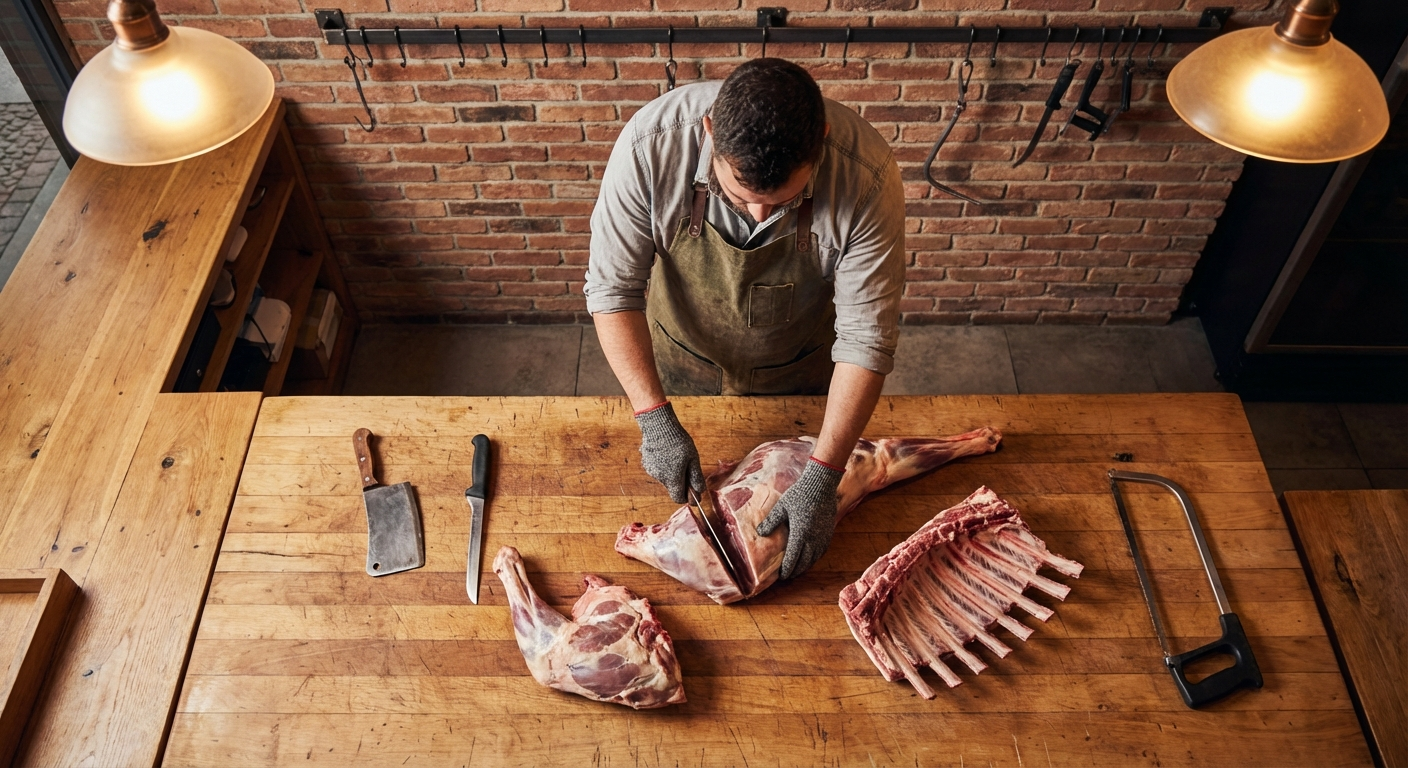
Goat is the most widely consumed red meat on the planet. More people eat goat than beef, pork, or chicken combined when you look at global consumption. Yet in the United States, goat remains one of the least understood animals in the butcher shop. Most Western-trained butchers have never broken down a whole goat, and most home processors who raise goats rely on custom slaughter facilities rather than doing the work themselves.
That is changing. The growing interest in heritage breeds, whole-animal butchery, sustainable farming, and global cuisines — from Caribbean curry goat to Mexican birria to Middle Eastern slow-roasted shoulder — has created real demand for butchers who understand goat anatomy and processing. A whole goat yields roughly 50 to 55 percent of its live weight as a hanging carcass, and proper breakdown technique can turn that carcass into a diverse range of cuts suitable for roasting, braising, grilling, and grinding.
This guide covers the complete process from a cleaned, skinned carcass through final portioning. Whether you are a homesteader processing your own animals, a hunter working with feral goat, or a butcher looking to expand your protein repertoire, these techniques will give you the skills and confidence to break down a whole goat efficiently.
Understanding Goat Anatomy and Carcass Structure
Before making your first cut, understanding the skeletal and muscular structure of a goat carcass saves time and prevents waste. Goat anatomy shares similarities with lamb — both are small ruminants — but there are important differences that affect how you approach the breakdown.
A goat carcass is leaner than lamb. Where lamb carries significant external fat cover and intramuscular marbling, goat deposits most of its fat internally around the kidneys and organs rather than within the muscle tissue. This means goat meat dries out faster during cooking and benefits from moist-heat methods for most cuts. It also means your knife work needs to be more precise — without a thick fat cap to guide your cuts, you are working directly against lean muscle and connective tissue.
The major skeletal landmarks you will use during breakdown include:
- Spine (vertebral column): Runs the full length of the carcass from neck to tail. You will split this when halving the carcass and use individual vertebrae as landmarks for separating the rack from the loin.
- Ribcage (13 pairs of ribs): The ribs curve from the spine around the chest cavity. The first five or six ribs fall in the shoulder section, and ribs six through twelve form the rack. The thirteenth rib marks the beginning of the loin.
- Scapula (shoulder blade): A flat, triangular bone in the front shoulder. Locating this bone is essential for separating the shoulder from the rack cleanly.
- Pelvis (hip bone): The aitch bone and hip socket mark where the legs attach to the loin and saddle section.
- Femur and humerus: The large leg bones in the hind and front legs respectively. These are your guides for leg separation and deboning.
A typical market goat weighing 60 to 80 pounds live will yield a carcass of 30 to 44 pounds. From that carcass, expect roughly 20 to 28 pounds of usable meat including trim suitable for grinding.
Essential Tools and Setup
Goat butchery does not require specialized equipment beyond what any competent butcher already owns, but having the right tools laid out and sharp before you begin makes the process dramatically smoother.
Cutting tools:
- Boning knife (5 to 6 inch, stiff or semi-flex): Your primary tool for separating joints, following bone contours, and removing silverskin. A stiff blade gives more control on a small carcass.
- Breaking knife or cimeter (8 to 10 inch): For making the larger primal separation cuts through muscle.
- Bone saw or reciprocating saw: Essential for splitting the carcass down the spine and cutting through the pelvis. A hand bone saw works fine for a single goat; a band saw speeds up the process for multiple animals.
- Heavy cleaver: Useful for chopping through ribs and splitting joints when a saw is not practical.
- Steel and honing rod: Goat connective tissue dulls edges quickly. Steel your knives every few minutes throughout the process.
Work surface and environment:
- A sturdy table at a comfortable working height, covered with food-grade cutting board material or butcher paper
- Meat hooks or a gambrel if working from a hanging position
- Clean towels and sanitizer spray
- Labeled trays or bins for separating cuts, trim, bones, and waste
- Ambient temperature below 40°F (4°C) is ideal — work in a cooler or during cool weather if processing outdoors
Splitting the Carcass
Start with the carcass hanging from the hind legs on a gambrel, or laid out on your work surface with the backbone facing up. If the kidneys and kidney fat are still attached, pull them out now — this internal fat (called leaf fat or suet) renders beautifully and should be saved separately.
To split the carcass into halves, use your bone saw to cut straight down the center of the spine from tail to neck. On a small goat, this takes steady pressure rather than force. Keep your saw blade centered on the spinal column — drifting to either side wastes loin meat, which is the most valuable real estate on the animal.
Once halved, lay each side on the table with the interior (rib side) facing up. From this position, you can clearly see the rib structure, the loin muscles running along the spine, and the natural separation points between primals.
Some butchers prefer to work with the carcass whole, separating the front from the back before halving. Either approach works. Halving first gives you more manageable pieces and better access to the spine for loin and rack separation.
Separating the Front Quarter from the Hind Quarter
Each half of the carcass needs to be divided into a front quarter (shoulder, neck, rack, breast) and a hind quarter (loin, leg, flank). The separation point falls between the 12th and 13th ribs.
Count the ribs from the back of the carcass forward. The last rib — number 13 — is the shortest and is sometimes called the floating rib. Make your cut between rib 12 and rib 13, cutting perpendicular to the spine. Use your breaking knife to cut through the lean meat, then switch to the bone saw to cut through the spine at the same point.
This single cut gives you two major sections per side:
- Front quarter: Contains the shoulder, neck, foreshank, rack (rib section), and breast
- Hind quarter: Contains the loin, leg, hind shank, and flank
On a goat, the front quarter carries more weight than the hind quarter — roughly 55 to 60 percent of the carcass weight is forward of the 12th rib. This is the opposite proportion from beef, where the hindquarter is heavier and more valuable.
Breaking Down the Front Quarter
The front quarter contains the most complex anatomy and the most variety of cuts. Work methodically and you will extract the shoulder, neck, rack, foreshank, and breast.
Removing the Shoulder
The goat shoulder is not attached to the skeleton by any joint — it is held in place entirely by muscle. This makes removal straightforward once you know where to cut.
Lay the front quarter interior-side up. Locate the scapula (shoulder blade) by pressing through the meat on the outside of the carcass — you can feel the flat bone and its central ridge. Lift the shoulder section away from the ribcage and cut through the muscles that connect the shoulder to the ribs and spine. Follow the natural seam between the shoulder muscles and the rib meat. On a goat, this separation is cleaner and easier to find than on beef.
The separated shoulder includes the scapula, humerus (upper arm bone), and all the surrounding muscle. You can leave it whole as a bone-in shoulder roast — one of the finest cuts on the goat — or break it down further into:
- Bone-in shoulder roast: The whole shoulder, ideal for slow roasting or braising. Feeds four to six people.
- Shoulder blade chops: Cross-cut through the scapula for individual portions with good meat-to-bone ratio.
- Boneless shoulder meat: Remove the scapula and humerus, then separate the individual muscles for stew meat, kebabs, or grinding.
Removing the Neck
The neck runs from the shoulder separation point forward to the head. On a goat, the neck carries a surprising amount of meat relative to its size, and neck cuts are prized in many global cuisines for their rich, gelatinous quality when braised.
Cut the neck from the front quarter by sawing through the spine at the point where the neck meets the first rib. The neck can be left whole for a slow braise, cross-cut into neck rounds (each containing a cervical vertebra), or the meat can be stripped off the bone for grinding.
Separating the Rack from the Breast
What remains of the front quarter after removing the shoulder and neck is the rib section — the rack on top and the breast (or riblets) below.
To separate the rack from the breast, measure approximately three to four inches from the spine and cut parallel to the backbone through the ribs. Use your bone saw for this cut. The rack portion includes the loin eye muscle (the equivalent of a rib-eye on larger animals) plus the curved upper portion of each rib. The breast portion below includes the lower ribs, rib tips, and the thin belly meat between them.
The goat rack is a showpiece cut. A full rack of six or seven ribs can be frenched (rib tips exposed and cleaned) and roasted whole, or cut into individual rib chops. Because goat is so lean, rack chops cook best at high heat to medium-rare or medium — overcooking turns them tough and dry.
The breast section is excellent for slow braising, smoking, or cutting into riblets for grilling with a marinade.
The Foreshank
If you separated the shoulder with the foreshank still attached, remove it now by cutting through the joint where the humerus meets the radius and ulna. The foreshank is a small but deeply flavorful cut — braised goat shank is a staple in Mediterranean and Middle Eastern cooking. Leave the bone in for the best results.
Breaking Down the Hind Quarter
The hind quarter is simpler than the front — fewer bones, larger muscles, and more straightforward separation points.
Removing the Leg
The hind leg is the single largest cut on a goat and one of the most versatile. To separate it from the loin, locate the hip joint where the femur connects to the pelvis. Cut around the ball-and-socket joint with your boning knife, then pop the joint by bending the leg backward. Finish cutting through the remaining connective tissue.
The whole bone-in leg makes a spectacular roast — rubbed with garlic, herbs, and olive oil, then slow-roasted until fork-tender. You can also break the leg down further:
- Leg steaks: Cross-cut through the femur for individual bone-in steaks, best when marinated and grilled
- Boneless leg: Remove the femur, aitch bone, and shank bone. Butterfly the boneless leg for grilling, or tie it into a compact roast
- Shank: The lower portion of the leg below the knee joint. Separate at the joint for individual braising portions
- Sirloin: The top portion of the leg near the hip contains the sirloin muscle, which can be separated as a small premium roast
Separating the Loin
After removing the leg, you are left with the loin section — the most tender and prized area of the goat. The loin runs along the spine from the 13th rib back to the hip. It contains the loin eye muscle on top of the vertebrae and the tenderloin underneath.
You have several options for the loin:
- Bone-in loin chops: Cross-cut through the spine to produce individual chops, each containing a section of loin eye and tenderloin. These are the goat equivalent of T-bone steaks.
- Saddle roast: Leave both loins attached to the spine (before halving the carcass) for an impressive double-sided roast
- Boneless loin: Remove the loin eye from the spine as a boneless strip. This small, tender muscle is excellent seared quickly at high heat.
- Tenderloin: The small, ultra-tender muscle that runs along the underside of the spine. On a goat, this is quite small — often only eight to twelve ounces — but it is the most tender cut on the animal.
The Flank
The flank is the thin belly section below the loin. On a goat, there is very little flank meat compared to beef or pork. What flank meat exists is thin, tough, and best used for grinding, stew meat, or minced preparations like kofta.
Trim, Grind, and Offal
A whole goat produces a significant amount of trim — small pieces of lean meat from between bones, along connective tissue seams, and from areas too irregular to portion as retail cuts. This trim is valuable.
Goat makes excellent ground meat and sausage, but because it is so lean, you need to add fat. A ratio of 80 percent lean goat to 20 percent added fat (pork fat, beef fat, or lamb fat all work) produces ground meat with enough moisture and binding to form burgers and sausages without crumbling.
Do not discard the offal. Goat liver, kidneys, and heart are considered delicacies in many cuisines. The liver can be seared or made into pâté. The heart is excellent grilled. Kidneys are traditional in stews and pies. Save the bones and any scraps for stock — goat bone broth has a clean, slightly sweet flavor that makes an excellent base for soups and braises.
Aging and Storage
Unlike beef, goat does not benefit from extended dry aging. The carcass is too small and too lean to develop the enzymatic tenderization and flavor concentration that makes dry-aged beef worthwhile. However, a brief rest period of 24 to 48 hours in a refrigerator after slaughter allows rigor mortis to resolve and produces noticeably more tender meat.
For storage, vacuum-seal individual cuts and freeze what you will not use within three to four days. Goat freezes well and maintains quality for six to eight months at 0°F (-18°C). Label each package with the cut name and date — goat cuts look similar to lamb when frozen, and you do not want to confuse a shank destined for braising with a loin chop meant for the grill.
Yield Expectations
Knowing what to expect from a whole goat helps with planning and pricing. From a typical 70-pound market goat:
- Hanging carcass weight: 35 to 39 pounds (50-55% of live weight)
- Total usable meat: 22 to 26 pounds (including trim for grinding)
- Bone and waste: 12 to 14 pounds
- Premium cuts (rack, loin, tenderloin): 3 to 4 pounds
- Roasting cuts (shoulder, leg): 10 to 13 pounds
- Braising cuts (shanks, neck, breast): 4 to 5 pounds
- Trim for grinding: 4 to 5 pounds
The yield percentages are lower than beef or pork because goat carries less fat cover and has a higher bone-to-meat ratio, especially in the rib and spine areas. This is normal and expected — the trade-off is exceptionally flavorful, lean meat that rewards proper cooking technique.
Cooking Recommendations by Cut
Each primal cut on a goat has an ideal cooking method based on its connective tissue content, muscle fiber structure, and fat level:
- Leg (whole or boneless): Slow roast at 325°F until internal temp reaches 185-190°F for pull-apart tenderness, or roast to 145°F for a sliceable medium finish
- Shoulder: Braise or slow roast — this cut has heavy connective tissue that needs time and moisture to break down into gelatin
- Rack and loin chops: High-heat grilling or pan-searing to medium-rare (130-135°F). Do not overcook these lean, tender cuts
- Shanks: Braise low and slow in liquid until fork-tender, typically 2.5 to 3 hours
- Neck: Long braise or pressure cook — the collagen-rich meat becomes silky and rich
- Breast and riblets: Smoke low and slow, or braise in a flavorful liquid
- Ground goat: Burgers, kofta, sausage, meatballs, or taco filling — add fat for juiciness
Goat pairs brilliantly with bold spices and aromatics: cumin, coriander, turmeric, chili, garlic, ginger, rosemary, oregano, and mint all complement the slightly sweet, gamy flavor of well-raised goat meat.
Common Mistakes to Avoid
Even experienced butchers make mistakes on their first goat. Here are the most common pitfalls:
- Treating it like lamb: While the anatomy is similar, goat is significantly leaner. Cuts that you would roast quickly on lamb need more careful heat management on goat.
- Cutting the rack too thin: Goat ribs are smaller than lamb ribs. Cut rack chops at least one inch thick (double-cut if possible) to prevent drying out during cooking.
- Wasting the neck and breast: These "lesser" cuts produce some of the best goat dishes in the world. Caribbean curry goat is almost entirely neck and shoulder. Do not grind everything that is not a chop or roast.
- Skipping the resting period: Butchering immediately after slaughter before rigor mortis resolves results in tough meat regardless of cooking method. Wait at least 24 hours.
- Overcooking lean cuts: Loin and rack must stay at medium or below. Past 145°F internal temperature, these cuts become dry and chewy.
Processing a whole goat is a skill that improves rapidly with practice. Your first goat may take two to three hours; by your third or fourth, you will have the breakdown finished in under an hour. The key is understanding the anatomy, keeping your knives sharp, and letting the natural seams between muscles guide your cuts rather than forcing your way through connective tissue and bone.
More Expert Guides
How to Trim a Brisket: The Complete Butcher's Guide
Proper brisket trimming is the difference between a backyard experiment and competition-quality results. Here is the professional technique for shaping a whole packer brisket before it ever touches the smoker.
14 min readHow to Butcher a Whole Chicken: Step-by-Step Guide
Breaking down a whole chicken yourself saves 40-50% compared to buying individual parts. Here is the professional technique for turning one bird into perfectly portioned pieces.
14 min readHome Butchering Safety Guide: Essential Protocols for Safe Meat Processing
Learn professional butchering safety protocols from a master butcher with 25+ years of experience. Essential guidance for anyone processing meat at home.