How to Choose a Meat Cleaver: Weight, Steel, and What Actually Matters
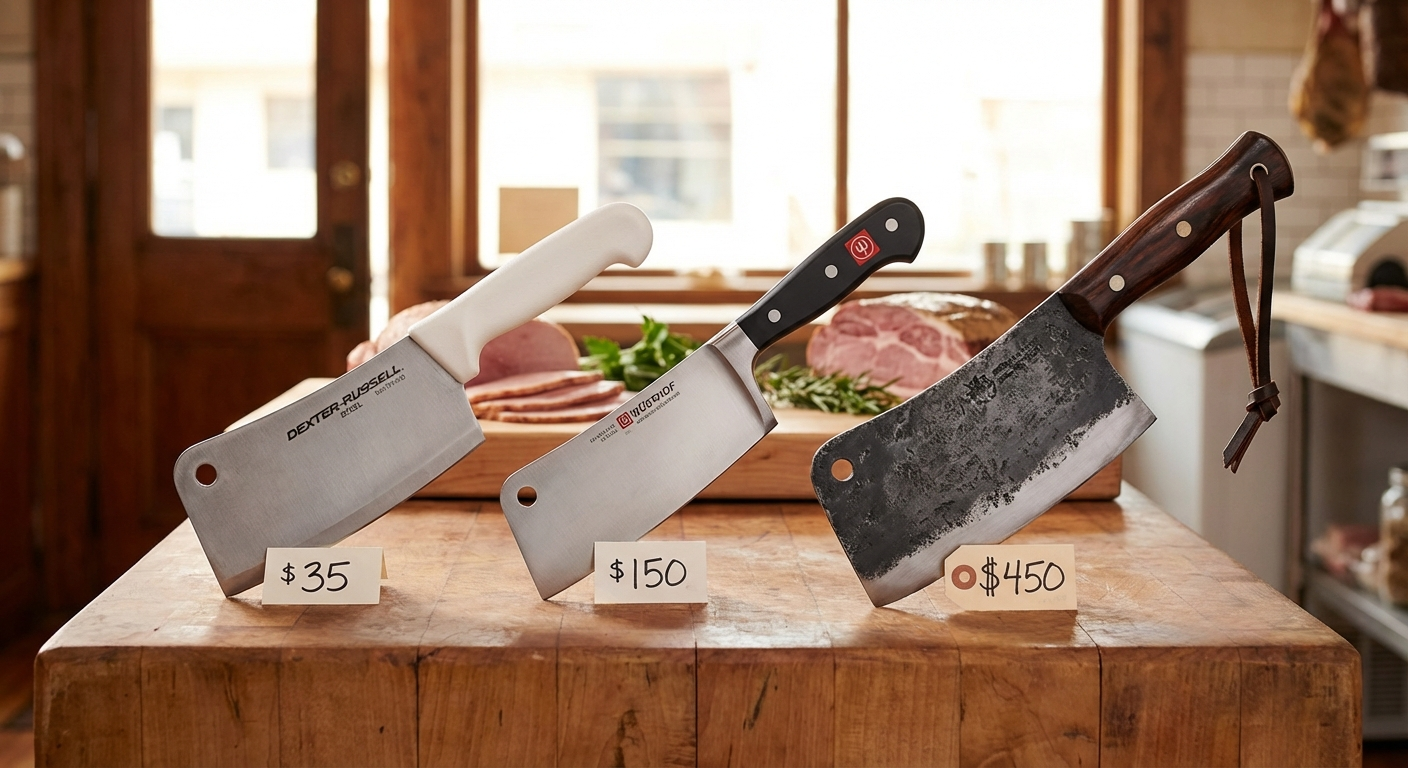
Walk into any kitchen supply store and you'll face a wall of cleavers ranging from $20 no-name brands to $400 handforged Japanese beauties. The salesperson will talk about "Damascus steel" and "hand-hammered edges" and "ergonomic polymer handles." Most of it is irrelevant to how the cleaver actually performs.
Here's what nobody tells you: a $40 Dexter-Russell cleaver will chop through chicken bones just as effectively as a $300 premium model. The difference isn't in cutting performance—it's in craftsmanship, aesthetics, and edge retention that matters more for precision knives than bone choppers. I've used both, and I reach for the Dexter-Russell ninety percent of the time.
That said, there ARE differences that matter. Weight distribution, blade thickness, and handle construction separate tools that last decades from ones that fail after a year. Let me walk you through exactly what to look for so you buy once and buy right.
Understanding What a Meat Cleaver Actually Does
Before we talk about choosing a cleaver, you need to understand what job it's actually built for. This isn't a precision instrument—it's a controlled falling weight designed to separate bones at joints and cut through softer bones and cartilage.
What cleavers ARE designed for:
- Breaking down whole chickens (chopping through backbones, splitting breasts)
- Portioning ribs (cutting spare ribs or baby backs into individual bones)
- Separating poultry joints (wings, leg quarters, thighs from drumsticks)
- Chopping bones for stock (creating marrow bone pieces)
- Cutting through cartilage and smaller joints on pork, lamb, and game
What cleavers are NOT designed for:
- Large beef bones (use a bandsaw)
- Frozen meat (will crack the blade or cause dangerous bouncing)
- Precision boning work (use a boning knife)
- Slicing boneless meat (use a chef's knife or slicer)
- Detail trimming (the weight and thickness make this impossible)
Your choice of cleaver should match these use cases. If you're only breaking down chickens twice a month, you don't need a premium cleaver. If you're processing whole animals weekly, investing in better construction makes sense.
The Five Factors That Actually Matter
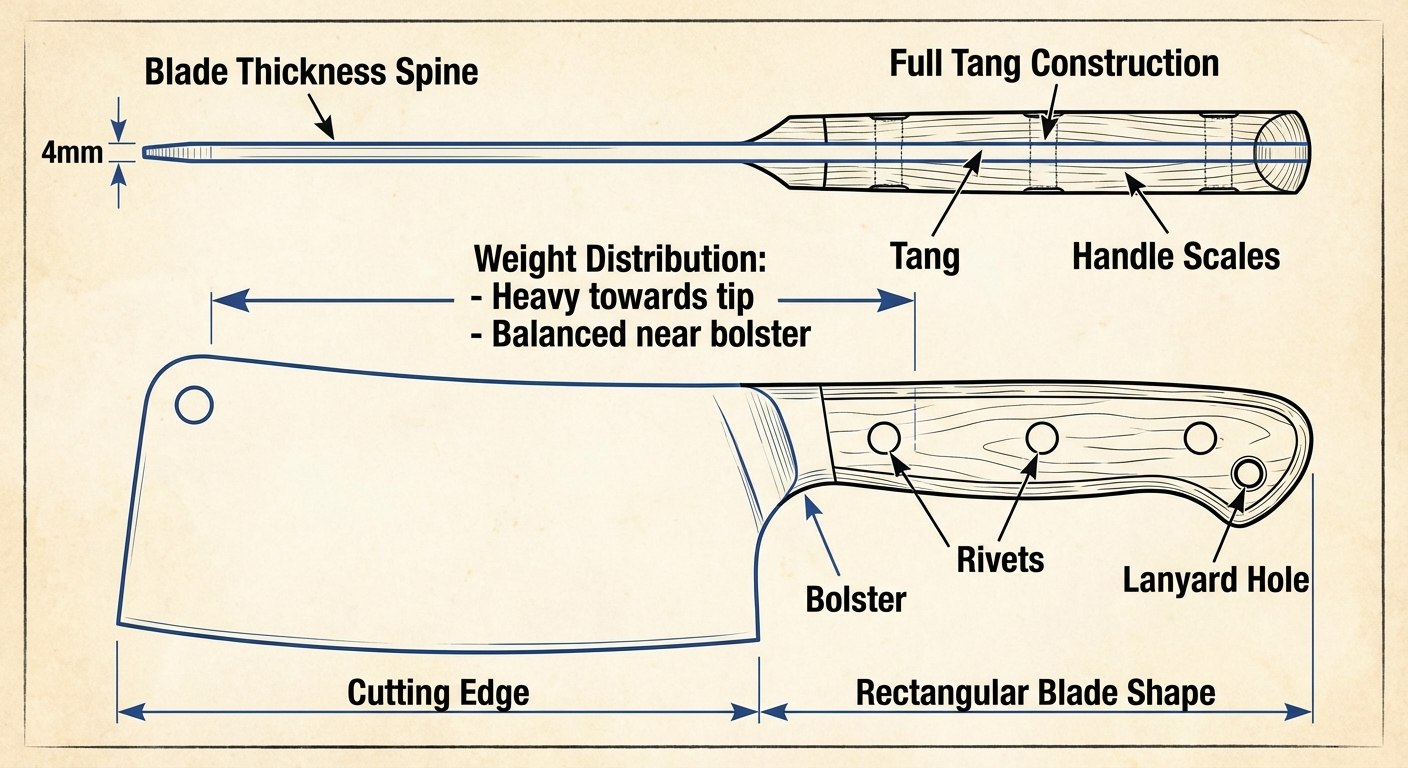
1. Weight and Balance
This is the single most important factor, and it's something you CANNOT evaluate from product photos or specifications alone. You must hold the cleaver in your hand.
Ideal weight range: 2 to 2.5 pounds for general home butchering
Why this range? Lighter cleavers (under 1.5 pounds) don't have enough mass to cut through bones effectively—you'll find yourself muscling cuts that should be effortless. Heavier cleavers (over 3 pounds) tire your hand quickly and require more control to use safely. The sweet spot is 2-2.5 pounds, which provides enough momentum for clean cuts without excessive fatigue.
Balance point test:
Hold the cleaver as you would when chopping. The balance point should be just forward of the handle—at the bolster where blade meets handle, or slightly toward the blade. You want to feel the blade's weight, but it shouldn't pull your hand forward or require constant grip strength to keep level.
A well-balanced 2.5-pound cleaver will feel more controlled than a poorly balanced 2-pound model. This is why you need to physically handle cleavers before buying if possible.
Red flags:
- Balance point far forward into the blade (will tire your hand)
- Balance point behind the handle (blade-heavy, poor control)
- Cleaver feels awkward or unnatural when held in cutting position
2. Blade Thickness
The blade spine thickness determines what materials your cleaver can handle without chipping or cracking. This is measurable and you should check it before buying.
Standard meat cleaver: 3-4mm blade thickness
Heavy-duty bone cleaver: 4-6mm blade thickness
Chinese vegetable cleaver: 2-3mm blade thickness (NOT for bone work)
For home butchering—chickens, ribs, lamb chops—a 3-4mm blade handles everything you'll encounter. Thinner than 3mm and you risk chipping on harder cartilage or bones. Thicker than 5mm is overkill unless you're regularly splitting pig heads or processing whole carcasses.
How to check: Look at the spine of the blade near the handle. Quality manufacturers will list the thickness in specifications. If shopping in person, you can compare blade thickness visually or ask to measure with calipers. A 3-4mm blade will feel substantial but not overly chunky.
Warning about Chinese cleavers: Many home cooks buy a "cleaver" that's actually a Chinese vegetable cleaver (cai dao). These look similar but have thin blades (2-3mm) optimized for vegetables and boneless meat. Use them on chicken bones and you'll chip or crack the blade immediately. If the product description mentions "vegetables" or "all-purpose," it's not a bone cleaver.
3. Tang Construction
The tang is the part of the blade that extends into the handle. For a cleaver—which experiences significant impact forces—this is non-negotiable:
Full tang construction ONLY.
A full tang means the blade steel runs the entire length and width of the handle, visible as a metal strip sandwiched between handle scales (usually wood, plastic, or composite material). The handle scales are riveted or pinned through the tang, creating a single solid piece.
How to identify full tang:
- Look at the top and bottom edges of the handle—you should see metal
- Check for rivets or pins going through the handle (usually 2-4 of them)
- The blade should visibly extend all the way to the end of the handle
Avoid:
- Half-tang (partial tang): Blade extends partway into handle but not the full length. Will eventually loosen or break under cleaver impact forces.
- Rat-tail tang: Blade narrows to a thin rod that goes into the handle. Common in cheap cleavers. Will fail catastrophically—the tang will snap off inside the handle, often mid-cut.
- Glued construction: Some manufacturers glue handle scales onto the tang without mechanical fasteners (rivets/pins). Glue alone will fail over time, especially with the shock of bone chopping.
I've seen half-tang cleavers fail after just six months of regular use. The blade wobbles in the handle, then eventually separates. Don't risk it—full tang costs maybe $10 more and lasts decades.
4. Steel Type and Hardness
Here's where conventional knife advice doesn't apply. For precision knives like chef's knives or boning knives, steel type makes a huge difference in edge retention and sharpness. For cleavers, it matters much less.
Why steel type matters less for cleavers:
- You're not chasing micro-level sharpness—the edge doesn't need to be razor-sharp
- Impact toughness is more important than edge retention
- The blade gets resharpened infrequently (every 3-4 months for home use)
- Mass and geometry do most of the cutting work, not the edge
What to look for:
High-carbon stainless steel — Alloys like X50CrMoV15 (German) or similar. Good balance of toughness, rust resistance, and ease of sharpening. This is what most commercial cleavers use.
Medium hardness: 54-58 HRC (Rockwell hardness) — Softer than premium chef's knives (which run 60-62 HRC), but that's intentional. Medium hardness steel is tougher and less likely to chip on bone impact. A cleaver with 56 HRC will outperform one with 62 HRC for bone work.
What you DON'T need:
- Damascus steel patterns (beautiful, but no functional advantage for cleavers)
- VG-10 or other premium Japanese steels (overkill for bone chopping)
- High hardness ratings (60+ HRC makes blades more brittle)
- Hand-forged construction (nice for collectors, irrelevant for performance)
Carbon vs. stainless:
Traditional carbon steel cleavers (non-stainless) can take a slightly sharper edge and are easier to sharpen, but they require more maintenance (rust prevention, oil coating after use). Unless you're a professional butcher who sharpens tools daily, stainless steel is more practical for home use.
5. Handle Design and Ergonomics
You'll be gripping this tool firmly during forceful chopping motions. Handle comfort and security matter more than aesthetics.
What makes a good cleaver handle:
Size: Large enough for your whole hand to grip securely, with room for your pinky finger. Small handles force a cramped grip that tires quickly and reduces control.
Shape: Slightly oval or D-shaped cross-section (not perfectly round). This prevents rotation in your hand during chopping. Some models have a slight bulge at the end to prevent slipping.
Material: Wood, textured plastic, or composite materials all work. Avoid smooth polished handles (slippery when wet) and soft rubber (degrades over time). Hardwood (like rosewood or pakkawood) provides good grip and durability.
Texture: Slight texture or grain helps with grip. Super-smooth handles become slippery when working with fatty meats.
The grip test:
Hold the cleaver firmly as if about to chop. Your grip should feel secure without requiring a death grip. There should be no sharp edges or uncomfortable pressure points. If the handle feels awkward in your hand after 30 seconds of holding, it will feel worse after 30 minutes of work.
Budget Tiers: What You Get at Each Price Point
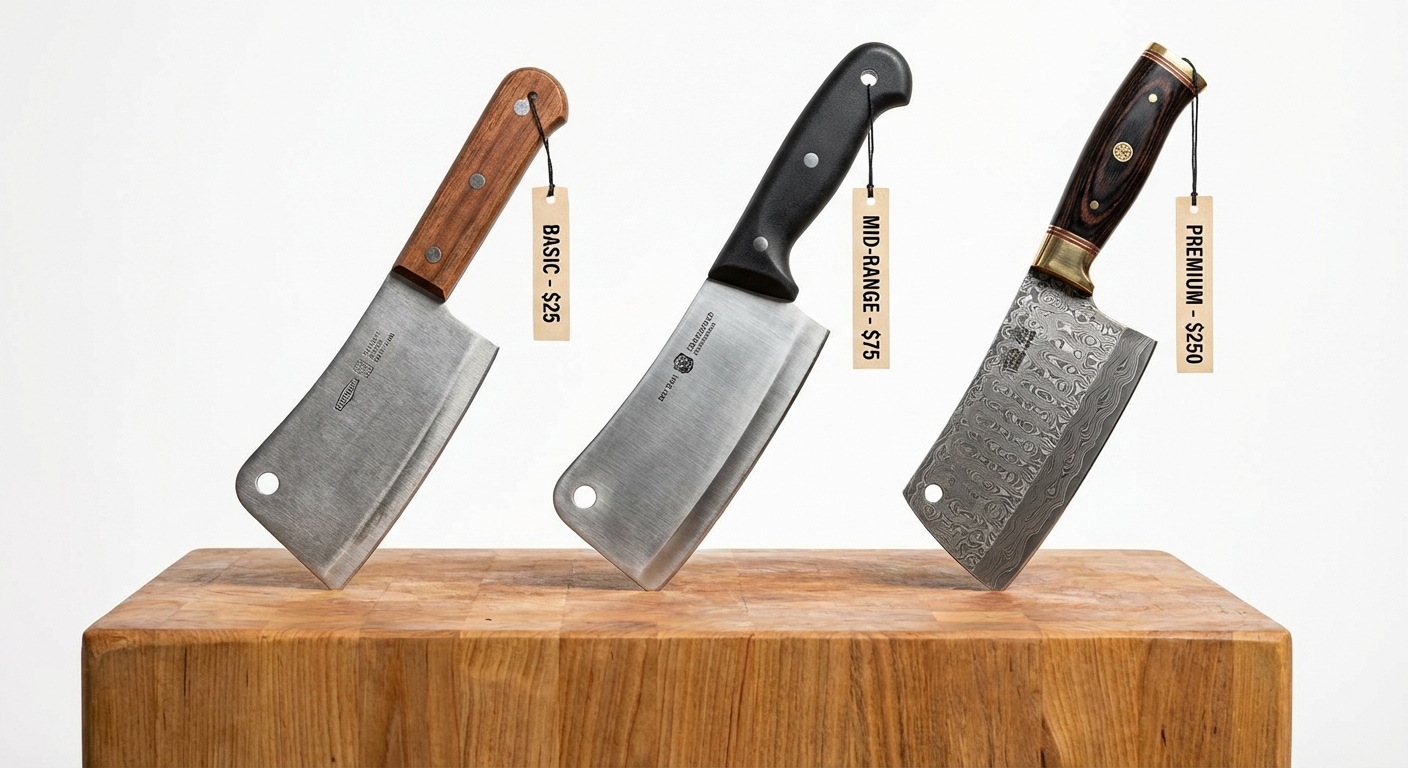
Understanding what you're actually paying for at each tier helps you avoid overspending—or under-buying and regretting it.
Budget Tier: $25-50
Examples: Dexter-Russell, Winco, Kiwi brand commercial cleavers
What you get:
- Basic high-carbon stainless steel (functional, not exotic)
- Full tang construction (if you choose wisely—check before buying)
- Simple plastic or wood handles
- 2-2.5 pound weight range
- Factory edge that needs sharpening before first use
- No frills—stamped production models, not hand-finished
Performance: Will chop through chicken bones, ribs, and cartilage just as effectively as premium models. The edge won't stay sharp quite as long, and the handle may be less comfortable, but functional performance is 95% there.
Best for: Home cooks who break down chickens weekly or process occasional ribs. If you're not doing high-volume butchering, this tier is all you need.
Recommendation: Dexter-Russell 8" cleaver ($40-50). This is the workhorse cleaver in restaurant kitchens nationwide. Full tang, solid construction, performs reliably for years.
Mid-Range: $75-150
Examples: Wüsthof, Victorinox, Mercer Culinary, some Global models
What you get:
- Better steel (still high-carbon stainless, but more refined)
- Hand-finished edges (sharper out of the box)
- More comfortable handles with better ergonomics
- Tighter quality control (better balance, more consistent weight)
- Nicer aesthetics (polished blades, branded handles)
- Sometimes lighter weight (1.5-2 pounds) for reduced fatigue
Performance: Slightly better edge retention (maybe 20% longer between sharpenings). Noticeably more comfortable to use for extended sessions. Balance and fit-and-finish are superior.
Best for: Serious home butchers who process multiple chickens weekly, or anyone doing occasional whole-animal breakdowns. If you're spending 2+ hours per week with a cleaver in hand, the ergonomic improvements justify the cost.
Recommendation: Wüsthof Classic 6" cleaver ($100-120). Excellent balance, comfortable handle, built to last decades. Slightly lighter than budget models but still effective for home use.
Premium: $200-400+
Examples: High-end Japanese cleavers (Shibazi, CCK), handmade custom cleavers, Damascus blade models
What you get:
- Exotic steel alloys or Damascus layered construction
- Hand-forged blades with visible hammer marks
- Premium handle materials (stabilized wood, buffalo horn)
- Superior edge retention (in theory—matters less for cleaver work)
- Collectible craftsmanship and aesthetics
- Bragging rights
Performance: Functionally, a $300 cleaver does not chop through chicken bones better than a $50 cleaver. The mass and geometry matter more than the steel. What you're paying for is craftsmanship, beauty, and the experience of using a finely made tool.
Best for: Collectors, professional butchers who use cleavers daily for years, or anyone who wants a tool that doubles as an heirloom piece. If you appreciate fine craftsmanship and can afford it, these are wonderful tools—just don't expect night-and-day performance differences.
My take: I own both a $45 Dexter-Russell and a $280 Shibazi cleaver. I reach for the Dexter-Russell 90% of the time because I'm not worried about dings, and it performs the job perfectly. The Shibazi is beautiful and I enjoy using it, but the chicken doesn't know the difference.
Special Considerations
Left-Handed Users
Most cleavers are symmetrical and work equally well for left- or right-handed users. Unlike Japanese knives that may have single-bevel edges, Western-style cleavers have symmetrical double bevels. The only consideration is handle shape—some ergonomic handles are contoured for right-handed grips. Test before buying if the handle has pronounced contouring.
Hand Size
If you have small hands (glove size small or medium), look for cleavers with more compact handles. Some Chinese-style meat cleavers have smaller grips than Western models. Weight is more important than length—a well-balanced 2-pound cleaver will feel more controllable than a poorly balanced 1.5-pound model.
If you have large hands (glove size XL or larger), make sure there's enough handle length for your whole hand. Budget cleavers sometimes have short handles that force large hands into cramped grips.
Storage Constraints
Cleavers are big and heavy. Before buying, confirm you have appropriate storage:
- Magnetic strips: Must be heavy-duty rated for 3+ pounds. Standard strips won't hold cleavers securely.
- Knife blocks: Most blocks don't have slots wide enough for cleaver blades (which are 3+ inches tall). Measure first.
- Drawers: A cleaver rolling around loose in a drawer is dangerous. Use a blade guard or dedicated drawer organizer.
- Wall hooks: Many cleavers have a hole in the spine for hanging—this is often the best storage solution.
How to Test a Cleaver Before Buying
If you're buying in a physical store (always preferable to online for your first cleaver), here's my testing protocol:
Step 1: Visual Inspection
- Check that blade and handle are one continuous piece (full tang visible)
- Look for rivets or pins securing the handle scales
- Inspect the edge for chips or irregularities
- Confirm blade thickness is 3mm or greater at the spine
Step 2: Weight and Balance Check
- Hold the cleaver in chopping position (not like a chef's knife)
- Feel where the balance point is—should be at or just forward of the handle
- Lift it 6-8 inches and let it drop (controlled, into your other hand)—does the weight feel manageable?
- Hold for 30 seconds—do you feel strain in your hand or wrist?
Step 3: Handle Comfort
- Grip firmly as if chopping—no sharp edges or pressure points?
- Is there room for your whole hand without cramping?
- Does the handle feel secure or does it want to rotate in your grip?
Step 4: Edge Check
- Gently run your thumb perpendicular across the edge (NOT along it)—you should feel a distinct edge
- Many cleavers come with factory edges that are dull—plan to sharpen before first use
- Check for any chips or rolls in the edge
Step 5: The Paper Test (If Allowed)
- If the store permits, try slicing through a piece of paper
- The cleaver should cut cleanly without tearing excessively
- You're not looking for razor-sharpness—clean cutting is enough
If the cleaver passes all five tests and feels good in your hand, it's probably a solid choice.
Buying Online: What to Check in Product Listings
If you must buy online (or want to research before visiting a store), here's what to verify in product descriptions:
Must-have information:
- Weight: Should be listed in pounds or ounces. Target 2-2.5 lbs (32-40 oz).
- Blade length: 7-8 inches is standard. Shorter than 6" is too small; longer than 9" is unwieldy for home use.
- Tang construction: Must explicitly state "full tang." If it doesn't mention this, assume half-tang.
- Steel type: Look for "high-carbon stainless steel" or a specific alloy designation (like X50CrMoV15).
- Blade thickness: Rarely listed but critical. Check reviews or contact the manufacturer.
Red flags in product descriptions:
- "Vegetable cleaver" or "all-purpose cleaver" (means it's not for bones)
- Weight under 1.5 pounds (too light for effective bone cutting)
- No mention of tang construction (probably half-tang)
- "Damascus steel" listed as the primary selling point (you're paying for aesthetics)
- Blade length over 9 inches (professional/commercial size, excessive for home use)
Check the reviews for:
- Complaints about handle loosening (indicates poor tang construction)
- Reports of blade chipping on chicken bones (blade too thin or steel too hard)
- Comments about balance or weight (too heavy, too light, front-heavy)
- Whether edge holds up or needs immediate sharpening
Maintenance Requirements
Before committing to a purchase, understand the maintenance your cleaver will need. This affects the total cost of ownership.
Stainless Steel Cleavers
Maintenance: Low. Wash and dry after use, sharpen every 3-4 months.
Best for: Home cooks who want minimal upkeep.
Carbon Steel Cleavers
Maintenance: Moderate to high. Wash, dry thoroughly, apply mineral oil coating after each use to prevent rust. Sharpen every 2-3 months.
Best for: Users who enjoy knife maintenance and want slightly better edge retention.
Unless you're prepared to oil your cleaver after every use, stick with stainless steel. The performance difference is minimal for cleaver work, and stainless is far more forgiving of occasional neglect.
Common Buying Mistakes to Avoid
Mistake 1: Buying a Chinese Vegetable Cleaver for Bone Work
This is the most common error. The rectangular shape looks the same, but Chinese vegetable cleavers (cai dao) are thin, light knives for vegetables and boneless meat. Use them on chicken bones and you'll chip or crack the blade immediately.
How to avoid: Check the weight (should be 2+ pounds for a bone cleaver) and blade thickness (3mm+ for bone work). If the product description emphasizes vegetables, pass.
Mistake 2: Buying an Oversized "Professional" Cleaver
Some retailers market 9-10 inch, 3+ pound cleavers as "professional grade" without explaining that these are designed for commercial butchers processing hundreds of animals. For home use, they're fatiguing and overkill.
How to avoid: Stick to 7-8 inch blades and 2-2.5 pounds unless you're regularly processing whole pigs or lambs.
Mistake 3: Prioritizing Aesthetics Over Function
Damascus patterns, decorative etching, and exotic handle materials look beautiful but add cost without improving performance. A $300 Damascus cleaver doesn't chop bones better than a $50 workhorse.
How to avoid: Decide if you're buying a tool or a showpiece. If you want both, go for it—but understand you're paying for craftsmanship, not performance.
Mistake 4: Buying Based on Brand Prestige Alone
Expensive brands like Wüsthof and Shun make excellent cleavers, but they also make expensive cleavers. For bone-chopping work, a budget Dexter-Russell performs 95% as well at 25% of the cost.
How to avoid: Evaluate the cleaver's specs (weight, tang, steel, thickness) independently of the brand name. Premium brands earn their price with chef's knives and boning knives where edge retention and precision matter. For cleavers, budget brands often perform just as well.
Mistake 5: Choosing Half-Tang Construction to Save Money
Saving $15-20 by buying a half-tang cleaver seems smart until the blade separates from the handle mid-chop. Full tang construction is non-negotiable for impact tools.
How to avoid: Always verify full tang construction before buying. If you can't confirm it from the product listing, don't buy.
My Specific Recommendations
After using dozens of cleavers over three decades, these are the models I recommend to home butchers at different budget levels:
Best Budget Pick: Dexter-Russell 8" Cleaver ($40-50)
Weight: 2.25 lbs
Steel: High-carbon stainless
Tang: Full
Why it's great: This is the cleaver I use most often in my own kitchen. Full tang, solid construction, proper weight and balance. The handle is basic but comfortable. The blade holds an edge reasonably well and is easy to sharpen. It's the cleaver you'll find in restaurant kitchens everywhere because it works and lasts.
Best Mid-Range Pick: Wüsthof Classic 6" Cleaver ($100-120)
Weight: 1.8 lbs
Steel: X50CrMoV15 high-carbon stainless
Tang: Full
Why it's great: Slightly lighter than budget models but still effective. Superior handle ergonomics—comfortable for extended use. Excellent balance. Better out-of-box edge. If you're doing high-volume home butchering and can afford it, the comfort upgrade is worth it.
Best Premium Pick: Shibazi F208-2 Chinese Cleaver ($150-200)
Weight: 2.5 lbs
Steel: High-carbon stainless
Tang: Full
Why it's great: This is the premium cleaver for users who want professional-grade craftsmanship without going full custom. Hand-forged blade, excellent balance, beautiful fit-and-finish. It's a joy to use and will last a lifetime. The performance difference over budget models is minimal, but the experience difference is real.
Best for Small Hands: Victorinox 6" Cleaver ($50-70)
Weight: 1.5 lbs
Steel: High-carbon stainless
Tang: Full
Why it's great: Lighter weight and smaller handle make this ideal for users with smaller hands or less upper-body strength. Still heavy enough to chop through chicken bones effectively. Fibrox handle provides excellent grip.
Final Thoughts
Choosing a meat cleaver doesn't need to be complicated. Focus on the fundamentals—proper weight (2-2.5 pounds), blade thickness (3-4mm), full tang construction, and comfortable handle. Everything else is either marketing or personal preference.
For most home butchers, a $40-50 budget cleaver from Dexter-Russell or Winco will serve you perfectly for years. If you're doing high-volume work or want better ergonomics, spending $100-120 on a mid-range Wüsthof or Victorinox is worthwhile. Premium cleavers ($200+) are beautiful tools but offer minimal performance gains—buy them if you appreciate fine craftsmanship, not if you're chasing better results.
The most important step is to actually test the cleaver in your hand if possible. Weight, balance, and handle fit are personal—what feels perfect to me might feel awkward to you. Order from retailers with good return policies if you're buying online, and don't hesitate to return a cleaver that doesn't feel right.
Buy once, buy right, and you'll have a tool that serves you for decades. Now get out there and break down some chickens.
Frequently Asked Questions
What size meat cleaver is best for home use?
For home butchering, a 7-8 inch blade weighing 2-2.5 pounds is ideal. This size provides enough mass to cut through chicken bones and ribs effectively without being fatiguing to use. Smaller cleavers (under 6 inches) lack cutting power, while larger professional models (9+ inches, 3+ pounds) are overkill for home use and tire your hand quickly.
Do I need an expensive cleaver or will a cheap one work?
For bone-chopping work, a $40-50 budget cleaver performs nearly as well as a $300 premium model. The key factors are weight (2-2.5 lbs), blade thickness (3-4mm), and full tang construction—all of which budget cleavers provide. Premium cleavers offer better ergonomics and craftsmanship but minimal performance gains. Start with a budget Dexter-Russell cleaver; upgrade only if you do high-volume butchering and want more comfort.
What is the difference between a meat cleaver and a Chinese cleaver?
A meat cleaver (Western-style) weighs 2-3 pounds with a thick blade (3-4mm) designed for chopping through bones. A Chinese cleaver (cai dao) weighs only 8-12 oz with a thin blade (2-3mm) designed for vegetables and boneless meat—it looks similar but will chip or break if used on bones. Always check the weight and blade thickness to distinguish them.
Should I buy a stainless or carbon steel cleaver?
For home use, stainless steel is more practical. Carbon steel cleavers require oiling after every use to prevent rust and need more frequent sharpening. The edge retention advantage of carbon steel is minimal for cleaver work (where the edge doesn't need to be razor-sharp). Unless you enjoy knife maintenance, stick with high-carbon stainless steel.
What is full tang and why does it matter for cleavers?
Full tang means the blade steel extends through the entire length of the handle, visible as metal between the handle scales and secured with rivets or pins. This creates a single solid piece that can withstand the impact forces of bone chopping. Half-tang or rat-tail construction (where the blade only extends partway into the handle) will eventually loosen or break. Full tang construction is non-negotiable for cleavers—it's the difference between a tool that lasts decades and one that fails after months.
More Expert Guides
The Butcher's Cleaver: Complete Guide to the Heavy Rectangular Knife
The butcher's cleaver—that heavy, rectangular blade—is one of the most misunderstood tools in meat cutting. After decades in the trade, I've learned it's not a crude hacking tool, but a precision instrument for controlled bone cutting. This guide covers everything from cleaver anatomy to advanced techniques.
15 min readHow to Trim a Brisket: The Complete Butcher's Guide
Proper brisket trimming is the difference between a backyard experiment and competition-quality results. Here is the professional technique for shaping a whole packer brisket before it ever touches the smoker.
14 min readHow to Butcher a Whole Chicken: Step-by-Step Guide
Breaking down a whole chicken yourself saves 40-50% compared to buying individual parts. Here is the professional technique for turning one bird into perfectly portioned pieces.