How to Cut a Whole Ribeye into Steaks: The Complete Butcher's Guide
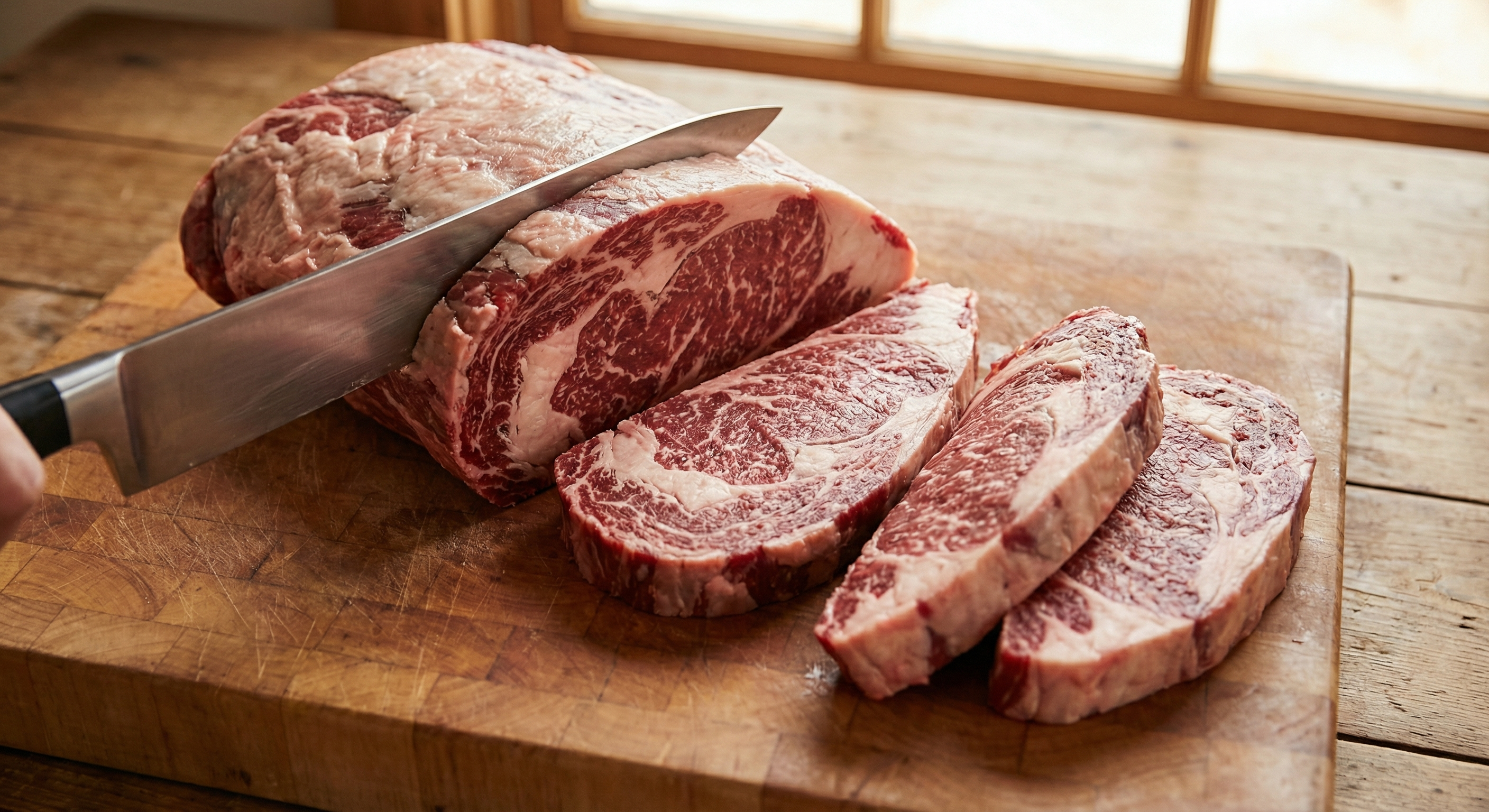
A whole boneless ribeye primal — sometimes labeled as a beef rib roast, bone-out — typically weighs 12 to 18 pounds and costs significantly less per pound than pre-cut ribeye steaks. At most warehouse clubs and butcher shops, you will pay $8 to $14 per pound for a whole subprimal compared to $16 to $28 per pound for individually cut steaks. That means a 15-pound ribeye at $10 per pound costs $150 and yields 10 to 12 steaks — roughly $12 to $15 per steak instead of $25 to $40 each.
The process is straightforward. You do not need professional equipment or years of butchery experience. A sharp knife, a cutting board, and 20 minutes of focused work will produce steaks that rival anything from a high-end butcher counter.
Understanding Ribeye Anatomy
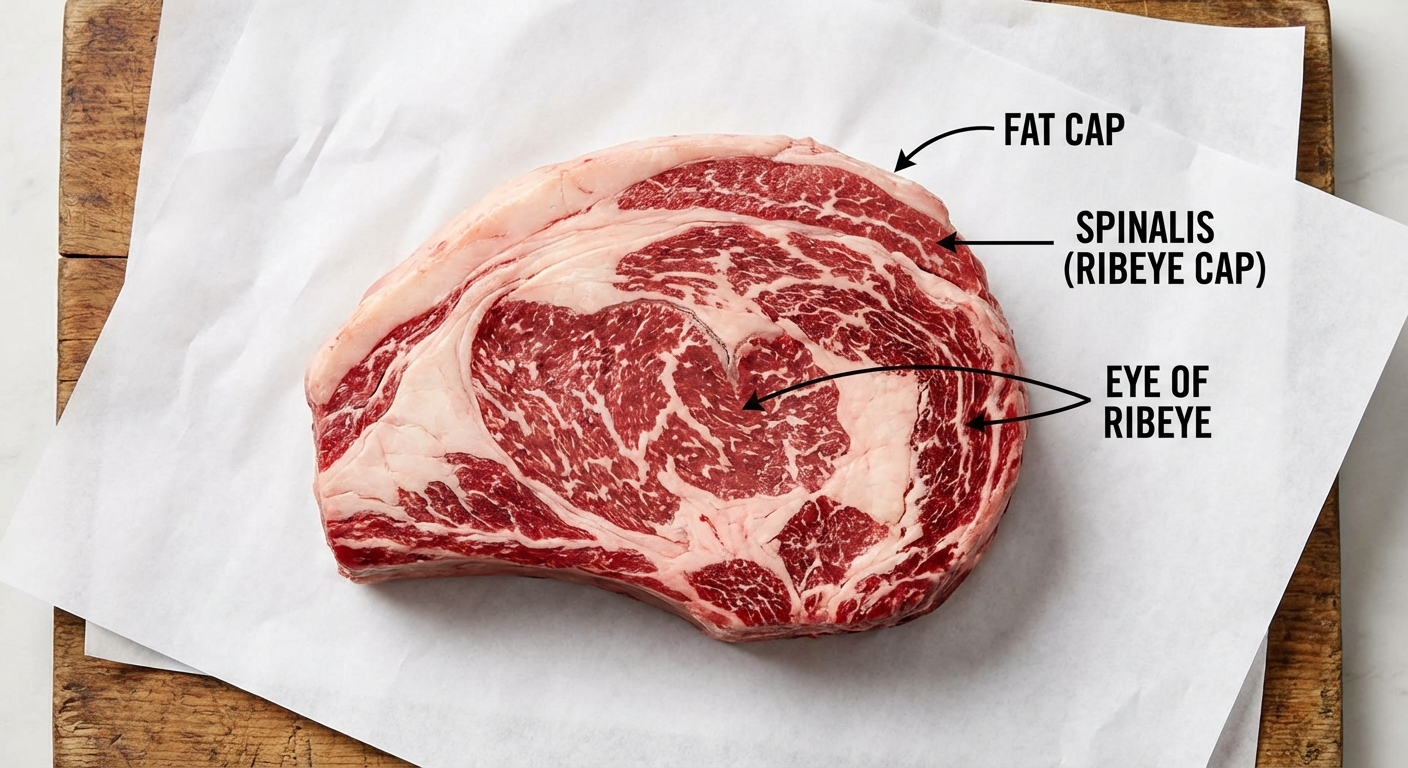
Before you start cutting, understanding what you are working with makes every decision easier. A whole boneless ribeye comes from the rib section of the steer, specifically ribs 6 through 12. It contains three main muscles:
- Longissimus dorsi (the eye): This is the large, round center muscle that makes up the bulk of a ribeye steak. It has excellent marbling and a tender, beefy flavor. This is what most people think of when they picture a ribeye.
- Spinalis dorsi (the cap or deckle): The crescent-shaped muscle that wraps around the outside of the eye. Many butchers and chefs consider this the single best-tasting muscle on the entire animal. It has intense marbling, a buttery texture, and rich flavor that surpasses even the eye.
- Complexus: A smaller muscle that appears on steaks cut from the chuck end (ribs 6-8). It sits between the eye and the cap and has a slightly different grain. Not every steak will have this muscle — it tapers off toward the loin end.
The ribeye also has a fat cap — a layer of external fat running along one side — and seam fat between the muscles. Both are important to manage during trimming.
As you look at the whole subprimal, you will notice it is not uniform. One end is significantly larger in diameter than the other. The large end (chuck end, ribs 6-8) has more muscles, more fat seams, and a bigger spinalis cap. The small end (loin end, ribs 10-12) is leaner, rounder, and more uniform — these steaks look more like a classic steakhouse ribeye.
Tools You Need
You do not need a commercial setup. Here is what works:
- Sharp 10-to-12-inch slicing knife or chef's knife: Length matters here. You need a blade long enough to cut through the full width of the ribeye in one or two smooth strokes. A short knife forces you to saw back and forth, which tears the meat and produces ragged edges.
- Large cutting board: At least 20 by 15 inches. The subprimal is long — typically 16 to 22 inches — and you need room to work.
- Paper towels: For drying the surface and maintaining grip.
- Kitchen scale: Optional but useful for consistent portioning. If you want every steak within an ounce of each other, weigh as you go.
- Plastic wrap and freezer paper: For wrapping steaks you plan to freeze.
- Permanent marker: For labeling packages with the date and cut.
The single most important tool is a sharp knife. Dull blades compress the meat instead of slicing cleanly, which damages the muscle fibers, causes uneven cuts, and makes the entire process frustrating. If your knife does not glide through a tomato without pressure, sharpen it before you start.
Trimming the Ribeye
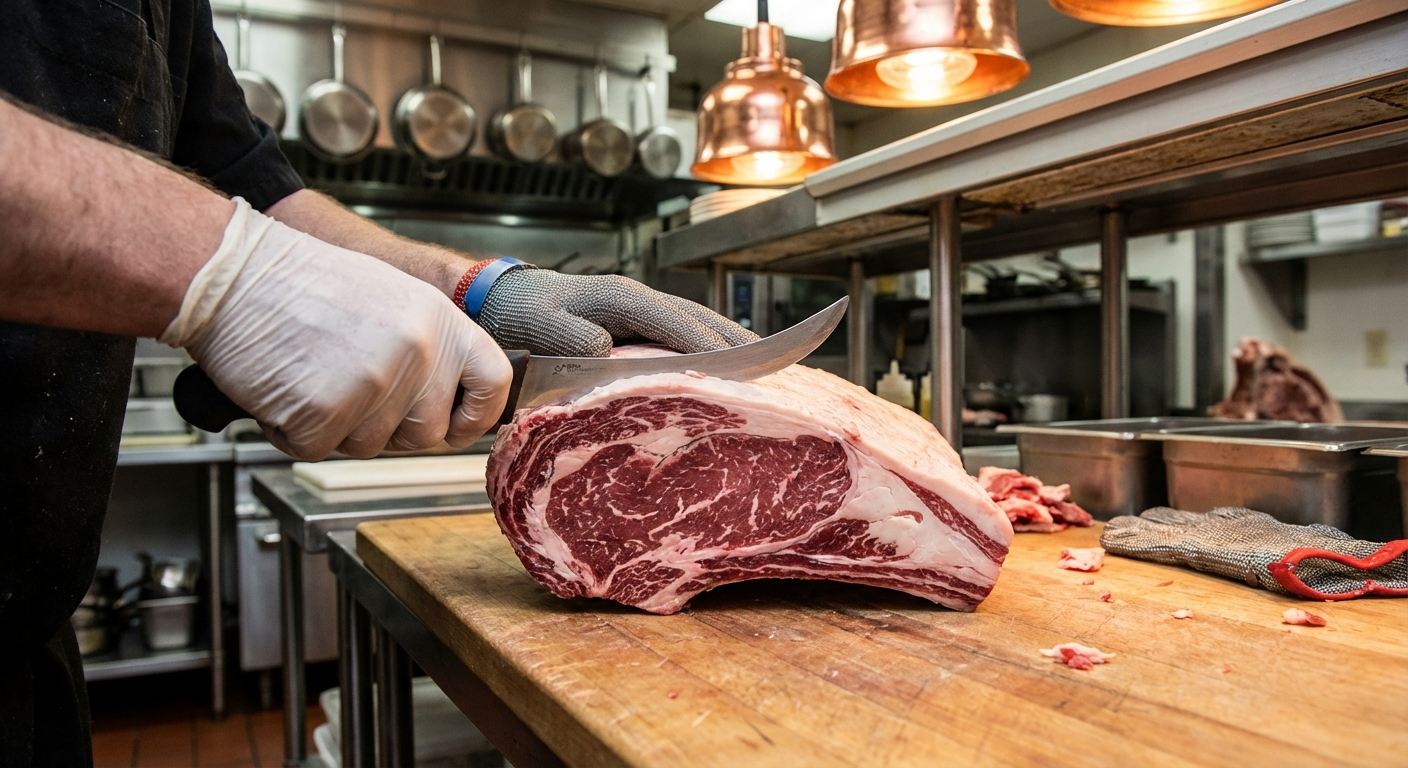
Trimming happens before you cut a single steak. The goal is to remove excess external fat while leaving enough to protect the meat during cooking and add flavor.
Fat Cap Trimming
Place the ribeye fat-cap-up on your cutting board. You will see a layer of hard white fat covering one side. The thickness varies — some areas might be a quarter inch, others over an inch.
Using long, smooth strokes, trim the fat cap down to approximately one-quarter inch of uniform thickness across the entire surface. Angle your knife almost parallel to the meat, keeping the blade just above the muscle surface. Work from one end to the other in steady passes.
Do not remove the fat cap entirely. That quarter inch of fat serves a purpose: it bastes the steak during cooking, protects the meat from direct heat, and adds flavor. Steaks trimmed completely bare cook drier and have less flavor than steaks with a thin fat cap.
Removing the Chain Meat
Along one edge of the ribeye, you will find a loose strip of meat and fat called the chain (or lip). This ragged piece connects loosely to the main muscle and is typically full of sinew and hard fat. Peel it away from the main muscle with your hands — it separates easily — then use your knife to cut through any connecting tissue.
Do not throw the chain away. It is excellent ground into burger blends or cut into pieces for stew. The flavor is outstanding even though the texture is too chewy for steaks.
Cleaning the Ends
Both ends of the subprimal will have rough, dried-out surfaces from aging and exposure during storage. Trim a thin slice — about a quarter to half inch — from each end to expose fresh, bright red meat. These end pieces can go into the grind pile with the chain meat.
Cutting the Steaks
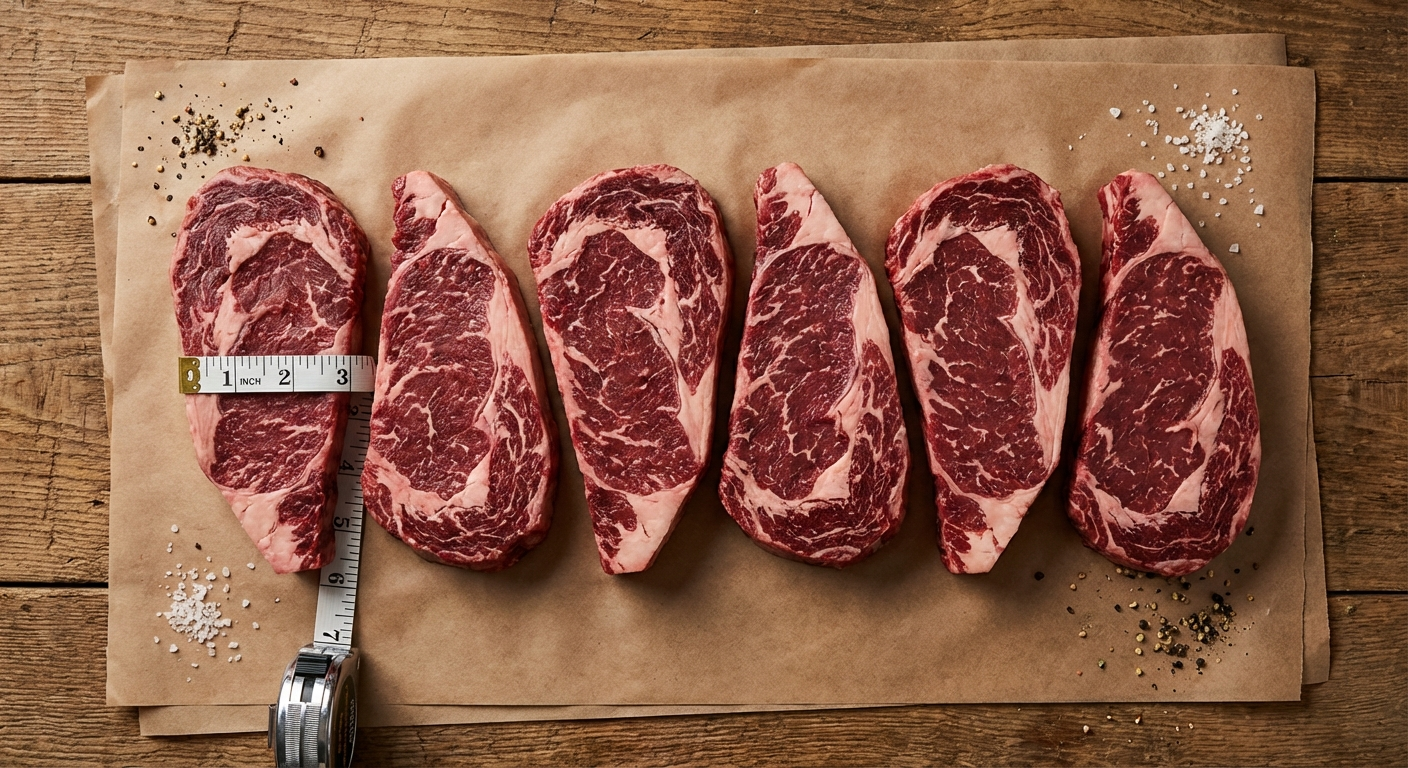
With trimming complete, it is time to turn that whole subprimal into individual steaks. This is where precision matters most.
Choosing Your Thickness
Steak thickness is a personal preference, but it affects cooking dramatically:
- 1 inch (about 10-12 oz from the large end, 8-10 oz from the small end): Good for quick searing. Easy to overshoot on doneness — small margin for error. Best for experienced cooks who want a fast weeknight steak.
- 1.25 inches (about 12-14 oz large end, 10-12 oz small end): The sweet spot for most home cooks. Thick enough to develop a good crust before the interior overcooks. This is what most steakhouses serve.
- 1.5 inches (about 14-18 oz large end, 12-14 oz small end): Restaurant-quality thickness. Requires reverse sear or sous vide for best results. Produces a dramatic medium-rare center with a thin seared crust.
- 2 inches and above (18-24+ oz): These are show-stoppers. Must be reverse seared, sous vide, or cooked with a combination method. Not ideal for a standard pan sear.
For your first time, 1.25 inches is the safest choice. It forgives small inconsistencies in thickness and cooks well with nearly any method.
The Cutting Technique
Position the trimmed ribeye so you are cutting across the grain — perpendicular to the length of the subprimal. Start at whichever end you prefer, though most butchers begin at the loin end (the smaller, leaner end) because those steaks are the most uniform and attractive.
- Measure your first cut. Use a ruler or simply eyeball 1.25 inches from the trimmed end. Some people use a small nick at the top of the meat as a guide mark.
- Position your knife perpendicular to the cutting board. Keep the blade straight up and down — angled cuts produce steaks that are thicker on one side than the other.
- Cut in one or two smooth, long strokes. Draw the knife from the heel to the tip in a single confident motion. Do not saw back and forth. Let the sharp edge and the length of the blade do the work. If the cut takes more than two strokes, your knife is not sharp enough.
- Set the steak aside and repeat. Use the first steak as a thickness reference for subsequent cuts. Consistency matters more than hitting an exact measurement.
A 15-pound trimmed subprimal typically yields 10 to 12 steaks at 1.25-inch thickness, depending on how much you trimmed and the original size. You will also have end pieces that are slightly irregular — these make excellent steak sandwiches, stir-fry, or can be ground.
Dealing with the Chuck End
The last two or three steaks from the chuck end (large end) will look different from the rest. They have more fat seams, the complexus muscle appears, and the overall shape becomes less round and more irregular. These steaks are not lesser cuts — they actually have more flavor than the leaner loin-end steaks because of the extra marbling and the larger spinalis cap. Many butchers prefer eating the chuck-end steaks themselves.
If the final piece at the chuck end is too small or irregular for a steak, cut it into a thick roast (3 to 4 inches). A bone-out ribeye roast is spectacular when slow-roasted or reverse seared as a single piece, then sliced to serve.
Storage and Freezing
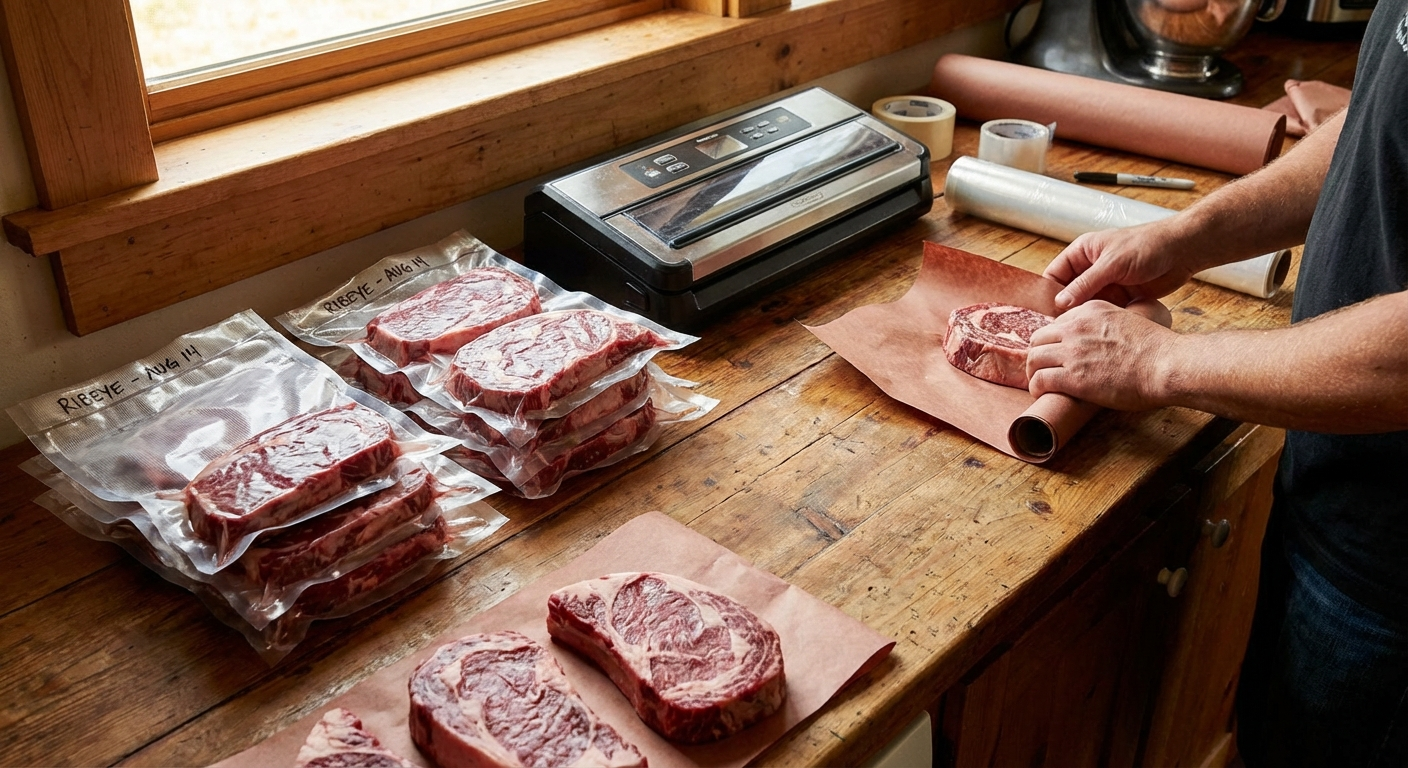
Unless you are feeding a crowd, you will freeze most of the steaks you cut. Proper wrapping prevents freezer burn and preserves quality for months.
For the Refrigerator (Use Within 3-5 Days)
Place steaks on a wire rack set over a sheet pan, uncovered, in the refrigerator. This dry-brines the surface slightly and allows airflow around the meat. The result is better browning when you cook them. If you prefer to wrap them, use butcher paper — it breathes better than plastic wrap and prevents moisture buildup.
For the Freezer (Good for 6-12 Months)
The best method is vacuum sealing. Vacuum-sealed steaks suffer zero freezer burn and maintain quality for up to 12 months. If you do not own a vacuum sealer, use the double-wrap method:
- Wrap each steak tightly in plastic wrap, pressing out all air pockets.
- Wrap again in freezer paper or aluminum foil.
- Label with the date and cut name.
- Lay flat in the freezer until frozen solid, then stack or store upright.
Thaw frozen steaks in the refrigerator overnight — never at room temperature. A vacuum-sealed steak thaws in 12 to 18 hours in the fridge. For faster thawing, submerge the sealed package in cold water, changing the water every 30 minutes. A one-inch steak thaws in about 45 minutes using the cold water method.
How Much Money You Actually Save
The economics are straightforward. Here is a real-world comparison using typical 2026 pricing:
- Whole choice ribeye (Costco): 15 lbs at $10.99/lb = $164.85. After trimming (about 1.5 lbs of waste), you get roughly 13.5 lbs of steaks and usable trim. Effective cost: $12.21/lb for steaks.
- Pre-cut choice ribeye steaks (grocery store): $18.99 to $24.99/lb. For the same 13.5 lbs of meat: $256 to $337.
- Savings: $91 to $172 on a single subprimal. That is 35% to 51% less.
If you buy one whole ribeye per month, you save $1,100 to $2,000 per year on ribeyes alone. Apply the same approach to strip loins, tenderloins, and pork loins and the annual savings compound significantly.
Frequently Asked Questions
Frequently Asked Questions
Should I buy bone-in or boneless whole ribeye?
Boneless is far easier to work with at home. Bone-in primals (standing rib roasts) require a band saw to cut into steaks, which most home kitchens do not have. Boneless subprimals only need a sharp knife. If you specifically want bone-in ribeye steaks, ask your butcher to cut a standing rib roast into steaks for you.
How can I tell if a whole ribeye is good quality before buying?
Look for abundant white marbling flecks throughout the meat — especially in the eye muscle. The fat should be white to creamy white, not yellow. The meat should be bright cherry red (or dark red if dry-aged). Avoid subprimals with large areas of connective tissue visible on the surface or excessive external fat that you will pay for and then trim off.
What is the difference between choice and prime whole ribeye?
USDA Prime has more intramuscular marbling (fat within the muscle) than Choice. Prime steaks are more tender, juicier, and have richer beef flavor. The tradeoff is cost — prime whole ribeyes typically cost $3 to $6 more per pound than choice. For many home cooks, upper choice ribeyes offer excellent quality at a better value.
Can I cut ribeye steaks different thicknesses from the same subprimal?
Absolutely. Many people cut thicker steaks from the loin end (where the eye is leaner and benefits from thickness for proper cooking) and thinner steaks from the chuck end (where extra marbling keeps thinner steaks moist). Adjust to your cooking methods and preferences.
What should I do with the trim and end pieces?
Grind them for premium burger meat, dice for stew or chili, slice thin for cheesesteaks or stir-fry, or render the fat trimmings into beef tallow. Ribeye trim makes some of the best ground beef you will ever taste because of the high fat-to-lean ratio and the quality of the marbling.
More Expert Guides
Butcher Terms Explained: What to Ask For at the Meat Counter
Stop guessing at the meat counter. This practical guide decodes essential butcher terms so you can confidently request exactly what you need, explained with real-world examples from 15 years behind the block.
18 min readButcher Terms Glossary: 50+ Essential Meat Cutting Terms Every Home Cook Should Know
Master the language of professional butchery with this comprehensive glossary. Learn 50+ essential butcher terms, from primal cuts to seam butchery, explained by Elena Vasquez.
14 min readButcher Shop Slang: What Your Butcher Really Means When They Talk Shop
Walk into a butcher shop and you will hear phrases like "break it down," "clean it up," or "two-finger thick." Here is what your butcher really means — and how to speak the language like a pro.