How to Debone a Leg of Lamb: Step-by-Step Butcher's Guide
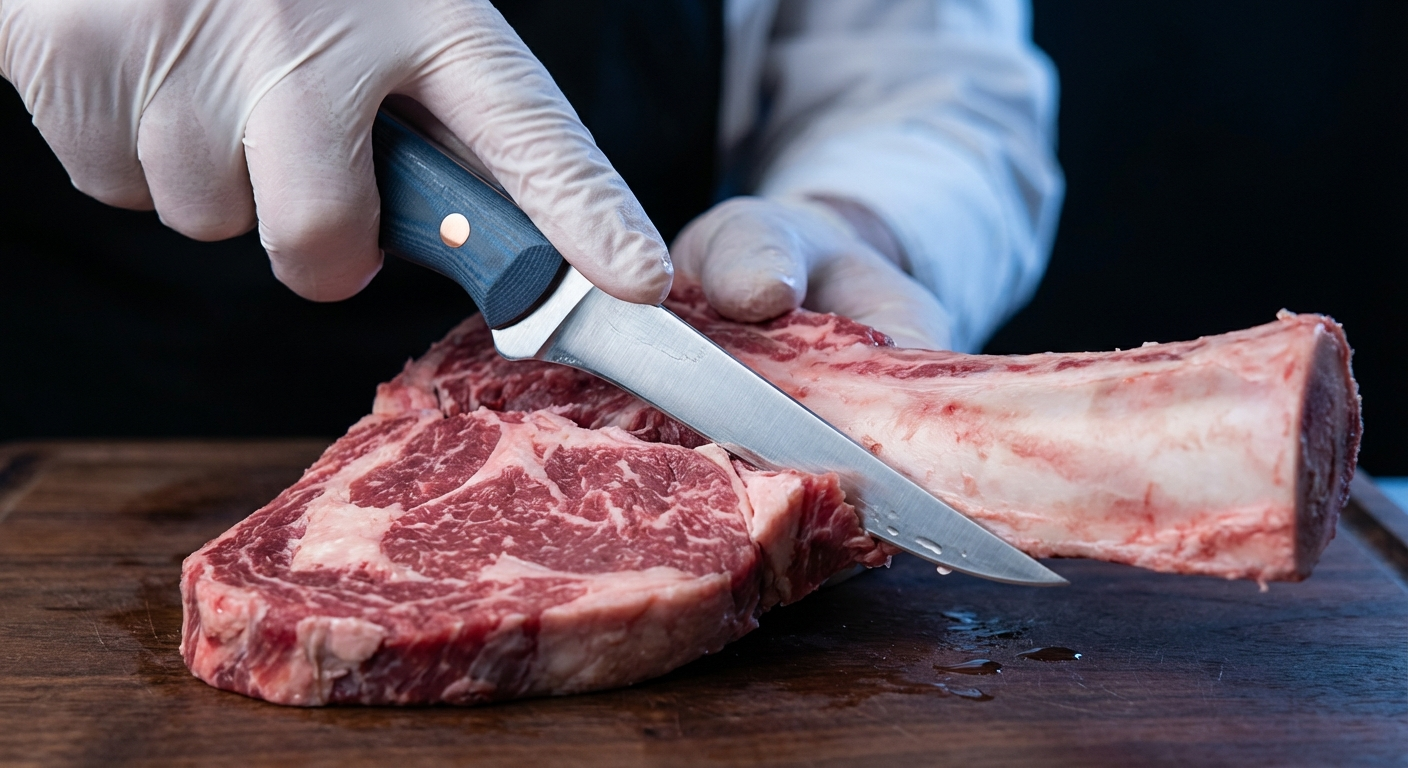
A whole bone-in leg of lamb is one of the most rewarding cuts to learn to debone at home. Bone-in legs are significantly cheaper per pound than boneless, and doing the work yourself means you control the final shape — whether that is a butterflied leg for the grill, a rolled roast for the oven, or individual muscles separated for different cooking methods.
The anatomy is straightforward once you understand it. Three bones, a handful of muscle groups, and some connective tissue holding everything together. A sharp boning knife and 15 minutes of focused work will get you a cleanly deboned leg that looks like it came from a professional butcher case.
Understanding Lamb Leg Anatomy
Before you pick up a knife, you need a mental map of what is inside. A whole leg of lamb contains three bones arranged in a rough Z-shape:
- The Shank Bone (tibia): The long, straight bone at the narrow end of the leg. This is the easiest bone to identify and remove — it is the handle you grab when picking up the leg.
- The Leg Bone (femur): The large central bone that runs through the thickest part of the leg. This is the main bone you are working around. It connects the shank bone at the knee joint and the aitch bone at the hip.
- The Aitch Bone (pelvic bone): A flat, irregularly shaped piece of the pelvis at the wide end of the leg. This is the trickiest bone to remove because of its odd shape and the tendons attached to it.
The knee joint connects the shank bone to the femur. The ball-and-socket hip joint connects the femur to the aitch bone. Your knife work focuses on separating meat from bone and cutting through these two joints.
The major muscle groups in the leg are the top round (inside), the bottom round (outside), the eye of round (a cylindrical muscle near the femur), and the sirloin tip (near the aitch bone). You do not need to separate these for a standard debone — just know they exist so you can follow the natural seams if you want individual muscles later.
Tools You Need
- Sharp boning knife (5-6 inches, semi-flexible): This is the only knife you truly need. The narrow, flexible blade follows bone contours and gets into tight spots around joints. A Victorinox Fibrox Pro boning knife is the industry standard and costs under $30.
- Large cutting board: At least 18x12 inches. A whole lamb leg is bulky and you need room to maneuver.
- Paper towels or a clean kitchen towel: For drying the surface and maintaining grip. Lamb fat is slippery.
- A bowl for trim and scraps: Keep your workspace clean as you go.
Work with a cold leg straight from the refrigerator. Cold meat and fat are firm, which makes every cut cleaner and more precise. A room-temperature leg is slippery and the fat smears instead of cutting cleanly.
Step 1: Remove the Shank Bone
Place the leg on your cutting board with the shank end (the narrow, bony end) pointing toward you. The fat cap should be facing up.
Start by cutting around the shank bone at the narrow tip where very little meat covers it. Make a circular cut through the meat and tendons all the way around the bone, about two inches up from the knuckle end. Cut down to the bone — you should feel your knife scraping against it.
Now work your way up the shank bone toward the knee joint. Use short, scraping strokes with the blade angled slightly toward the bone. The goal is to peel the meat away from the bone while leaving as little meat on the bone as possible. Think of it as shaving the bone clean.
When you reach the knee joint, you will feel the bone widen and the connective tissue get thicker. Cut through the ligaments and tendons around the joint. Bend the shank bone backward to open the joint — you will see the white cartilage surface where the two bones meet. Slice through the remaining connective tissue to free the shank bone completely.
Set the shank bone aside. It is excellent for stock or braising liquid.
Step 2: Expose and Remove the Femur
With the shank bone removed, you can now see the end of the femur at the knee joint. This is your entry point into the center of the leg.
Make a long cut along the length of the femur, following the bone from the knee end toward the hip end. Cut through the meat on top of the bone — you are essentially splitting the leg open along the bone line. Cut deep enough to feel your knife touching bone the entire length.
Now work one side at a time. Starting on the right side of the femur (or whichever feels more natural), use short scraping strokes to separate the meat from the bone. Keep your blade flat against the bone surface and use the bone as a guide rail. The meat will peel away in a clean sheet if your knife is sharp and you stay tight to the bone.
Repeat on the other side. You are essentially tunneling around the femur, freeing the meat from all sides. When you reach the underside of the bone, you may need to lift the bone slightly to get your knife underneath it.
At the hip end, you will feel the femur widen into the ball joint. This is where the femur connects to the aitch bone. Do not try to cut through the ball — instead, cut around it. Slice through the ligaments holding the ball in the socket. You may need to twist and pull the femur while cutting to pop the ball joint apart.
Once the hip joint is separated, the femur should pull free. If it does not come out cleanly, look for any remaining attachments — usually a tendon or piece of connective tissue you missed — and cut them.
Step 3: Remove the Aitch Bone
The aitch bone is the most challenging part because it is flat, irregularly shaped, and buried in the thickest part of the meat at the wide end of the leg. Take your time here.
Feel for the aitch bone with your fingers at the wide end of the leg. It is a flat, hard plate of bone just under the surface. You can usually feel its edges through the meat.
Starting at the socket where the femur was just removed, trace around the aitch bone with your knife. Use the tip of the blade and keep it pressed against the bone surface at all times. Work in small, controlled strokes — this is detail work, not power cutting.
Follow the outer edge of the aitch bone, cutting the meat away from the flat surface. The bone curves and has ridges, so you need to adjust your blade angle constantly. Imagine you are peeling the meat off a curved plate.
When you have freed the meat from the outer surface and edges, slide your knife under the bone to release the inner side. There will be tendons attached at the thickest part of the bone — cut through these firmly. Once all attachments are severed, the aitch bone lifts out.
Check the cavity with your fingers for any bone fragments or chips. Run your fingertips along every surface where bone was removed to confirm it is clean.
Step 4: Clean Up the Boneless Leg
With all three bones removed, you have a boneless leg of lamb that is opened up and roughly butterfly-shaped. Now clean it up:
- Remove loose fat and sinew: Trim any thick deposits of hard fat from the interior surfaces. Leave a thin layer of fat on the exterior — this bastes the meat during cooking.
- Remove the lymph node: There is usually a small, round lymph gland embedded in fat near where the aitch bone was. It looks like a small, pale, bean-shaped lump. Cut it out — it has an unpleasant texture when cooked.
- Trim silverskin: Look for thin, silvery membranes on the exposed muscle surfaces. Slide your knife under one end of the silverskin, grip the freed end with a paper towel, and pull it away while angling your blade slightly upward to separate it from the meat.
- Even out the thickness: If one area is significantly thicker than another and you plan to cook it flat, make a horizontal cut partway through the thick section and fold it open like a book. This is called butterflying and creates a more uniform thickness for even cooking.
What to Do with Your Boneless Leg
A deboned leg of lamb is incredibly versatile. Here are the most common preparations:
Butterflied and Grilled
Open the leg flat, pound any thick spots to even thickness (about 1.5 to 2 inches throughout), and grill over high heat. This is the fastest way to cook a whole leg — 20 to 25 minutes total for medium-rare. The uneven surface creates a mix of charred edges and juicy interiors that is spectacular.
Season aggressively with garlic, rosemary, olive oil, salt, and pepper. Lamb can handle bold flavors. Marinating for 4 to 24 hours in a mixture of yogurt, lemon, garlic, and cumin is another excellent approach — the yogurt tenderizes the surface and promotes browning.
Rolled and Roasted
Spread your seasoning or stuffing over the interior surface, then roll the leg back into its original shape and tie it with butcher's twine at 1-inch intervals. Roast at 325°F until the internal temperature reaches 130°F for medium-rare (about 20 minutes per pound).
Popular stuffings include: spinach and feta, sun-dried tomatoes and olives, fresh herbs with breadcrumbs, or a simple layer of Dijon mustard and minced garlic.
Separated into Individual Muscles
Follow the natural seams between muscles to separate the leg into the top round, bottom round, eye of round, and sirloin tip. Each muscle can be cooked differently — sear the eye of round as a small roast, slice the top round thin for stir-fry, cube the bottom round for stew. This approach maximizes the value of a single leg.
Common Mistakes and How to Avoid Them
- Cutting too far from the bone: Stay tight to the bone. Every millimeter of space between your blade and the bone is meat you are leaving behind. Use scraping strokes, not slicing strokes, when working along bone surfaces.
- Forcing through joints: If your knife is meeting heavy resistance, you are cutting into bone, not through a joint. Stop, reposition, and find the seam between bones. Joints separate with minimal force when you hit the right spot.
- Working with a dull knife: A dull knife requires more force, which means less control, which means ragged cuts and more meat left on the bone. Sharpen before you start. A few passes on a honing steel is not enough — use a whetstone or pull-through sharpener to put a real edge on the blade.
- Rushing the aitch bone: This is where most people make a mess. Slow down, use the tip of your knife, and feel for the bone edges as you go. Two extra minutes of careful work here saves you from gouging out chunks of meat.
- Not using your free hand: Your non-knife hand should be constantly pulling meat away from the bone as you cut. Use tension to your advantage — stretching the meat away from the bone opens up the seam and shows you exactly where to cut next.
Saving Money: Bone-In vs. Boneless Pricing
A bone-in leg of lamb typically costs $5 to $8 per pound, while boneless legs run $9 to $14 per pound. The bones account for about 15 to 20 percent of the total weight, which means you are paying roughly 50 to 75 percent more per pound of actual meat when you buy boneless.
On a 7-pound bone-in leg (which yields about 5.5 to 6 pounds of boneless meat), doing the work yourself saves $20 to $35. You also get lamb bones for stock — a quart of rich lamb stock would cost $8 to $12 at a specialty store. The total value of deboning at home easily exceeds $30 per leg.
The math gets even better if you buy whole legs on sale or directly from a farm. Many lamb producers sell bone-in legs for $4 to $6 per pound when bought by the case or during seasonal sales around Easter and Eid.
Frequently Asked Questions
Frequently Asked Questions
How long does it take to debone a leg of lamb?
For a beginner, expect 20 to 30 minutes. With practice, you can debone a leg cleanly in 10 to 15 minutes. The aitch bone removal is what slows most people down — once you have done it a few times, muscle memory takes over and the whole process speeds up dramatically.
Can I debone a frozen leg of lamb?
No. A frozen leg is too hard to cut safely and you cannot feel the bone contours through frozen meat. Thaw the leg completely in the refrigerator (allow 24 to 48 hours for a whole leg) before deboning. Partially frozen legs are equally problematic — the ice crystals make the meat tear rather than cut cleanly.
What should I do with the bones after deboning?
Roast the bones at 400°F for 30 to 40 minutes until deeply browned, then simmer them with aromatics (onion, carrot, celery, bay leaf) for 4 to 6 hours to make rich lamb stock. The shank bone and femur produce excellent gelatin-rich stock. Freeze the stock in ice cube trays for easy portioning.
Do I need a special knife to debone lamb?
A semi-flexible boning knife (5 to 6 inches) is the right tool. Its narrow blade follows bone contours precisely. A chef knife is too wide and rigid to navigate around joints and the aitch bone. The Victorinox Fibrox Pro boning knife is the most recommended option and costs under $30.
Is deboning a leg of lamb difficult for beginners?
It is one of the easier whole-muscle deboning tasks because the anatomy is simple — three bones in a line. Chicken is actually harder to debone cleanly because the bones are smaller and more fragile. If you can follow the bone with your knife and you are not in a rush, you will get a good result on your first try.
More Expert Guides
How to Trim a Brisket: The Complete Butcher's Guide
Proper brisket trimming is the difference between a backyard experiment and competition-quality results. Here is the professional technique for shaping a whole packer brisket before it ever touches the smoker.
14 min readHow to Butcher a Whole Chicken: Step-by-Step Guide
Breaking down a whole chicken yourself saves 40-50% compared to buying individual parts. Here is the professional technique for turning one bird into perfectly portioned pieces.
14 min readHome Butchering Safety Guide: Essential Protocols for Safe Meat Processing
Learn professional butchering safety protocols from a master butcher with 25+ years of experience. Essential guidance for anyone processing meat at home.