How to Make Sausage at Home: The Complete Butcher's Guide
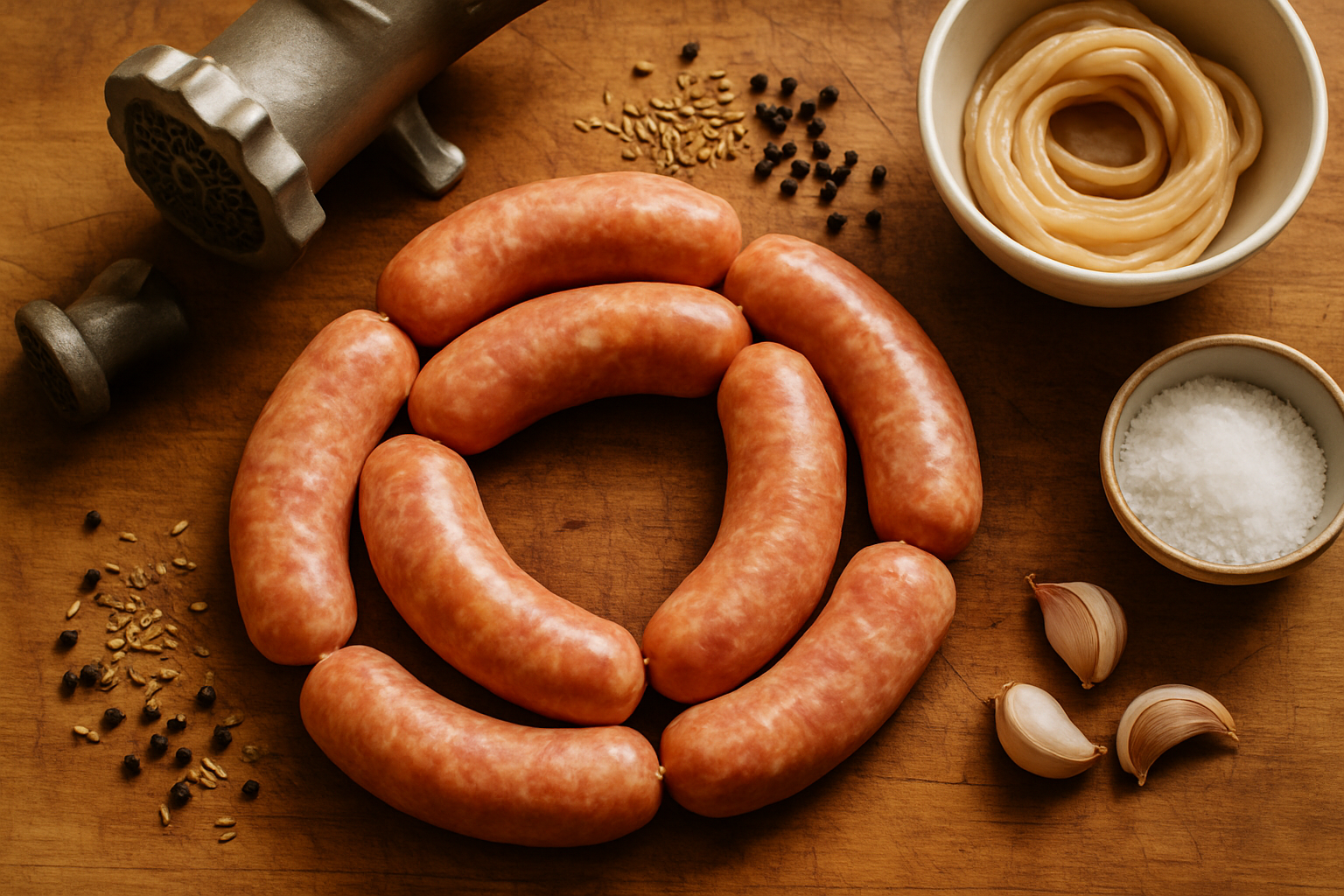
Making sausage at home is one of the most rewarding skills a butcher or home cook can develop. You control every ingredient — the cut of meat, the fat ratio, the seasonings, the casing. No fillers, no preservatives you cannot pronounce, no mystery meat. Just clean protein transformed into something greater than the sum of its parts.
The process is straightforward once you understand the fundamentals: grind cold meat with the right fat ratio, season it properly, stuff it into casings, and link it. Every step has a reason behind it, and skipping any one of them shows up in the final product. This guide walks through the entire process the way a professional butcher approaches it — methodically, with attention to temperature, texture, and technique.
Essential Equipment for Home Sausage Making
You do not need a commercial setup, but you do need a few specific tools. Trying to make sausage without a grinder and stuffer is like trying to trim a brisket with a butter knife — technically possible, frustratingly inefficient.
The Meat Grinder
A dedicated meat grinder is non-negotiable. The grinding attachment for a KitchenAid stand mixer works for small batches under five pounds, but it struggles with larger quantities and heats the meat too much during extended grinding sessions. For serious sausage making, invest in a dedicated electric grinder.
- Budget ($80-150): LEM #8 or STX Turboforce. Handles 5-10 pound batches reliably. The #8 designation refers to the plate size — adequate for home use.
- Mid-range ($200-400): LEM #12 Big Bite. Faster throughput, better motor, handles 20+ pound batches without overheating. This is the sweet spot for most home sausage makers.
- Premium ($400+): LEM #22 or commercial Hobart. Overkill for home use unless you are processing whole animals regularly.
Elena's note: Whatever grinder you choose, buy extra plates. You want a coarse plate (3/8 inch holes) and a fine plate (3/16 inch holes) at minimum. Different sausage styles require different grinds.
The Sausage Stuffer
Do not try to stuff sausage through your grinder's stuffing attachment. The auger mechanism shears the meat a second time, destroys the texture you worked to create, and heats everything up. A dedicated stuffer uses a piston to push meat through gently and evenly.
- Vertical stuffers ($100-250): The standard choice. A 5-pound capacity vertical stuffer handles most home batches. LEM and Hakka both make reliable models.
- Horizontal stuffers ($150-300): Easier to crank with one hand while guiding the casing with the other. Slightly more ergonomic for solo work.
Other Essentials
- Large mixing tub or bowl: Stainless steel, at least 10-quart capacity. You need room to mix meat and seasoning without it spilling everywhere.
- Digital scale: Seasoning by weight, not volume. A tablespoon of fine salt weighs twice as much as a tablespoon of kosher salt. Weigh everything.
- Meat thermometer: Monitor internal meat temperature during grinding. If it climbs above 40°F, stop and re-chill.
- Sheet pans: For freezing cubed meat before grinding and for laying out finished links.
- Butcher twine: For tying off links if you prefer tied sausage over twisted links.
Selecting and Preparing the Meat
Sausage quality starts with meat selection. The two critical factors are flavor and fat content. Get either one wrong and no amount of seasoning will fix it.
The Best Cuts for Sausage
Pork shoulder (Boston butt): The gold standard for sausage making. Pork shoulder naturally contains roughly 20-30% fat, has excellent flavor, and grinds cleanly. If you are making your first sausage, start here. Buy a bone-in shoulder, debone it yourself (or ask your butcher), and use everything — lean meat, fat, and the small tender muscles tucked along the blade bone.
Pork belly trimmings: Pure fat source for adjusting your lean-to-fat ratio. When shoulder alone is not fatty enough (some are trimmed lean by the packer), belly trimmings bring the ratio back to where it needs to be.
Beef chuck: For beef sausage or beef-pork blends. Chuck has good flavor and adequate fat, though you will usually need to add pork fat or beef suet to reach the right ratio.
Chicken or turkey thighs: For poultry sausage. Always use thigh meat, never breast. Breast meat is too lean and produces dry, crumbly sausage. Thigh meat has enough fat and connective tissue to create a proper bind.
The Fat Ratio Rule
Target 25-30% fat by weight in your sausage mixture. This is not optional — it is physics. Fat lubricates the grind, carries flavor, and creates the juicy texture that makes sausage satisfying. Lean sausage (below 20% fat) is dry, crumbly, and tastes like seasoned sawdust.
To calculate: weigh your lean meat and your fat separately. For a 10-pound batch, you want roughly 7 pounds lean meat and 3 pounds fat. If your pork shoulder is already well-marbled, you may only need to add a pound of extra back fat.
Preparing the Meat for Grinding
- Cut into 1-inch cubes: Uniform pieces feed through the grinder consistently. Irregular chunks jam the auger and create uneven heat.
- Remove sinew and silverskin: These will not grind — they wrap around the blade and clog the plate. Trim them out now.
- Spread cubes on sheet pans in a single layer.
- Freeze for 30-45 minutes until the surface is firm and slightly crunchy but not frozen solid. You want the internal temperature around 28-32°F.
- Chill the grinder parts too: Put the blade, plates, and auger in the freezer alongside the meat. Cold metal keeps the fat from smearing during grinding.
Why temperature matters this much: When fat warms above 40°F during grinding, it smears instead of cutting cleanly. Smeared fat coats the lean meat in a greasy film, prevents proper protein binding, and produces sausage with a mushy, grainy texture and fat that pools and separates during cooking. Keep everything cold. This is the single most important variable in sausage making.
Grinding: The Foundation of Texture
Grinding is not just about making meat smaller. It is about creating the right particle size and extracting myosin — the sticky protein that binds everything together when you mix and cook the sausage.
Single Grind vs. Double Grind
Single grind (coarse plate, 3/8 inch): Produces a rustic, chunky texture. Use for Italian sausage, bratwurst, and breakfast sausage where you want visible meat structure. The fat and lean remain as distinct particles.
Double grind (coarse first, then fine plate, 3/16 inch): Produces a smoother, more emulsified texture. Use for hot dogs, bologna-style sausage, and any sausage where you want a uniform, snappy bite. The second grind breaks fat particles smaller and extracts more myosin.
For most home sausage — Italian, bratwurst, breakfast links — a single grind through the coarse plate is what you want. Save the double grind for specialty sausages once you have the basics down.
Grinding Technique
- Set up the grinder with the coarse plate and a chilled bowl underneath to catch the output.
- Feed the partially frozen meat cubes steadily into the hopper. Do not force them — let the auger pull them in.
- Alternate lean and fat pieces. This distributes the fat evenly through the grind.
- If the grinder slows down or the meat starts coming out as a paste rather than distinct strands, stop. The blade is dull, the plate is clogged, or the meat has warmed up. Disassemble, clean, re-chill, and resume.
- The output should look like distinct strands of meat and fat falling cleanly from the plate. If it looks smeared or mushy, something is wrong.
Seasoning: Precision Over Guesswork
Sausage seasoning is one of the few areas in cooking where precision actually matters more than intuition. You are seasoning a raw mixture that you cannot taste-test the way you would a soup. Get the ratios right from the start.
The Universal Seasoning Formula
The baseline for almost every sausage style is 1.5-2% salt by total weight. For a 10-pound batch, that is 2.4 to 3.2 ounces of salt (68-90 grams). This is not negotiable — below 1.5% tastes flat, above 2.5% tastes cured.
From that baseline, you build flavor profiles:
Classic Italian Sausage (per 5 lbs meat)
- 1.5 oz (42g) kosher salt
- 0.5 oz (14g) coarse black pepper
- 0.5 oz (14g) fennel seed (toasted and lightly crushed)
- 0.25 oz (7g) granulated garlic
- 0.25 oz (7g) paprika
- 1 tsp red pepper flakes (for hot Italian — omit for sweet)
- 2 tbsp ice-cold red wine
Bratwurst (per 5 lbs meat)
- 1.5 oz (42g) kosher salt
- 0.35 oz (10g) white pepper
- 0.15 oz (4g) ground nutmeg
- 0.1 oz (3g) ground ginger
- 0.1 oz (3g) ground mace
- 1 whole egg
- 0.25 cup ice-cold milk or cream
Breakfast Sausage (per 5 lbs meat)
- 1.5 oz (42g) kosher salt
- 0.5 oz (14g) rubbed sage
- 0.35 oz (10g) black pepper
- 0.25 oz (7g) brown sugar
- 0.15 oz (4g) dried thyme
- 0.15 oz (4g) ground nutmeg
- Pinch of cayenne
- 2 tbsp ice-cold maple syrup (optional, for maple breakfast sausage)
Mixing the Seasoning In
Sprinkle seasoning evenly over the ground meat in your mixing tub. Add any liquid ingredients (wine, milk, water). Then mix with your hands — not a spoon, not a paddle, your hands — using a folding and kneading motion. You are not stirring. You are developing the bind.
Mix for 2-3 minutes until the mixture becomes sticky and cohesive. When you pick up a handful, it should hold together and feel tacky. If it is still crumbly and loose, keep mixing. The stickiness comes from myosin extraction — the salt draws out this protein, which acts as a natural glue that holds the sausage together during cooking.
The fry test: Before stuffing the entire batch, pinch off a small patty and cook it in a skillet. Taste for seasoning. Adjust salt, pepper, or spices on the remaining mixture. This five-minute test prevents the heartbreak of stuffing 10 pounds of under-seasoned sausage.
Casings: Natural vs. Collagen
Natural Hog Casings
The traditional choice and still the best for most sausage. Natural hog casings are the cleaned and salted small intestines of pigs. They come packed in salt and need to be soaked and rinsed before use.
Preparation:
- Pull out what you need (about 15 feet of casing per 5 pounds of meat).
- Rinse under cold running water for 2-3 minutes to remove surface salt.
- Soak in lukewarm water (not hot) for 30 minutes to soften.
- Open one end of the casing and run water through the entire length. This flushes the inside and makes them easier to slide onto the stuffing tube.
- Keep them in the water until ready to use. They dry out fast.
Natural casings produce a satisfying snap when you bite through them. They are permeable, which allows smoke to penetrate when smoking sausage. And they shrink with the meat during cooking, maintaining a tight fit.
Collagen Casings
Made from processed beef or pork collagen. They are uniform in diameter, do not require soaking, and are easier for beginners. The trade-off: they lack the snap of natural casings and can sometimes feel slightly rubbery. Good for fresh sausage that will be removed from the casing before cooking (like breakfast patties made from links) but inferior for anything where casing texture matters.
Stuffing: Patience Over Speed
Loading the stuffer and filling casings is where most beginners rush — and where most sausage problems originate. Air pockets, burst casings, and uneven filling all come from impatience at this stage.
Loading the Stuffer
- Pack the meat firmly into the stuffer cylinder, pressing out air pockets as you go. Push each handful down before adding the next. Trapped air inside the cylinder becomes trapped air inside your sausage.
- Slide the entire length of soaked casing onto the stuffing tube. Bunch it up like a sleeve being pushed up your arm. Leave about 3 inches hanging off the end — do not tie it yet.
Filling the Casing
- Start cranking the stuffer slowly. When meat reaches the end of the tube and starts to enter the casing, let the first inch or two push out any air, then tie off the end with a simple overhand knot.
- Continue cranking at a steady, moderate pace. Use your other hand to guide the casing off the tube, applying gentle back-pressure with your thumb and fingers. This back-pressure controls how tightly the sausage fills.
- Fill to about 80-85% capacity. This is critical. Overstuffed sausage bursts when you twist it into links. The casing should feel firm but still have some give when you squeeze it.
- If you see an air pocket, stop. Prick it with a sausage pricker or a clean pin. The small hole lets the air escape without affecting the casing integrity.
- When you run out of casing, stop the stuffer, pull the remaining casing off, and leave about 6 inches of empty casing at the end for tying off and linking.
Linking: The Twist Technique
You now have one long coil of filled sausage. Time to turn it into individual links.
Standard Twist Link Method
- Starting from the tied end, measure your desired link length (5-6 inches for standard links, 3-4 inches for breakfast links).
- Pinch the casing at that point and twist the link away from you 5-7 full rotations.
- Measure the next link, pinch, and twist toward you this time. Alternating twist direction prevents the previous link from unraveling.
- Continue alternating direction down the entire length.
- Tie off the open end with a knot.
The links will look slightly loose right after twisting. That is normal. As the casings dry slightly in the refrigerator, they tighten up and the links firm into their shape.
Resting the Sausage
Lay the linked sausage on a sheet pan lined with parchment paper. Place uncovered in the refrigerator for at least 4 hours, preferably overnight. This rest period does three things:
- The casing dries and tightens, setting the link shape
- The seasoning distributes more evenly through the meat
- The myosin bind strengthens, giving the sausage a firmer texture
Cooking Your Homemade Sausage
Fresh homemade sausage should reach an internal temperature of 160°F for pork and 165°F for poultry. How you get there matters for texture and casing integrity.
Pan Method (Best for Breakfast Links)
- Place links in a cold skillet with 1/4 inch of water.
- Cover and cook over medium heat until the water evaporates (about 5 minutes).
- Remove the lid and continue cooking, turning occasionally, until browned on all sides and internal temperature reaches 160°F.
- The water-first method gently cooks the casing so it does not burst from sudden high heat.
Grill Method (Best for Italian and Bratwurst)
- Set up two-zone heat: hot side for searing, cooler side for gentle cooking.
- Start on the cooler side, cooking with the lid down for 15-20 minutes, turning every 5 minutes.
- Finish on the hot side for 2-3 minutes per side to develop char marks.
- Never pierce the casing with a fork to check doneness. Use a thermometer. Piercing releases all the juice you worked to keep inside.
Oven Method (Best for Large Batches)
- Arrange links on a sheet pan with a wire rack.
- Bake at 375°F for 25-30 minutes, turning once halfway through.
- Finish under the broiler for 2-3 minutes if you want a browned exterior.
Storage and Shelf Life
Fresh sausage without curing salt (sodium nitrite) is perishable. Treat it like any fresh ground meat:
- Refrigerator: 2-3 days maximum
- Freezer: Up to 3 months for best quality, safe indefinitely if kept at 0°F
- For freezing: Separate links by cutting the twisted connections. Vacuum seal or wrap tightly in freezer paper, then place in a zip-top bag with the air pressed out. Label with the sausage type, date, and weight.
Common Mistakes and How to Fix Them
Dry, Crumbly Sausage
Cause: Not enough fat, or the meat was too warm during grinding (fat smeared instead of staying in distinct particles). Fix: Increase fat to 30%. Ensure meat is partially frozen before grinding.
Grainy, Mealy Texture
Cause: Under-mixed. The myosin was not extracted enough to bind the meat. Fix: Mix longer — the mixture should feel sticky and tacky, not loose and crumbly.
Air Pockets in the Links
Cause: Air trapped during stuffing. Fix: Pack the stuffer cylinder more carefully, pressing out air with each addition. Prick any visible air bubbles in the casing immediately.
Casings Bursting During Stuffing
Cause: Overfilling, dry casings, or a weak spot in the casing. Fix: Fill to 80-85% capacity only. Keep casings soaking until the moment you use them. Inspect casings while rinsing and discard any sections with holes or thin spots.
Bland Flavor
Cause: Under-seasoned. Raw meat absorbs more salt during cooking than you expect. Fix: Always do the fry test before stuffing. Season at the upper end of the 1.5-2% salt range until you calibrate your own preference.
Frequently Asked Questions
What is the best meat for making sausage at home?
Pork shoulder (Boston butt) is the best starting point for home sausage making. It naturally contains 20-30% fat, has excellent flavor, and grinds cleanly. For beef sausage, use chuck. For poultry sausage, use thigh meat — never breast, which is too lean.
What fat percentage should sausage have?
Target 25-30% fat by total weight. This ratio produces juicy, flavorful sausage with proper texture. Below 20% fat produces dry, crumbly sausage. Weigh your lean meat and fat separately to ensure accuracy.
Do I need a sausage stuffer or can I use my grinder?
A dedicated sausage stuffer produces significantly better results than a grinder stuffing attachment. Grinder attachments shear the meat a second time, destroying the texture you created during grinding and heating the mixture. A piston stuffer pushes meat gently and evenly.
How long does homemade sausage last in the fridge?
Fresh homemade sausage without curing salt lasts 2-3 days in the refrigerator. For longer storage, freeze it — properly wrapped sausage maintains quality for up to 3 months in the freezer.
Why is my homemade sausage dry and crumbly?
The two most common causes are not enough fat in the mixture (below 20%) or meat that was too warm during grinding. Warm fat smears instead of cutting cleanly, which prevents proper binding. Keep meat partially frozen during grinding and target 25-30% fat content.
More Expert Guides
How to Trim a Brisket: The Complete Butcher's Guide
Proper brisket trimming is the difference between a backyard experiment and competition-quality results. Here is the professional technique for shaping a whole packer brisket before it ever touches the smoker.
14 min readHow to Butcher a Whole Chicken: Step-by-Step Guide
Breaking down a whole chicken yourself saves 40-50% compared to buying individual parts. Here is the professional technique for turning one bird into perfectly portioned pieces.
14 min readHome Butchering Safety Guide: Essential Protocols for Safe Meat Processing
Learn professional butchering safety protocols from a master butcher with 25+ years of experience. Essential guidance for anyone processing meat at home.