How to Portion Steaks: The Professional Butcher's Guide
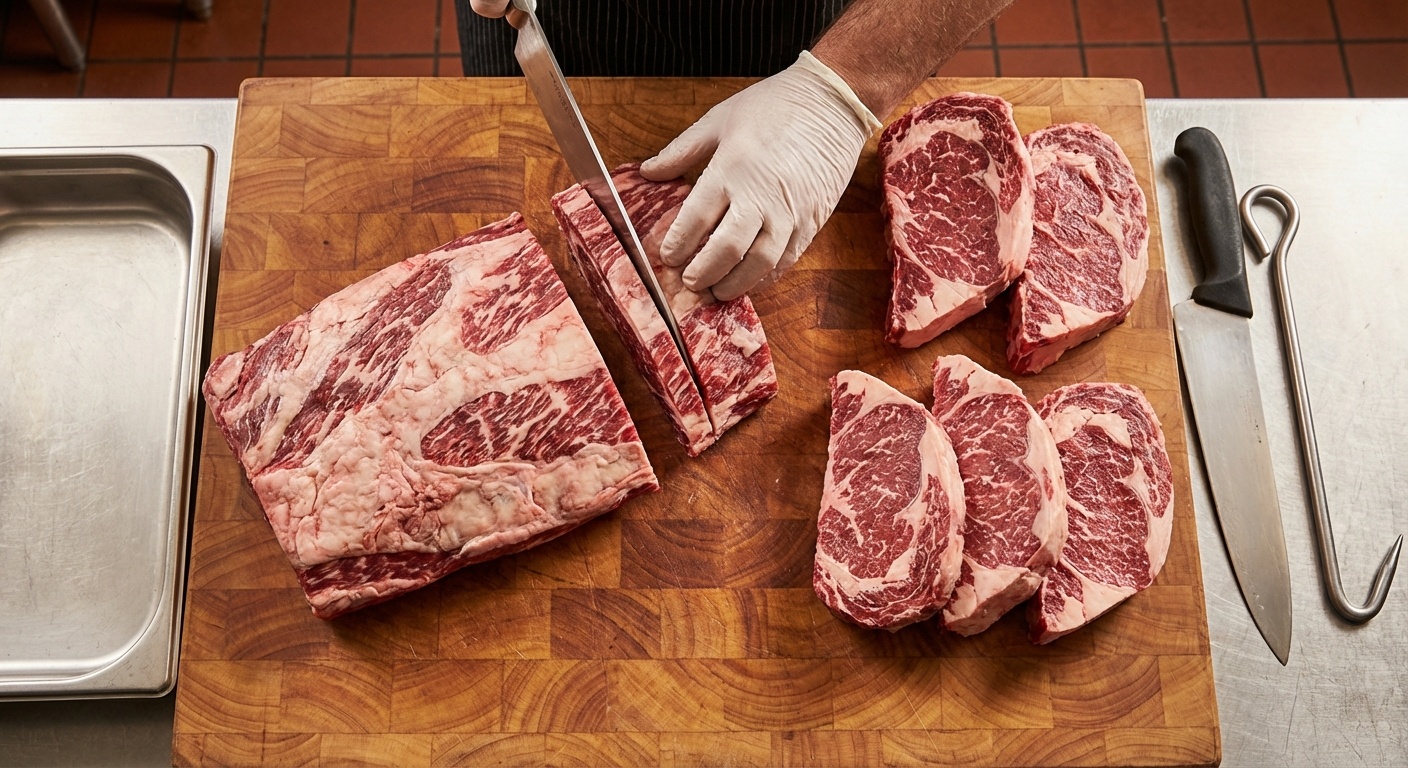
Every steak starts as part of something bigger. A whole ribeye roll, a strip loin, a tenderloin — these subprimals arrive at the butcher block as long, irregular muscles that need to be transformed into uniform portions that cook consistently and look professional on the plate. The difference between a butcher shop that earns repeat customers and one that does not often comes down to this single skill: the ability to portion steaks with precision.
Portioning is not just cutting meat into pieces. It requires understanding muscle structure, managing taper and thickness variation, hitting target weights, and maintaining clean presentation faces. A properly portioned steak cooks evenly from edge to edge, hits the customer's expected weight within half an ounce, and looks identical to every other steak in the case.
Understanding Subprimal Geometry
Before you make the first cut on any subprimal, you need to understand its shape. Every muscle tapers, curves, or changes composition along its length. Ignoring this geometry is the single biggest reason home butchers and inexperienced professionals produce inconsistent steaks.
A whole bone-in ribeye, for example, changes dramatically from the chuck end to the loin end. The chuck end has a larger spinalis (cap) muscle, more fat seams, and a bigger overall cross-section. The loin end is leaner, smaller in diameter, and has a more pronounced eye. If you cut every steak to the same thickness, you will get wildly different weights — and wildly different eating experiences — from one end to the other.
The strip loin presents a different challenge. It tapers significantly from the sirloin end (thick, wide) to the short loin end (narrower but taller). The fat cap thickness also varies, which affects both yield and presentation.
A tenderloin is the most extreme example of taper. The butt end can be three to four inches in diameter while the tail end narrows to barely an inch. Portioning a tenderloin into uniform steaks requires a completely different approach than working with a strip or ribeye.
Before cutting, lay the subprimal on the board and study it. Feel the muscle density along its length. Note where fat seams run. Identify the thickest and thinnest points. This assessment takes 30 seconds and saves you from producing reject cuts that cost money.
Essential Tools for Steak Portioning
Precision portioning requires the right equipment. You cannot produce consistent steaks with dull knives, no scale, or the wrong cutting surface.
- Breaking knife (10-inch, curved): For initial subprimal breakdown and removing large fat deposits. The curve lets you follow natural seams efficiently.
- Steak knife or scimitar (12-14 inch): The primary portioning tool. A long, slightly curved blade lets you make single, clean passes through the meat. Short knives require sawing, which tears muscle fibers and creates ragged faces.
- Boning knife (6-inch, stiff or semi-flex): For detail work around bones, removing silverskin, and trimming fat pockets between muscles.
- Digital portion scale: Accurate to 0.1 ounce. Weigh every single steak. Guessing by eye is not portioning — it is gambling.
- Steel or ceramic honing rod: Touch up your edge every 10-15 cuts. A knife that drags through meat instead of gliding produces torn faces and inconsistent portions.
- Large cutting board (24 x 18 minimum): You need room to lay out the full subprimal and arrange finished portions. Cramped boards lead to sloppy cuts.
One tool deserves special emphasis: the scale. Professional butchers weigh every steak, no exceptions. A 16-ounce ribeye that actually weighs 14 ounces means the customer got cheated. An 18-ounce steak priced at 16 ounces means you gave away margin. Neither outcome is acceptable.
Setting Up Your Cutting Specs
Before you start cutting, you need to establish your specifications. In professional butchery, cutting specs define three things for every portion: target weight, acceptable variance, and thickness range.
A typical cutting spec for bone-in ribeye steaks might read: 18 oz target, plus or minus 1 oz, cut 1.25 inches thick. This means every steak should weigh between 17 and 19 ounces, and the thickness at the thickest point should be approximately 1.25 inches.
Common steak portioning specs by cut:
- Bone-in ribeye: 16-20 oz, 1.0-1.5 inches thick
- Boneless ribeye: 10-14 oz, 1.0-1.25 inches thick
- New York strip (bone-in): 14-18 oz, 1.0-1.25 inches thick
- New York strip (boneless): 10-14 oz, 1.0-1.25 inches thick
- Filet mignon: 6-8 oz, 1.5-2.0 inches thick
- T-bone: 18-24 oz, 1.0-1.25 inches thick
- Porterhouse: 24-32 oz, 1.25-1.5 inches thick
- Flat iron: 8-10 oz, 0.75-1.0 inches thick
Notice that thickness and weight work together. You cannot arbitrarily set both — the muscle's cross-section at any given point determines how thick you cut to hit your target weight. This is why understanding subprimal geometry matters. A thick ribeye from the chuck end might need to be cut thinner than one from the loin end to hit the same weight target.
Portioning a Whole Ribeye
The ribeye is the most popular subprimal for steak portioning and presents moderate difficulty due to its taper and varying fat content. Here is the professional approach.
Start by placing the whole ribeye roll (NAMP 112A for boneless, 109 for bone-in export style) on the cutting board with the fat cap facing up and the chuck end to your left (assuming right-handed). Remove any excessive external fat, leaving a cap of about a quarter inch. Do not remove the spinalis (cap) muscle — it stays attached.
Identify the two ends. The chuck end is larger, rounder, and has more visible fat seams. The loin end is smaller, leaner, and has a more defined central eye. Your first two to three steaks from the chuck end will be your largest cross-section cuts. The last two to three from the loin end will be smallest.
For boneless ribeyes targeting 12 ounces, start cutting from the loin end. Make your first cut about 1.25 inches from the end. Weigh it. If it is under target, your next cut should be slightly thicker. If over, go slightly thinner. This feedback loop is how professionals dial in their cuts — the first steak calibrates everything that follows.
As you move toward the chuck end and the cross-section grows larger, you will need to reduce thickness to maintain your target weight. A chuck-end ribeye cut at the same thickness as a loin-end ribeye might weigh 16 ounces instead of 12. Reduce thickness by a quarter inch or so as the diameter increases.
The transition zone in the middle of the subprimal is where most butchers find their sweet spot — the cross-section is ideal, the fat marbling is balanced, and hitting target weight at optimal thickness is easiest. These center-cut ribeyes are your premium product.
Portioning a Strip Loin
The strip loin (NAMP 180 bone-in, 180A boneless) requires attention to two variables: the dramatic taper from sirloin end to short loin end, and the fat cap that varies in thickness.
Position the strip loin with the fat cap up and the sirloin end to your left. The sirloin end is wider and flatter. The short loin end is narrower but taller, with a thicker fat cap.
Trim the fat cap to an even quarter-inch thickness along the entire length. This step is critical for two reasons: it creates a consistent presentation face, and it removes the variable that makes weight prediction difficult. A half-inch fat cap on one steak and a quarter-inch cap on the next means your weights will be inconsistent even at identical thicknesses.
The sirloin end often has a piece of connective tissue and the gluteus medius muscle attached. Remove these if your spec calls for center-cut strips. Some shops sell the sirloin-end strips as a lower-priced option since they include more connective tissue and can be chewier.
Cut from the short loin end first. These steaks have the classic New York strip shape — tall, compact, with a clean fat cap. As you move toward the sirloin end, the steaks become wider and flatter. Adjust thickness to compensate for the increasing cross-section.
A common professional technique is to separate the strip loin into three zones: short loin end (premium), center cut (premium), and sirloin end (value). Price and present them accordingly rather than trying to make all steaks identical.
Portioning a Tenderloin
The tenderloin (NAMP 189A, PSMO) is the most challenging subprimal to portion because of its extreme taper. The butt end can be 3.5 inches in diameter while the tail end narrows to barely an inch. No single cutting approach produces uniform steaks from end to end.
First, remove the chain muscle (the long, thin strip running along one side) and the silverskin. Peel the silverskin by inserting your boning knife under one end, angling the blade slightly upward against the membrane, and pulling the silverskin taut while sliding the knife forward. Clean silverskin removal is essential — any remaining membrane will tighten during cooking and cause the steak to cup and cook unevenly.
Divide the tenderloin into functional zones:
- Butt end (first 4-5 inches): Cut into chateaubriand portions (12-16 oz for two servings) or thick filet mignon steaks (8 oz, cut 2 inches thick).
- Center cut (next 8-10 inches): This is prime filet mignon territory. Cut steaks 1.5-2 inches thick for 6-8 ounce portions. The cross-section here is the most consistent.
- Tail end (last 4-6 inches): Too thin for standard filet mignon. Options include tournedos (fold the tail back on itself and tie with butcher twine to create a thicker portion), medallions for stir-fry or stroganoff, or tips for kebabs.
The fold-and-tie technique for tail portions deserves attention. Take the last 5-6 inches of the tail, fold the thin end back underneath so it doubles up, and tie it with two loops of butcher twine. This creates a portion that is roughly the same diameter as your center-cut filets. It cooks more evenly than a flat, thin piece and can be sold at filet mignon prices if the weight is right.
The Single-Pass Cut Technique
The hallmark of professional steak portioning is the single-pass cut. Each steak should be separated from the subprimal with one smooth, continuous knife stroke — not sawing back and forth.
Here is the technique:
- Position your knife. Place the heel of the blade (closest to the handle) at the top of the subprimal at your measured cutting point.
- Angle slightly. The blade should be perpendicular to the cutting board and perpendicular to the length of the subprimal. Even a slight angle produces a steak that is thicker on one side than the other.
- Apply steady downward pressure. Do not push the knife forward. Let the weight of the blade and gentle downward pressure do the work.
- Draw through in one motion. Pull the knife toward you while pressing down, letting the full length of the blade slide through the meat. The cut should take about one second.
- Inspect the face. A clean single-pass cut produces a smooth, slightly glossy surface. Sawing produces visible striations and a rough, torn surface that weeps more juice and looks less appealing in the case.
If your knife is sharp and your technique is correct, you should feel almost no resistance. If you are fighting the meat, your knife is dull. Stop and hone immediately. A dull knife is the enemy of consistent portioning — it forces you to saw, which makes precise thickness control impossible.
Managing End Pieces and Trim
Every subprimal produces end pieces that do not meet your standard steak spec. How you handle these pieces determines your overall yield and profitability.
End pieces from a ribeye are typically the first cut from the chuck end (often too large with excessive fat seams) and the last cut from the loin end (too small). Options for these pieces:
- Thin-cut steaks: Slice the end pieces into half-inch-thick steaks for quick-cook applications. Market them as breakfast steaks, sandwich steaks, or minute steaks at a lower price point.
- Stew meat or kebab cubes: Cut into 1.25-inch cubes. Ribeye cubes make exceptional stew meat and command a premium over chuck-based stew meat.
- Ground beef premium blend: Grind end pieces into a premium ground beef blend. Ribeye ground beef has excellent fat content and flavor.
Tenderloin tails and chain muscles should never be discarded. The chain muscle has intense beefy flavor despite its irregular shape — grind it into premium burger blend or cut it for stroganoff. Tenderloin tails make excellent kebab meat or can be sold as tips.
Track your trim percentage. A skilled butcher should achieve 85-90 percent yield on a boneless ribeye (meaning 85-90 percent of the starting weight ends up as saleable product). If your trim pile is growing faster than your steak pile, reevaluate your technique.
Quality Control and Consistency Checks
After portioning an entire subprimal, line up all the steaks in cutting order and perform a quality check:
- Visual uniformity: All steaks should look approximately the same thickness when viewed from the side. Obvious thin or thick outliers need to be reclassified or re-cut.
- Weight check: Weigh every steak. Any steak outside your acceptable variance gets downgraded to a different price tier or repurposed.
- Face quality: Inspect the cut faces. Clean, smooth surfaces indicate good knife technique. Torn or ragged faces indicate a dull knife or sawing motion.
- Fat cap consistency: If you are selling fat-on steaks, the fat cap should be uniform across all portions. Trim any steak where the fat cap is significantly thicker or thinner than the others.
- Bone cuts (bone-in): For bone-in steaks, check that the bone was cut cleanly by the bandsaw. Bone dust should be rinsed off. Splintered or uneven bone cuts make the steak look unprofessional.
Keep a cutting log. Record the subprimal weight, number of steaks produced, average steak weight, number of reject cuts, and trim weight. Over time, this data reveals patterns — you might find that certain suppliers provide subprimals with more consistent geometry, or that your yield improves as you refine technique on specific cuts.
Common Portioning Mistakes
Even experienced butchers fall into these traps. Awareness is the first step to avoidance.
- Cutting all steaks the same thickness: This ignores taper and produces wildly inconsistent weights. Adjust thickness to hit target weight, not the other way around.
- Ignoring grain direction: Steaks should be cut perpendicular to the grain so the muscle fibers are short across the width of the steak. Cutting with the grain produces tough, chewy steaks regardless of tenderness grade.
- Skipping the scale: Eyeballing steak weight is inaccurate. Professional butchers weigh every single portion. No exceptions.
- Using a dull knife: A dull blade requires pressure and sawing, which destroys the cut face, makes thickness control impossible, and fatigues your arm. Hone every 10-15 cuts.
- Rushing the first cut: The first steak from any subprimal is your calibration piece. Cut it carefully, weigh it, and use that data to set your approach for the rest of the subprimal.
- Wasting end pieces: Every ounce of trim has value. The difference between profitable and marginal butchery often comes down to end piece utilization.
Frequently Asked Questions
How thick should steaks be cut?
Standard steak thickness ranges from 1 to 1.5 inches for most cuts. Filet mignon is typically cut thicker (1.5 to 2 inches) because of its smaller diameter. The optimal thickness depends on your target weight and the cross-sectional area of the subprimal at each cutting point.
How do you keep steaks the same weight?
Adjust thickness as you move along the subprimal to compensate for changing cross-section. Use a digital scale to weigh every steak and use the first cut as calibration. As the subprimal gets wider, cut thinner. As it gets narrower, cut thicker.
What is the best knife for cutting steaks?
A 12 to 14 inch scimitar or steak knife is the professional standard. The long blade allows single-pass cuts through the full width of the meat without sawing. Keep the edge sharp with a honing rod every 10 to 15 cuts.
How many steaks do you get from a whole ribeye?
A typical boneless ribeye roll (NAMP 112A) weighing 14 to 18 pounds yields 10 to 14 steaks at 12 to 14 ounces each, plus end pieces. Bone-in ribeye yields fewer but heavier steaks. Exact count depends on your target weight and thickness specs.
What do you do with steak end pieces?
End pieces should never be wasted. Options include thin-cut breakfast steaks, stew meat cubes, kebab meat, premium ground beef blend, or sandwich steaks. A skilled butcher achieves 85 to 90 percent yield by repurposing every end piece and trim scrap.
More Expert Guides
How to Trim a Brisket: The Complete Butcher's Guide
Proper brisket trimming is the difference between a backyard experiment and competition-quality results. Here is the professional technique for shaping a whole packer brisket before it ever touches the smoker.
14 min readHow to Butcher a Whole Chicken: Step-by-Step Guide
Breaking down a whole chicken yourself saves 40-50% compared to buying individual parts. Here is the professional technique for turning one bird into perfectly portioned pieces.
14 min readHome Butchering Safety Guide: Essential Protocols for Safe Meat Processing
Learn professional butchering safety protocols from a master butcher with 25+ years of experience. Essential guidance for anyone processing meat at home.