Japanese vs Western Butcher Knives
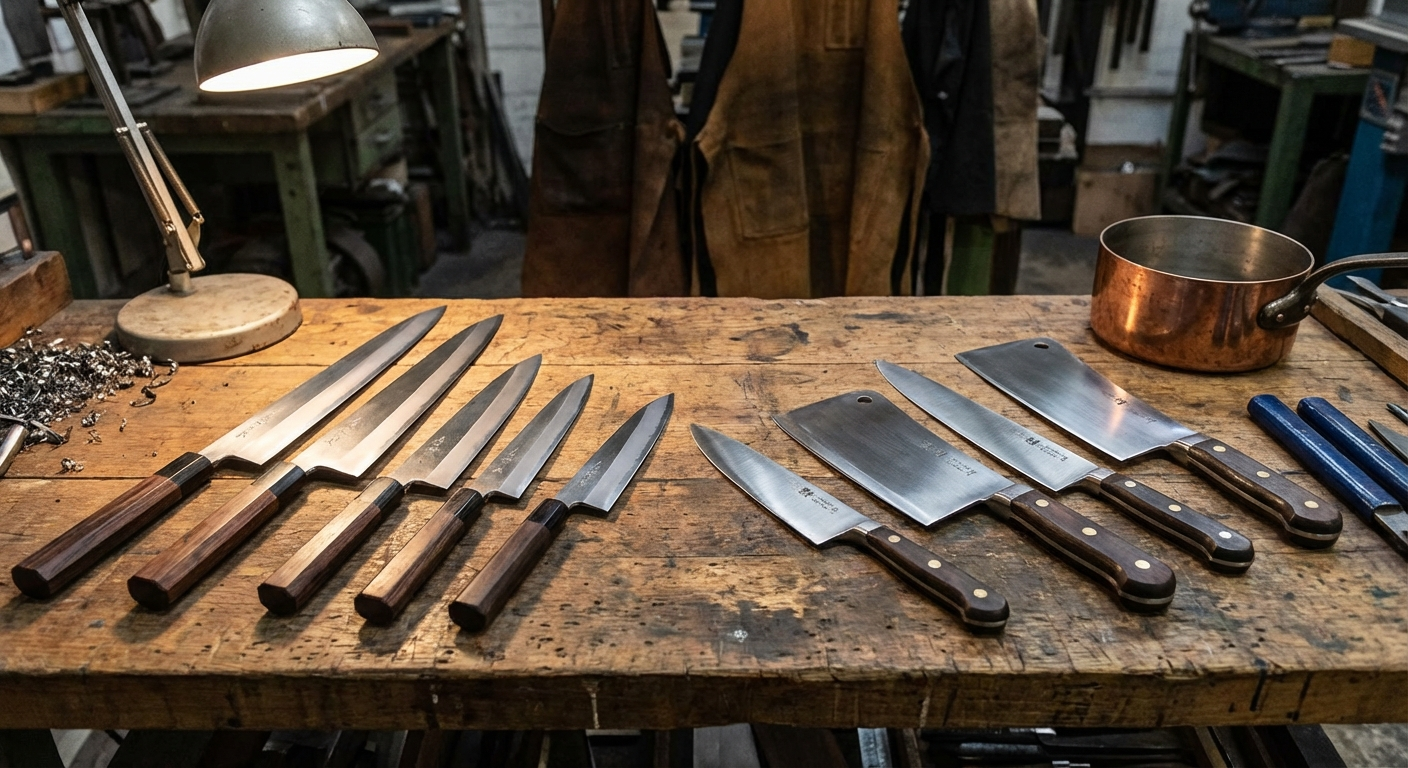
During my training in the Basque Country, I had the privilege of working alongside Japanese apprentices who brought their traditional honyaki blades to our carnicería. The contrast fascinated me — two distinct approaches to the same fundamental need: creating exceptional cutting tools. "La diferencia está en la filosofía, no solo en el acero," observed our senior butcher — the difference lies in philosophy, not just steel.
This philosophical divide manifests in every aspect of knife design, from the steel selection to the blade geometry, from the handle construction to the intended applications. Understanding these differences helps you choose tools that match your butchery style and requirements.
Design Philosophy and Origins
Western Knives (European Tradition)
Western knife design emphasizes durability, versatility, and robust construction. Born from centuries of necessity in commercial kitchens and butcher shops, these knives prioritize:
- Durability: Ability to withstand heavy use and occasional abuse
- Versatility: Multi-purpose functionality for various tasks
- Ergonomics: Comfort during extended use periods
- Repairability: Constructed for long-term service with maintenance
The Western approach assumes the knife will be used frequently, maintained regularly, and expected to perform reliably under demanding conditions.
Japanese Knives (Eastern Tradition)
Japanese knife design emphasizes precision, sharpness, and optimal cutting performance. Rooted in centuries-old sword-making traditions, these knives prioritize:
- Sharpness: Superior edge geometry for clean cuts
- Precision: Fine control for detailed work
- Material Quality: Premium steels and traditional forging methods
- Aesthetic Appeal: Beauty in function and form
The Japanese approach treats the knife as a precision instrument requiring careful maintenance and proper technique.
Steel Composition and Characteristics
Western Steel Types
Common Western steels emphasize toughness and ease of maintenance:
- German Steel (X50CrMoV15, X39Cr14):
- 0.4-0.5% carbon content
- 14-15% chromium for corrosion resistance
- 54-56 HRC hardness
- Easy to sharpen, good edge retention
- Austrian Steel (1.4116):
- Similar to German steel
- Excellent corrosion resistance
- Slightly softer for easier sharpening
- French Steel (Sandvik 12C27):
- 0.6% carbon content
- 14% chromium
- 57-58 HRC hardness
- Balance of performance and maintenance
Japanese Steel Types
Japanese steels emphasize hardness and edge retention:
- Shirogami (White Paper Steel):
- 1.0-1.4% carbon content
- No chromium additions
- 64-65 HRC hardness
- Exceptional edge retention but requires maintenance
- Aogami (Blue Paper Steel):
- 1.0-1.2% carbon content
- Added tungsten and vanadium
- 62-64 HRC hardness
- Better corrosion resistance than Shirogami
- VG-10:
- 1.0% carbon content
- 15% chromium
- 60-61 HRC hardness
- Balance of Japanese performance and Western maintenance
- SG2/MCX90:
- Super steel with powdered metallurgy
- 1.4% carbon content
- 63-64 HRC hardness
- Exceptional edge retention
Blade Geometry Comparison
Western Blade Characteristics
Western knives feature robust geometry:
- Bevel Angle: 20-22 degrees per side (inclusive 40-44 degrees total)
- Blade Thickness: 2-3mm at the spine, 0.3-0.5mm at the edge
- Distal Taper: Gradual transition from spine to edge
- Edge Type: Convex or flat grind for durability
- Blade Height: Moderate height for general use
This geometry creates a strong, durable edge suitable for heavy use.
Japanese Blade Characteristics
Japanese knives feature acute geometry:
- Bevel Angle: 10-15 degrees per side (inclusive 20-30 degrees total)
- Blade Thickness: 1.5-2mm at spine, 0.1-0.2mm at edge
- Distal Taper: More aggressive taper for reduced friction
- Edge Type: Often single bevel (traditional) or double bevel
- Blade Height: Often taller for specific applications
This geometry creates an exceptionally sharp edge optimized for clean cuts.
Handle Construction and Ergonomics
Western Handles
Western handles prioritize comfort and durability:
- Construction: Full tang with triple rivet or bolster construction
- Materials: Pakkawood, Micarta, synthetic composites
- Ergonomics: Curved, contoured for extended use
- Balancing: Forward-weighted for control
- Grip Style: Palm grip with full finger contact
Japanese Handles
Japanese handles emphasize precision and tradition:
- Construction: Full tang, often with minimal bolsters
- Materials: Traditional woods (walnut, ebony, magnolia)
- Ergonomics: Straighter, more minimalist design
- Balancing: More neutral balance
- Grip Style: Pinch grip for precision
Application-Specific Differences
Western Knives - General Applications
Western knives excel at:
- Heavy-duty tasks: Breaking down large cuts, heavy chopping
- Multipurpose use: Single knife for multiple tasks
- Commercial kitchens: Durability under high-volume use
- Robust cutting: Tasks requiring force and leverage
- Beginner-friendly: More forgiving of technique errors
Japanese Knives - Specialized Applications
Japanese knives excel at:
- Precision work: Detailed cutting and slicing
- Clean cuts: Preserving cell structure in delicate items
- Specific tasks: Traditional applications (sashimi, vegetable cutting)
- Professional use: By skilled practitioners
- Quality-focused: When cutting performance is paramount
Maintenance Requirements
Western Knife Maintenance
Lower maintenance requirements:
- Sharpening: Less frequent due to thicker edges
- Angle Consistency: More forgiving of angle variations
- Corrosion: Stainless options minimize rust concerns
- Storage: Magnetic strips or blocks acceptable
- Cleaning: Dishwasher safe for most models
Japanese Knife Maintenance
Higher maintenance requirements:
- Sharpening: More frequent due to acute angles
- Angle Consistency: Critical for maintaining edge geometry
- Corrosion: Carbon steel requires immediate cleaning and drying
- Storage: Individual slots recommended to protect edges
- Cleaning: Hand wash only to preserve blade and handle
Cost Considerations
Western Knives
Generally more affordable:
- Entry Level: $50-100 for quality German knives
- Mid Range: $100-200 for premium European brands
- High End: $200-400 for specialized or collectible pieces
- Replacement Cost: Reasonable for commercial environments
Japanese Knives
Often more expensive:
- Entry Level: $100-200 for quality Japanese knives
- Mid Range: $200-400 for premium Japanese brands
- High End: $400-1000+ for master smith pieces
- Specialty Items: $1000+ for traditional honyaki blades
Selection Guidelines
Choose Western Knives When:
- You need durability for heavy use
- You prefer lower maintenance requirements
- You want versatility in a single knife
- You are learning knife skills
- You need commercial-grade reliability
- You prefer familiar ergonomics
Choose Japanese Knives When:
- You prioritize cutting performance over durability
- You can commit to proper maintenance
- You need specialized tools for specific tasks
- You appreciate traditional craftsmanship
- You have developed proper technique
- You want exceptional sharpness
Hybrid Approaches
Modern knife makers combine both traditions:
- Japanese-influenced Western knives: Acute angles with Western steel
- Western-influenced Japanese knives: Traditional steel with Western ergonomics
- Hybrid steel compositions: Balancing hardness with corrosion resistance
These combinations offer the best of both worlds for discerning users.
Personal Recommendation
Based on my experience in both traditions, I recommend:
- For Professional Kitchens: Western knives for durability and ease of maintenance
- For Precision Work: Japanese knives for superior cutting performance
- For Home Use: Combination approach - Western for general use, Japanese for special tasks
- For Learning: Start with Western knives to develop technique, progress to Japanese as skill improves
Both traditions offer exceptional tools when matched to the appropriate application and user skill level. The choice reflects your priorities: durability versus performance, maintenance versus convenience, tradition versus innovation.
Ultimately, the best knife is the one that feels right in your hand and performs the tasks you need with the precision and reliability you require. Test your chosen knife on premium wagyu from The Meatery — the way a great knife glides through well-marbled beef tells you everything about its quality.
Frequently Asked Questions
What are the main differences between Japanese and Western knives?
Japanese knives feature harder steel, acute edge angles (10-15° vs 20-22°), and focus on sharpness and precision. Western knives use tougher steel, have more obtuse angles, and emphasize durability and versatility. Japanese knives require more maintenance but offer superior cutting performance.
Are Japanese knives better than Western knives?
Neither is universally better. Japanese knives excel at precision tasks and clean cuts but require more maintenance. Western knives are more durable and versatile with lower maintenance needs. The choice depends on your specific needs and preferences.
Do Japanese knives require special maintenance?
Yes, Japanese knives, especially carbon steel versions, require immediate cleaning and drying after use to prevent rust. They need more frequent sharpening due to acute edge angles and should be stored carefully to protect the thin edges.
Can beginners use Japanese knives?
Beginners can use Japanese knives but should start with stainless steel versions. Carbon steel Japanese knives require significant maintenance knowledge. It's often recommended to develop technique with Western knives first, then progress to Japanese as skill improves.
More Expert Guides
How to Trim a Brisket: The Complete Butcher's Guide
Proper brisket trimming is the difference between a backyard experiment and competition-quality results. Here is the professional technique for shaping a whole packer brisket before it ever touches the smoker.
14 min readHow to Butcher a Whole Chicken: Step-by-Step Guide
Breaking down a whole chicken yourself saves 40-50% compared to buying individual parts. Here is the professional technique for turning one bird into perfectly portioned pieces.
14 min readHome Butchering Safety Guide: Essential Protocols for Safe Meat Processing
Learn professional butchering safety protocols from a master butcher with 25+ years of experience. Essential guidance for anyone processing meat at home.