Primal Cuts of Beef: A Butcher's Complete Guide to Every Section
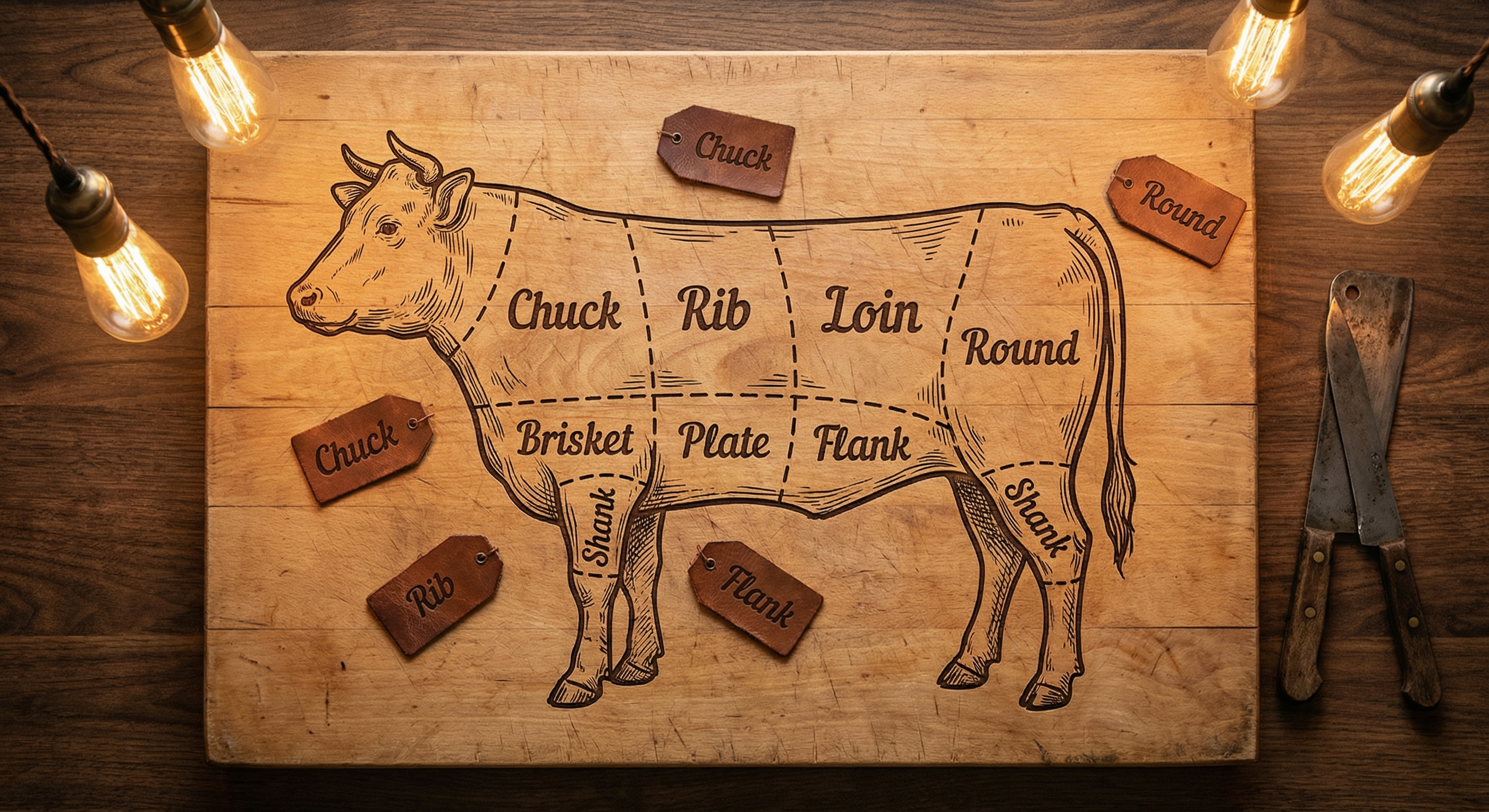
Primal Cuts of Beef: A Butcher's Complete Guide
Every steak, roast, and ground beef package in a butcher case started as one of eight primal cuts. Understanding these primals is not just academic knowledge — it is the foundation that determines how you break down a carcass, price your cuts, and advise customers on cooking methods.
Whether you are a home butcher processing your first side of beef or a professional refreshing your fundamentals, this guide covers each primal in detail: where it sits on the animal, what subprimals it yields, and how to get the most value from every section.
What Are Primal Cuts?
When a beef carcass is split down the spine into two sides, each side is then divided into large sections called primal cuts (also called "primals"). The USDA recognizes eight primal cuts of beef. These are not the steaks and roasts you see in the display case — those are retail cuts, obtained by further breaking down primals into smaller subprimals and then into individual portions.
The hierarchy works like this:
- Primal cut — the initial large section (e.g., the rib)
- Subprimal cut — a smaller portion from the primal (e.g., the ribeye roll)
- Retail cut — the final consumer portion (e.g., a boneless ribeye steak)
Knowing this hierarchy helps you understand pricing, yield, and cooking. Muscles that do less work are more tender and more expensive. Muscles that work hard develop more connective tissue and need slow, moist cooking to become tender.
1. Chuck
The chuck is the front shoulder section, spanning from the neck to the fifth rib. It accounts for roughly 26% of the carcass weight, making it the largest primal. Because the shoulder works constantly during the animal's life, chuck meat is rich in connective tissue and collagen — qualities that make it ideal for braising and grinding but challenging for quick-cooking methods.
Key Subprimals
- Chuck Roll
- The continuation of the ribeye muscle into the shoulder. It contains good marbling and, when cleaned properly, yields the chuck eye steak — sometimes called the "poor man's ribeye." Best seared or grilled when cut from the rib end.
- Shoulder Clod
- A large, lean muscle group from the outer shoulder. Commonly broken into the flat iron steak (infraspinatus muscle), ranch steak, and petite tender. The flat iron has become one of the most popular value cuts in recent years because of its excellent marbling despite being from a working muscle.
- Chuck Short Ribs
- Cut from ribs two through five, these are the meaty, well-marbled short ribs prized for braising. They contain layers of fat and connective tissue that melt into richness during long cooking.
- Neck
- Extremely tough with heavy connective tissue. Best used for ground beef, stew meat, or bone broth. Despite its toughness, the neck has excellent flavor from its high collagen content.
Best Cooking Methods
Braising, slow roasting, stewing, and grinding. The chuck eye steak and flat iron are exceptions that can handle dry-heat methods like grilling when cut thin and cooked to medium or less.
2. Rib
The rib primal covers ribs six through twelve, sitting directly behind the chuck along the upper back. It represents about 9% of the carcass weight but punches far above its weight in value. The rib contains some of the most well-marbled, tender meat on the animal because these muscles bear weight but do not move much.
Key Subprimals
- Ribeye Roll (Lip-On)
- The primary muscle of the rib section — the longissimus dorsi with the spinalis cap attached. This yields boneless ribeye steaks and, when the cap is separated, the prized ribeye cap (spinalis). Exceptional marbling and beefy flavor.
- Prime Rib (Bone-In Rib Roast)
- The whole rib section left on the bone, typically ribs six through twelve (a full seven-bone roast) or cut into smaller sections. The bones insulate the meat during roasting and add presentation value.
- Back Ribs
- The curved rib bones removed when fabricating boneless ribeye steaks. Less meaty than short ribs but excellent for grilling and smoking. These are what most people think of as "beef ribs" at a barbecue restaurant.
- Rib Cap (Spinalis Dorsi)
- A crescent-shaped muscle that wraps around the outside of the ribeye. Many butchers and chefs consider it the single best-tasting cut on the entire animal — intensely marbled, buttery, and rich. It can be separated and sold as a premium item or left attached for traditional ribeye steaks.
Best Cooking Methods
Dry-heat methods dominate: grilling, pan-searing, roasting. The rib's abundant intramuscular fat bastes the meat from within, keeping it moist and flavorful even at higher temperatures. Reverse-searing thick-cut ribeyes is particularly effective.
3. Short Loin
The short loin sits behind the rib, spanning from the thirteenth rib to the hip bone. At roughly 8% of carcass weight, it is a compact section that yields the most iconic steaks in the butcher case. Two major muscles run through this primal: the longissimus dorsi (strip) on one side of the T-shaped vertebra and the psoas major (tenderloin) on the other.
Key Subprimals
- Strip Loin (New York Strip)
- The longissimus dorsi muscle, removed from the bone. Yields New York strip steaks — firm-textured, well-marbled, with a satisfying beefy flavor and a strip of fat along one edge. A butcher shop staple.
- Tenderloin (Psoas Major)
- The most tender muscle on the animal because it does virtually no work. Runs along the underside of the spine, partially in the short loin and partially in the sirloin. Yields filet mignon, chateaubriand, and tournedos. Lean but exceptionally tender.
- T-Bone and Porterhouse Steaks
- Cross-sections through the short loin that include both the strip and tenderloin separated by a T-shaped bone. The difference between a T-bone and porterhouse is the size of the tenderloin section — a porterhouse must have a tenderloin portion at least 1.25 inches wide at its widest point, per USDA standards.
Best Cooking Methods
High-heat dry methods: grilling, broiling, pan-searing. These tender cuts should not be cooked past medium to preserve their texture. The tenderloin's leanness means it benefits from butter basting or wrapping in fat (as in beef Wellington).
4. Sirloin
The sirloin is the hip section, sitting behind the short loin and above the round. At about 9% of carcass weight, it is a transitional zone — less tender than the loin cuts ahead of it but more flavorful than the round behind it. The sirloin offers excellent value because it delivers good flavor and reasonable tenderness at a lower price point than loin or rib cuts.
Key Subprimals
- Top Sirloin Butt
- The most versatile subprimal from the sirloin. Yields top sirloin steaks (sometimes called sirloin cap or coulotte when the cap is separated), center-cut sirloin steaks, and baseball-cut sirloin. The cap — the picanha in Brazilian butchery — is increasingly popular for its fat cap and robust flavor.
- Bottom Sirloin
- Yields the tri-tip (triangular muscle popular in Central California barbecue), the ball tip, and the flap meat (bavette). These cuts have more texture than top sirloin but excellent flavor, particularly when marinated or cooked with dry rubs.
- Sirloin Tip
- Sometimes grouped with the round, this lean subprimal sits at the front of the rear leg. It is best suited for roasting, thin-slicing for sandwiches, or cutting into stir-fry strips.
Best Cooking Methods
Grilling, roasting, and pan-searing for top sirloin. Tri-tip excels on the grill or smoker. Bottom sirloin cuts benefit from marinades. Avoid overcooking — sirloin gets tough past medium.
5. Round
The round is the rear leg of the animal, a large, lean primal that accounts for approximately 22% of carcass weight. Because the hind legs do the most work in locomotion, round muscles are lean, tight-grained, and relatively tough. The round is the workhorse of commercial beef — it is where most roast beef, deli meat, and jerky come from.
Key Subprimals
- Top Round (Inside Round)
- The largest single muscle in the round, sitting on the inner leg. Lean and moderately tender for a round cut. Classic London broil candidate. Best roasted to medium-rare and sliced thin against the grain.
- Bottom Round (Outside Round)
- Slightly tougher than top round. Commonly used for pot roasts, Swiss steak, and deli roast beef. The eye of round — a small, very lean cylindrical muscle — is cut from this section and is ideal for roasting and thin-slicing.
- Knuckle (Sirloin Tip)
- Sits at the front of the round where it meets the sirloin. More tender than other round cuts. Good for roasting, kebabs, and stir-fry strips.
- Heel
- The toughest portion of the round, from the lower rear leg. Best for grinding, stew meat, or long braising.
Best Cooking Methods
Roasting (to no more than medium, then slicing thin), braising, slow cooking, grinding, and making jerky. Round cuts dry out quickly if overcooked because of their low fat content — moisture management is critical.
6. Brisket
The brisket is the breast section, cut from the lower chest between the front legs. It accounts for about 6% of carcass weight and is one of the hardest-working muscles on the animal — it supports roughly 60% of the standing body weight. This means abundant connective tissue and collagen, which breaks down into gelatin during long, slow cooking to create the melt-in-your-mouth texture that barbecue enthusiasts obsess over.
Key Subprimals
- Flat (First Cut, Deep Pectoral)
- The leaner, flatter portion of the brisket. Uniform thickness makes it easier to cook evenly. Preferred for corned beef, pastrami, and sliced barbecue brisket. Has a fat cap on one side that renders during cooking.
- Point (Second Cut, Deckle)
- The thicker, fattier portion that sits on top of the flat. More marbled and more flavorful. This is the section used for burnt ends in Kansas City-style barbecue. When separated from the flat, it can be braised or smoked on its own.
- Whole Packer Brisket
- Both the flat and point left together, typically weighing 12–18 pounds. This is what competition barbecue pitmasters cook. The fat between the two muscles (the "deckle fat") bastes the meat during the long smoking process.
Best Cooking Methods
Low and slow is the rule: smoking (225–275°F for 10–14 hours), braising, and slow roasting. Brisket needs to reach an internal temperature of 195–205°F for the collagen to fully render. Rushing a brisket produces tough, chewy meat.
7. Plate (Short Plate)
The plate sits below the rib primal, on the belly of the animal. It accounts for roughly 7% of carcass weight. This section is fatty and flavorful, containing muscles that work for breathing and movement. The plate is often undervalued in American butchery but yields some excellent cuts for braising and grilling.
Key Subprimals
- Short Ribs (Plate Short Ribs)
- Cut from ribs six through eight on the plate section, these are the thick, meaty short ribs favored by chefs for braising. They are fattier and more marbled than chuck short ribs. Plate short ribs are also the cut used for Korean galbi (flanken-cut across the bone).
- Skirt Steak
- The diaphragm muscle, long and flat with prominent grain. There are two skirt steaks per side: the outside skirt (more tender, usually reserved for restaurants) and the inside skirt. Essential for fajitas, carne asada, and stir-fry. Must be sliced against the grain.
- Hanger Steak
- Technically from the plate area, the hanger "hangs" from the diaphragm (hence the name). Also called the "butcher's steak" because butchers traditionally kept it for themselves rather than putting it in the case. Rich, beefy flavor with a distinctive coarse texture. Only one per animal.
Best Cooking Methods
Short ribs: braising or smoking. Skirt and hanger steaks: high-heat grilling or searing, cooked quickly to medium-rare and sliced thin against the grain. Overcooking these thin cuts makes them rubbery.
8. Flank
The flank is the abdominal section behind the plate, a lean and flat primal that represents only about 5% of carcass weight. It is one of the simplest primals — essentially one large, flat muscle with long, visible grain lines.
Key Subprimals
- Flank Steak
- The primary cut from this primal. A large, flat steak with prominent grain running lengthwise. Lean and flavorful but can be tough if cooked improperly. The grain structure makes it ideal for marinades, which penetrate easily between the muscle fibers.
- Flap Meat (sometimes grouped here)
- Depending on the butchery style, flap meat may be cut from the flank or the bottom sirloin. Regardless of origin, it is a loose-textured, flavorful cut popular for tacos, grilling, and slicing thin for sandwiches.
Best Cooking Methods
High-heat grilling or broiling to medium-rare, then slicing thin across the grain. Flank steak takes well to marinades (citrus, soy, and garlic-based marinades work particularly well). It is also a classic choice for London broil, stuffed and rolled preparations, and stir-fry.
9. Shank
The shank comes from the lower leg — both the foreshank (front legs) and hindshank (rear legs). It is the toughest primal on the animal, consisting of heavily worked muscle surrounding the leg bones. However, the shank is also one of the most collagen-rich sections, making it a powerhouse for stocks, broths, and braised dishes.
Key Cuts
- Cross-Cut Shank (Osso Buco)
- Thick cross-sections through the shank bone, exposing the marrow in the center. The Italian classic osso buco uses veal shanks, but beef shanks prepared the same way are deeply flavorful and economical. The marrow adds richness to the braising liquid.
- Whole Shank
- Used for stocks, bone broth, and long-braised dishes. The high collagen content produces intensely gelatinous, flavorful liquid. A well-made beef stock starts with shanks and knuckle bones.
Best Cooking Methods
Braising (3–4 hours minimum), slow simmering for stock, and pressure cooking. The shank rewards patience — its tough collagen converts to silky gelatin only with extended moist heat. Cross-cut shanks braised with aromatics and wine produce fork-tender meat and a sauce that sets like jelly when cooled.
Understanding Yield: What to Expect from a Side of Beef
When you buy a whole side (half) of beef, knowing the primal breakdown helps you plan your cutting and freezer space. A typical 400-pound side of beef (hanging weight) will yield approximately:
- Chuck: 104 lbs (26%)
- Round: 88 lbs (22%)
- Rib: 36 lbs (9%)
- Sirloin: 36 lbs (9%)
- Short Loin: 32 lbs (8%)
- Plate: 28 lbs (7%)
- Brisket: 24 lbs (6%)
- Flank: 20 lbs (5%)
- Shank: 16 lbs (4%)
- Trim, fat, and bone: ~16 lbs (4%)
Actual retail yield (boneless, trimmed meat) will be roughly 60–65% of hanging weight after accounting for bone, fat, and moisture loss. So that 400-pound side produces approximately 240–260 pounds of take-home meat.
Tips for Breaking Down Primals
Once you understand where each primal sits on the animal, the actual cutting becomes more intuitive. Here are the principles that guide professional butchers:
- Follow the seams. Natural seams of fat and connective tissue separate muscles. Cutting along these seams (seam butchery) produces cleaner, more uniform cuts than cutting straight through muscles.
- Keep your knives sharp. A sharp knife requires less force, gives you more control, and produces cleaner cuts. Hone your knife every few minutes while working and sharpen on a stone regularly.
- Work cold. Meat is easier to cut cleanly when cold (34–38°F). Partially frozen meat is even easier for precision work like thin steaks or portioning roasts.
- Understand grain direction. The direction muscle fibers run determines how you should eventually slice the cooked meat. Note the grain while butchering so you can advise customers or mark packages.
- Save everything. Trim becomes ground beef. Fat renders into tallow. Bones make stock. A skilled butcher wastes almost nothing.
From Primal Knowledge to Better Cooking
Understanding primal cuts is not just for butchers — it transforms how you shop, cook, and eat beef. When you know that a chuck roast comes from a hard-working shoulder muscle, you instinctively understand it needs low-and-slow cooking. When you see that a ribeye comes from a barely-used back muscle rich in intramuscular fat, you know it wants nothing more than a screaming-hot cast iron pan.
This knowledge also makes you a smarter shopper. A flat iron steak from the chuck primal eats nearly as well as a strip steak at a fraction of the price. Plate short ribs offer more marbling than chuck short ribs. Tri-tip from the bottom sirloin is one of the best-value cuts for feeding a crowd.
The next time you stand at a butcher counter, you will see not just names and prices — you will see an animal, its anatomy, and the logic behind every cut in the case.
Frequently Asked Questions
How many primal cuts of beef are there?
There are eight primal cuts of beef according to the USDA: chuck, rib, loin (short loin and sirloin), round, brisket, plate (short plate), flank, and shank. These are the initial large sections a carcass is divided into before further fabrication into subprimals and retail cuts.
What is the most expensive primal cut of beef?
The rib and short loin primals are the most expensive because they contain the most tender, well-marbled muscles — the ribeye, tenderloin, and strip steak. These muscles do very little work during the animal's life, resulting in superior tenderness that commands premium prices.
What is the difference between primal and subprimal cuts?
Primal cuts are the first large sections a beef carcass is divided into (eight total). Subprimal cuts are smaller portions obtained by further breaking down a primal — for example, the chuck primal yields subprimals like the chuck roll, shoulder clod, and chuck eye. Retail cuts (what consumers buy) come from further fabricating subprimals.
Which primal cut of beef is best for beginners to butcher?
The chuck is the best primal for beginners because it is forgiving, relatively inexpensive, and teaches fundamental seam-cutting techniques. Breaking down a whole chuck introduces you to separating muscles along natural seams, removing connective tissue, and identifying several different subprimals.
More Expert Guides
How to Trim a Brisket: The Complete Butcher's Guide
Proper brisket trimming is the difference between a backyard experiment and competition-quality results. Here is the professional technique for shaping a whole packer brisket before it ever touches the smoker.
14 min readHow to Butcher a Whole Chicken: Step-by-Step Guide
Breaking down a whole chicken yourself saves 40-50% compared to buying individual parts. Here is the professional technique for turning one bird into perfectly portioned pieces.
14 min readHome Butchering Safety Guide: Essential Protocols for Safe Meat Processing
Learn professional butchering safety protocols from a master butcher with 25+ years of experience. Essential guidance for anyone processing meat at home.