How to Break Down a Beef Plate: Short Ribs, Skirt Steak, and More
How to Break Down a Beef Plate: Short Ribs, Skirt Steak, and More
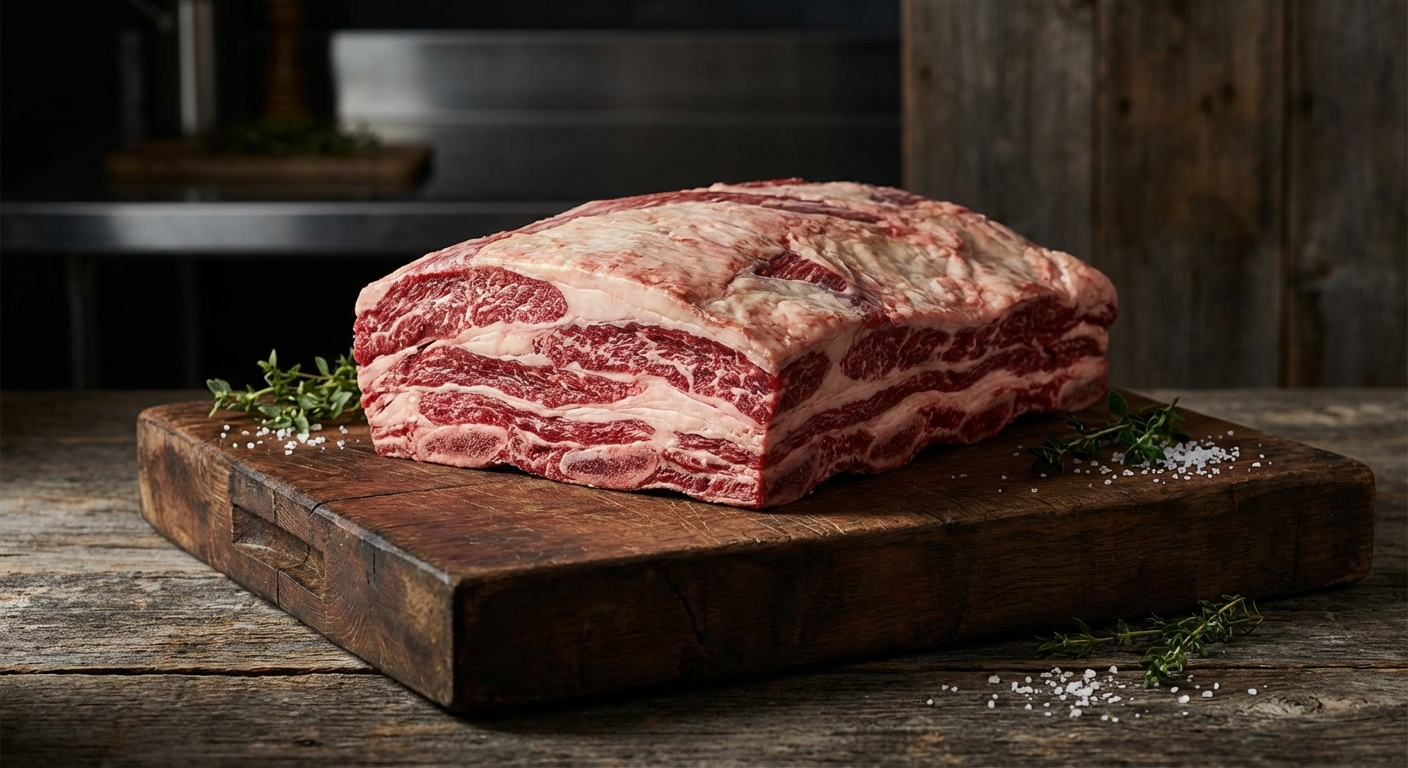
The beef plate primal — also called the short plate — is one of the most underrated sections on the animal. It sits below the rib primal on the belly side, running roughly from the 6th through the 12th rib. While it lacks the marquee name recognition of the ribeye or tenderloin, the plate contains some of the most intensely flavored cuts in all of beef butchery: short ribs, inside skirt steak, hanger steak, and excellent trim for grinding.
In the carnicería where I trained in Buenos Aires, the plate was never an afterthought. My master called it "el corazón del sabor" — the heart of flavor. The heavy marbling, the rich connective tissue, the proximity to the diaphragm — everything about this primal rewards the butcher who takes the time to separate it properly.
Breaking down a plate primal at home requires patience and a good understanding of the anatomy. The muscles here run in different directions, the bones demand respect, and the fat distribution is heavier than what you find in most other primals. But the payoff — a freezer stocked with short ribs for braising, skirt steak for the grill, and pounds of beautifully marbled trim for burgers — is well worth the effort.
Understanding the Beef Plate Primal
The plate primal is bounded by the rib section above, the brisket to the front, and the flank to the rear. It typically weighs 25-35 pounds when received as a whole primal with bones in, though you will more commonly encounter the short plate (a sub-section) at 12-20 pounds.
The key structures within the plate include:
- Rib bones (6-12): The lower portions of the ribs, which become short ribs when portioned
- Inside skirt steak (diaphragm muscle): A long, flat muscle with intense beef flavor and prominent grain — the prized cut for fajitas and carne asada
- Hanger steak (diaphragm pillar): Also called the "butcher's steak" because butchers historically kept it for themselves — tender, deeply flavored, and attached to the diaphragm
- Short rib meat: Layers of well-marbled meat between and on top of the rib bones
- Plate fat: Significant external and intermuscular fat, excellent for rendering or blending into ground beef
The grain direction varies significantly throughout the plate, which is why breaking it down along natural seams — rather than making arbitrary cross-cuts — produces better individual cuts that cook more predictably.
Tools You Will Need
The plate primal includes bones, heavy connective tissue, and thick fat layers. You will need:
- 10-inch breaking knife: For heavy separation cuts and portioning through meat between bones
- 6-inch boning knife (semi-flexible): For working around bones and separating the skirt and hanger
- Hand bone saw: For cutting through rib bones when portioning short ribs — a knife alone will not cut cleanly through bone. See our equipment guide for recommendations
- Large cutting board: 24x18 inches minimum — the plate primal is wide and flat
- Kitchen towels: The plate is fatty and your hands will get slippery
- Cut-resistant glove: Strongly recommended for the non-knife hand, especially during bone saw work
Keep your knives sharp — the dense connective tissue in the plate punishes dull edges. Hone your boning knife before you begin and again midway through.
Step 1: Orient and Inspect the Primal
Place the plate primal on your cutting board bone-side up. The concave inner surface of the ribs should face you. Take a moment to identify the key landmarks:
- The rib bones running across the primal — count them to confirm you have ribs 6-12 (or a subset)
- The thick layer of meat and fat on the bone side (this becomes your short rib meat)
- The inside skirt, which may still be attached to the inner surface of the ribs along the diaphragm area
- The overall fat coverage on the exterior
Flip the primal over so the meat side faces up. Note the heavy external fat cap and any loose flaps of meat or fat at the edges. These edges will need trimming.
Step 2: Remove the Inside Skirt Steak
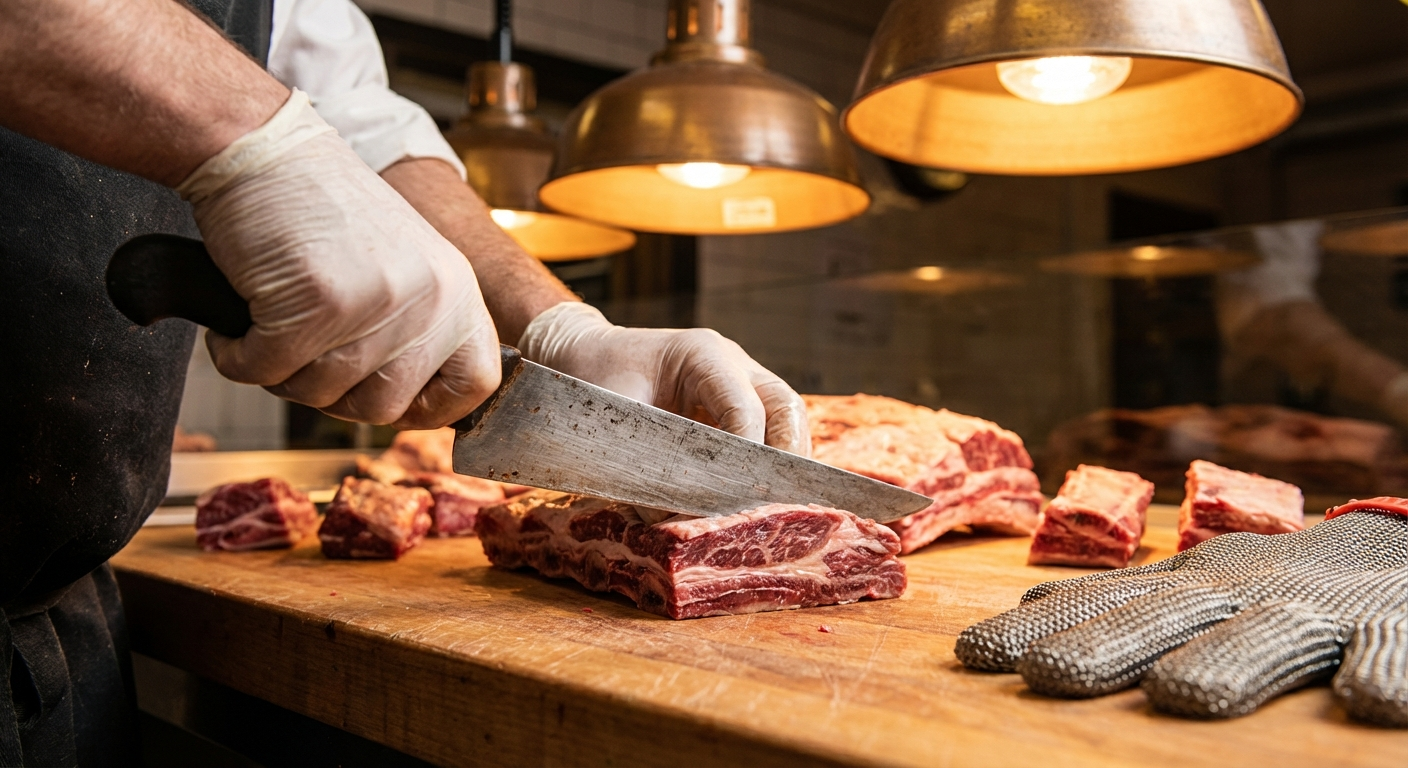
The inside skirt steak is the diaphragm muscle that lines the inner cavity of the plate. It is a long, flat muscle — typically 18-24 inches long and 3-4 inches wide — with heavy marbling and a distinctive coarse grain.
To remove it:
- Place the primal bone-side up. Locate the skirt — it runs along the inner surface, attached by a thin membrane
- Using your boning knife, lift one end of the skirt away from the rib surface
- Follow the membrane attachment with long, shallow strokes, keeping the blade flat against the ribs
- Work from one end to the other, peeling the skirt away as you cut
- The skirt should come away in one piece. If you encounter resistance, slow down and check that you are following the membrane rather than cutting into the rib meat
Once removed, the skirt will have a tough membrane on one side. Peel or trim this membrane off — it does not render during cooking and will make the finished steak chewy. Grab one corner of the membrane with a paper towel (for grip) and pull it off in sheets. Use your boning knife to assist where it clings tightly.
The cleaned inside skirt steak weighs 1-2 pounds and is one of the most flavorful steaks on the animal. It is best cooked hot and fast — high heat grill or cast iron — and sliced thin against the grain.
Step 3: Remove the Hanger Steak (If Present)
The hanger steak hangs from the diaphragm between the plate and the loin — it literally "hangs" from the kidney area. Depending on how your primal was separated by the processor, the hanger may or may not be included with the plate.
If present, you will find it as a thick, roughly V-shaped piece of dark red meat attached near the center of the diaphragm area. It has a central tendon running through its middle that divides it into two lobes.
To remove it:
- Identify the hanger's attachment point to the diaphragm membrane
- Cut along the membrane to free the hanger from the plate
- Trim the outer membrane
- To prepare for cooking, split the hanger along the central tendon, creating two individual steaks. Remove the tendon entirely — it is tough and does not break down
The hanger steak — el bistec del carnicero, the butcher's steak — is prized for its deep, almost livery beefy flavor. There is only one per animal, which is why it was historically kept by the butcher rather than sold. Cook it medium-rare at most; overcooking makes it tough.
Step 4: Portion the Short Ribs
With the skirt and hanger removed, the remaining plate is primarily rib bones with their attached meat and fat. This is where your short ribs come from.
There are two main styles of short rib portioning:
English-Cut Short Ribs (Bone-In Blocks)
These are individual segments cut parallel to the bone, each containing one bone with a thick layer of meat on top. This is the classic braising cut.
- Position the plate bone-side up
- Using your bone saw, cut between each rib bone to create individual rib sections
- Each section will be one bone wide, with 2-3 inches of meat sitting on top
- Trim excess fat from the exterior of each piece, leaving about ¼ inch for flavor during braising
For portion control, you can further cut each rib into shorter lengths (3-4 inches each) using the bone saw. Standard English-cut short ribs are 3-4 inches long with one bone.
Flanken-Cut Short Ribs (Cross-Cut)
Flanken-style ribs are cut across the bones, creating thin strips that contain 3-4 cross-sections of bone. This is the cut used for Korean galbi and Argentine asado.
- Position the plate so the ribs run vertically (perpendicular to your knife)
- Using your bone saw, cut across all the ribs at once in ¼-inch to ½-inch slices
- Each strip will contain cross-sections of 3-4 rib bones with meat between them
- These thin strips cook quickly on a grill — very different from the low-and-slow English cut
You can do a combination: English-cut from the thicker, meatier sections of the plate, and flanken-cut from the thinner sections where there is less meat per bone.
Step 5: Recover the Trim
The plate primal generates significant trimmings — fat caps, meat scraps, and connective tissue. Do not waste these:
- Lean trim: Collect clean meat scraps for grinding. Plate trim has excellent flavor for burger blends
- Fat trim: Plate fat is some of the best on the animal for rendering into tallow. It is also ideal for mixing into lean ground beef at a 80/20 or 75/25 ratio for juicy burgers
- Bones: Rib bone scraps and trimmings make outstanding beef stock. Roast them at 400°F until deep brown, then simmer with aromatics for 8-12 hours
A good butcher wastes nothing. The grinding guide covers how to turn your trim into excellent ground beef.
Yield Expectations
From a 20-pound short plate primal, expect approximately:
- Short ribs: 8-10 pounds (bone-in weight)
- Inside skirt steak: 1-2 pounds
- Hanger steak: 1-1.5 pounds (if included)
- Usable trim for grinding: 2-3 pounds
- Fat trim for rendering: 3-4 pounds
- Bone and waste: 2-3 pounds
Total usable yield runs 70-80% of starting weight, which is typical for a bone-in primal with significant fat coverage.
Storage Recommendations
Proper storage preserves the quality of your butchery work:
- Short ribs: Vacuum seal in portions of 2-4 ribs. Freeze for up to 12 months. Refrigerate for use within 3-5 days
- Skirt steak: Vacuum seal individually or in pairs. Best used fresh within 3 days or frozen for up to 6 months
- Hanger steak: Wrap tightly in butcher paper for 2-3 day refrigerated use, or vacuum seal and freeze for up to 6 months
- Trim: Bag in 1-pound portions for grinding later. Keep fat and lean trim separated so you can control your grind ratio
Cooking Notes for Each Cut
Each cut from the plate requires a different approach:
- English-cut short ribs
- Low and slow. Braise at 300-325°F for 3-4 hours in red wine, stock, and aromatics until fork-tender. The collagen melts into gelatin, creating that signature luscious texture. Also excellent smoked at 250-275°F for 6-8 hours.
- Flanken-cut short ribs
- Hot and fast. Grill over high heat for 3-4 minutes per side. Marinate in soy, garlic, sesame, and pear for Korean galbi, or season simply with salt for Argentine-style tira de asado.
- Inside skirt steak
- Maximum heat, minimum time. Grill or sear for 2-3 minutes per side to medium-rare. Rest 5 minutes and slice thin against the grain at a steep angle. The coarse grain means the direction of your slice determines tenderness.
- Hanger steak
- Medium-high heat, 4-5 minutes per side to medium-rare. Do not exceed medium doneness — the hanger becomes tough and livery when overcooked. Rest well and slice against the grain.
The plate primal delivers incredible value — between the braising short ribs, the grilling steaks, and the burger trim, it covers multiple meal occasions from one breakdown session. When you want to experience how a well-marbled plate primal breaks down, source quality beef and put these techniques to work. The craft rewards the patient butcher.
Frequently Asked Questions
What is the beef plate primal?
The beef plate (or short plate) is a primal cut from the belly side of the animal, below the rib primal, spanning roughly ribs 6-12. It contains short ribs, inside skirt steak, and sometimes the hanger steak, along with well-marbled trim ideal for grinding.
What cuts come from the beef plate?
The plate yields English-cut or flanken-cut short ribs (bone-in), inside skirt steak (the diaphragm muscle prized for fajitas), hanger steak (the butcher's steak), and excellent fat and lean trim for grinding into burger blends.
Do I need a bone saw to break down a beef plate?
Yes. The plate contains rib bones that cannot be cut cleanly with a knife. A hand bone saw ($30-50 with replaceable blades) is essential for portioning short ribs. A reciprocating saw with a meat blade works for higher volume.
What is the difference between English-cut and flanken-cut short ribs?
English-cut short ribs are cut parallel to the bone, yielding thick individual bone-in blocks ideal for braising. Flanken-cut ribs are sliced across the bones into thin strips containing cross-sections of 3-4 bones, perfect for grilling Korean galbi or Argentine asado.
How much usable meat does a beef plate yield?
A 20-pound short plate primal yields approximately 8-10 pounds of short ribs, 1-2 pounds of skirt steak, 1-1.5 pounds of hanger steak (if included), and 2-3 pounds of usable trim. Total usable yield is 70-80% of starting weight.
More Expert Guides
How to Trim a Brisket: The Complete Butcher's Guide
Proper brisket trimming is the difference between a backyard experiment and competition-quality results. Here is the professional technique for shaping a whole packer brisket before it ever touches the smoker.
14 min readHow to Butcher a Whole Chicken: Step-by-Step Guide
Breaking down a whole chicken yourself saves 40-50% compared to buying individual parts. Here is the professional technique for turning one bird into perfectly portioned pieces.
14 min readHome Butchering Safety Guide: Essential Protocols for Safe Meat Processing
Learn professional butchering safety protocols from a master butcher with 25+ years of experience. Essential guidance for anyone processing meat at home.