Butchering Terms: The Complete Glossary for Home and Professional Butchers
Butchering Terms: The Complete Glossary
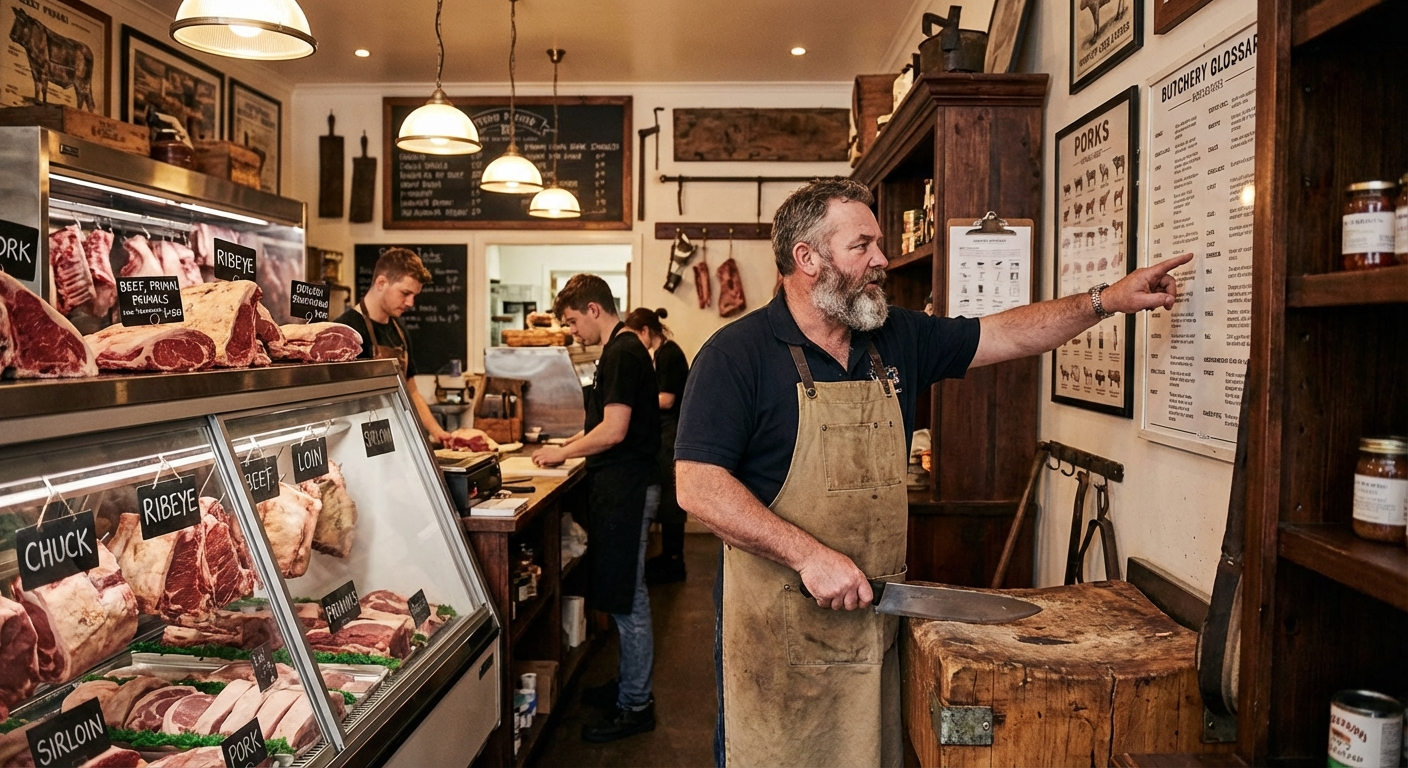
Walk into any butcher shop and you will hear a language all its own — primal, fabrication, seam cutting, silverskin. If you are new to butchering, this terminology can feel like a foreign language. Even experienced home processors sometimes encounter industry jargon that trips them up.
This glossary covers over 110 essential butchering terms organized by category. I have spent over 20 years in professional butcher shops learning these terms not from textbooks, but from cutting floors — from master butchers in the US and apprenticeships in Europe. Bookmark this guide and come back whenever you encounter an unfamiliar term in a guide, recipe, or conversation with your local butcher.
Technical definitions in this glossary align with USDA Agricultural Marketing Service standards and Food Safety and Inspection Service (FSIS) terminology.
Anatomy and Cut Terms
- Aitch Bone
- The pelvic bone (os coxae) found in the hip area of beef, pork, and lamb. Removing the aitch bone is one of the first steps when breaking down a hindquarter. It has a distinctive "H" or "Y" shape that becomes familiar with practice. In my experience, the aitch bone is where most beginners struggle during hindquarter fabrication — taking time here prevents downstream cutting errors.
- Back Strap
- The common term for the longissimus dorsi muscle that runs along the spine — what butchers call the "eye" of the loin. In beef this becomes ribeye and strip loin steaks, in venison it is a premium tender cut often grilled whole.
- Bavette
- The French term for flank steak, increasingly popular in American butcher shops and restaurants. A bavette comes from the abdominal muscles and delivers intense beefy flavor when sliced thin against the grain after quick high-heat cooking.
- Cap
- The outer layer of muscle on a cut, often separated for different cooking applications. The most famous is the spinalis dorsi — the ribeye cap — prized for its intense marbling and tenderness. Also refers to the fat cap on brisket or pork shoulder.
- Chine Bone
- The backbone or spinal column. "Chining" means cutting through or removing the backbone to allow a rack of ribs or loin to be portioned into individual chops. Your butcher may offer to chine a rack of lamb so you can slice between the ribs at home.
- Collar
- The neck and shoulder area of pork, particularly prized in Iberian and Italian butchery. Pork collar (coppa in Italian) is well-marbled, flavorful, and excellent for slow roasting or curing into charcuterie.
- Collagen
- A structural protein found in connective tissue, tendons, and ligaments. When cooked slowly at low temperatures (above 160°F), collagen converts to gelatin, which gives braised and smoked meats their rich, silky mouthfeel. According to food science research, collagen denaturation begins around 140°F but full conversion to gelatin requires sustained temperatures of 160-180°F. Cuts high in collagen (brisket, chuck, shank) benefit most from slow cooking.
- Connective Tissue
- The fibrous material that connects muscles to bones and surrounds individual muscle fibers. Includes silverskin, fascia, tendons, and ligaments. Proper removal of surface connective tissue (trimming) improves texture and presentation.
- Coppa (Capocollo)
- The Italian name for pork collar or neck muscle — a premium cut with excellent marbling running through the shoulder into the loin. When cured, coppa becomes a prized salume. Fresh coppa is exceptional for slow roasting or grilling as thick steaks. I source coppa specifically for dry-curing projects because the marbling distributes fat perfectly during the aging process.
- Coulotte
- The cap muscle covering the top sirloin, also called "picanha" in Brazilian butchery. This triangular cut has a thick fat cap on one side and tender, beefy meat underneath. Extremely popular in South American churrascarias where it is grilled whole with the fat cap crisped.
- Denver Cut
- A relatively new retail cut from the chuck under blade, part of the serratus ventralis muscle. Named for the city where it was popularized in the early 2000s. The Denver cut is tender, well-marbled, and cooks like a strip steak despite coming from the shoulder.
- Deckle
- The fatty, heavily marbled muscle and fat layer on top of a brisket point or between the ribs and the ribeye eye. Deckle-on ribeyes include this extra fat cap; deckle-off means it has been removed. Some pitmasters prize brisket deckle for its rich, unctuous texture after smoking.
- Denuding
- Removing the outer fat, silverskin, and connective tissue from a muscle to expose clean meat. Also called "cleaning" a muscle. Common when preparing tenderloins, strip loins, and other premium cuts for portioning.
- Eye
- The central, main muscle in a cut — the "eye" of the ribeye (longissimus dorsi) or round (top round, eye of round). The eye is typically the most tender and uniform part of a primal section.
- Fabrication
- The process of cutting primal and sub-primal cuts into retail-ready portions — steaks, roasts, stew meat, and ground. Fabrication is the final step in the butchering chain, turning large wholesale pieces into what you see in the display case.
- Fascia
- A sheet of connective tissue that wraps around and between muscles. Fascia is tougher than muscle but softer than silverskin. Butchers navigate fascia layers during seam cutting to separate individual muscles cleanly.
- Feather Bones
- The small, thin transverse process bones that stick out from the vertebrae in a beef loin. Removing feather bones is part of cleaning a strip loin or tenderloin for portioning into steaks.
- Fell
- A thin, papery membrane covering the outer surface of a lamb carcass, directly beneath the skin. Some butchers leave the fell on legs of lamb to help retain moisture during roasting; others prefer to remove it for better seasoning penetration.
- Flat Iron
- A highly marbled, tender steak cut from the shoulder clod (top blade) after removing the central tough connective tissue. Named for its flat, rectangular shape. One of the most successful "new" steaks created through seam-cutting innovation in the early 2000s.
- Forequarter
- The front half of a beef carcass, containing the chuck, rib, brisket, and plate (short plate) primals. Generally yields tougher, more flavorful cuts that benefit from slow cooking — with the notable exception of the rib primal, which produces ribeyes and prime rib.
- Gooseneck
- The round bone visible in a bone-in chuck roast or arm steak. Called gooseneck because of its curved, elongated shape. Presence of the gooseneck bone indicates the cut comes from the shoulder clod area.
- Grain
- The direction of muscle fibers within a cut of meat. Slicing against (perpendicular to) the grain shortens the fibers, making each bite more tender. This is especially important for cuts like flank steak, brisket, and skirt steak where the grain is prominent.
- Hanger Steak
- A V-shaped muscle that "hangs" between the rib cage and the loin, attached to the diaphragm. Intensely flavorful with a loose grain. Each animal has only one hanger steak, so it is often called the "butcher's steak" — tradition was that butchers kept it for themselves.
- Hindquarter
- The rear half of a beef carcass, containing the loin, sirloin, round, and flank primals. Generally produces more tender (and more expensive) cuts, particularly from the loin section.
- Knuckle
- The sirloin tip section from the round, used for roasts or lean steaks. Also called "ball tip." In pork, the knuckle is part of the ham closest to the shank — a tougher section best for slow cooking or curing.
- Marbling
- Intramuscular fat — the white streaks and flecks visible within the lean meat. Marbling is the primary factor in USDA beef grading (Prime, Choice, Select). Higher marbling equals more flavor, juiciness, and tenderness. According to the USDA grading standards, Prime beef must show abundant marbling, while Choice shows moderate marbling. Wagyu cattle are bred specifically for extreme marbling.
- Merlot Cut
- A small, triangular muscle from the shoulder blade (part of the infraspinatus), similar in tenderness to the flat iron. Named for its deep red color. The merlot cut weighs only 6-8 ounces per side and is a newer "butcher's cut" gaining popularity in high-end restaurants.
- Oyster
- Two small, tender muscles found on either side of the backbone in poultry, nestled in the hip socket. Considered a delicacy. In lamb and pork, similar small muscles near joints are sometimes also called oysters by professional butchers.
- Plate
- The short plate primal, located beneath the rib section in beef. Source of short ribs, skirt steak, and hanger steak. Often confused with brisket, which is a separate primal directly in front of the plate.
- Primal Cut
- The large, initial sections a carcass is divided into during the first stage of butchering. Beef has eight primals: chuck, rib, loin, sirloin, round, flank, plate, and brisket. Each primal is further broken down into sub-primals and then retail cuts. The USDA defines standardized specifications for each primal in the Institutional Meat Purchase Specifications (IMPS).
- Scotch Fillet
- The Australian and New Zealand term for a boneless ribeye steak. Called "scotch" because it was originally popularized by Scottish butchers who emigrated to Australia in the 1800s. Functionally identical to an American ribeye.
- Serratus Ventralis
- A shoulder muscle attached to the ribs, sometimes called "rib finger meat" in older butchery texts. This is the muscle from which the Denver cut is fabricated. When left attached during rib primal separation, it creates the classic "lip" on a bone-in ribeye.
- Shank
- The lower leg section of beef, pork, or lamb, containing lots of connective tissue and bone marrow. Ideal for slow braising (osso buco) or stock-making. Foreshank comes from the front leg, hindshank from the rear.
- Silverskin
- A tough, silvery-white membrane of connective tissue (fascia) that covers certain muscles, particularly tenderloins, ribs, and loins. Silverskin does not break down during cooking and must be removed with a sharp boning knife before preparation. Slide the knife under the membrane and angle upward to peel it away. When I train new butchers, removing silverskin cleanly without wasting meat is the skill that takes longest to master — expect to practice on dozens of tenderloins.
- Spider Steak
- A small, fan-shaped muscle from the hip area of beef, near the aitch bone. Similar in texture and flavor to hanger steak but even rarer — only about 6 ounces per animal. Prized by butchers and chefs who know where to look for it.
- Sub-Primal
- A smaller section cut from a primal. For example, the loin primal yields the strip loin and tenderloin sub-primals. Sub-primals are what wholesale buyers typically purchase, then fabricate into retail cuts.
- Sweetbreads
- Not a cut of muscle but the thymus gland (throat sweetbreads) and pancreas (heart sweetbreads) of young animals, particularly veal and lamb. Considered a delicacy in French cuisine. Must be soaked, blanched, and pressed before cooking.
- Teres Major
- A small shoulder muscle that runs along the scapula (shoulder blade), sometimes marketed as "petite tender" or "shoulder tender." Similar in shape and tenderness to the tenderloin but with more beefy flavor. Weighs about 8–12 ounces per side.
- Tri-Tip
- A triangular muscle from the bottom sirloin sub-primal, popular in California barbecue. Weighs 1.5-2.5 lbs and has prominent grain direction that changes within the cut — requiring careful slicing against the grain in two directions. Also called "triangle roast" or "Santa Maria steak."
Techniques and Processes
- Aging (Dry)
- Storing beef in a controlled environment (34–38°F, 80–85% humidity, with air circulation) for 21–45+ days. Enzymes naturally present in the meat break down muscle fibers, increasing tenderness. Moisture loss concentrates flavor, creating the distinctive nutty, beefy taste of dry-aged beef. Requires whole sub-primals — the dried exterior (pellicle) is trimmed away before portioning. Research from Texas A&M's Meat Science program shows that 28-35 days produces optimal flavor development without excessive trim loss.
- Aging (Wet)
- Aging vacuum-sealed meat in its own juices under refrigeration. More common commercially because there is zero weight loss (and thus no lost revenue). Wet aging improves tenderness but does not develop the concentrated flavor profile of dry aging.
- Barding
- Wrapping a lean cut of meat in fat (usually pork fatback or bacon) before roasting to keep it moist. The fat bastes the meat as it renders. Common for lean game meats like venison loin or pheasant breast.
- Blocking
- Squaring off a cut of meat by trimming irregular edges to create a uniform shape. Blocking ensures even cooking, consistent portion sizes, and professional presentation. The trim goes to grinding or stew meat — nothing wasted.
- Breaking
- The initial process of separating a carcass or side into primal cuts. "Breaking a side" means making the major separation cuts between chuck and rib, rib and loin, loin and round, etc. Requires a breaking knife (cimeter) and bone saw.
- Butterflying
- Cutting a thick piece of meat nearly in half horizontally, then opening it like a book to create a thinner, more even piece. Common with chicken breasts, pork chops, and thick steaks. Butterflying allows faster, more even cooking and is useful for stuffing and rolling.
- Chining
- Sawing or cutting through the backbone (chine bone) to allow a rack or loin to be easily portioned into individual chops. Chined racks of lamb, pork, or veal can be sliced between the ribs with just a knife — no saw required.
- Cross-Cutting
- Cutting perpendicular to the length of a muscle or bone. Cross-cut short ribs (flanken style) are sliced across the bones, creating thin strips with multiple small bone cross-sections — popular in Korean BBQ. Compare to English-cut short ribs, which are cut parallel to the bone.
- Frenching
- Scraping meat, fat, and membrane away from the ends of rib bones to expose clean bone for presentation. Common on rack of lamb, crown roasts, and tomahawk steaks. Frenching is purely aesthetic — it does not affect flavor or cooking.
- Jaccard Tenderizing
- Mechanically tenderizing meat using a Jaccard tenderizer (a handheld tool with arrays of thin blades that pierce the meat). The blades cut through muscle fibers and connective tissue, reducing cooking time and improving tenderness without pounding. Useful for tougher steaks like round or chuck. In my experience, Jaccard tenderizing works best on cuts you plan to marinate — the blade channels help marinade penetrate deeper.
- Larding
- Threading strips of fat through lean meat using a larding needle. An old technique for adding moisture to lean roasts (like venison or veal) before slow roasting. Largely replaced by barding or modern low-temperature cooking methods.
- Needling
- Piercing meat with a multi-blade tenderizer (like a Jaccard) to cut muscle fibers and improve tenderness. Also allows marinades to penetrate more deeply. Commercial processors often needle tougher cuts before packaging to improve consumer satisfaction.
- Paillard
- A piece of meat (typically chicken, veal, or pork) pounded very thin (about 1/4 inch) for quick high-heat cooking. Named after the 19th-century Parisian restaurateur who popularized the technique. Paillards cook in 2–3 minutes per side.
- Portioning
- Cutting a sub-primal or roast into individual serving-size pieces. Accurate portioning requires a sharp knife, a kitchen scale, and practice. Consistent portions mean consistent cooking times and consistent guest experience.
- Scaling
- Weighing portions to ensure consistent sizes, particularly important for steaks sold by the ounce or for commercial kitchens managing food costs. Professional butchers scale every cut before wrapping.
- Scoring
- Making shallow cuts in the surface of meat, typically through the fat cap or skin. Scoring allows fat to render more effectively, helps seasonings penetrate, and prevents cuts from curling during cooking (especially important with pork chops and duck breast).
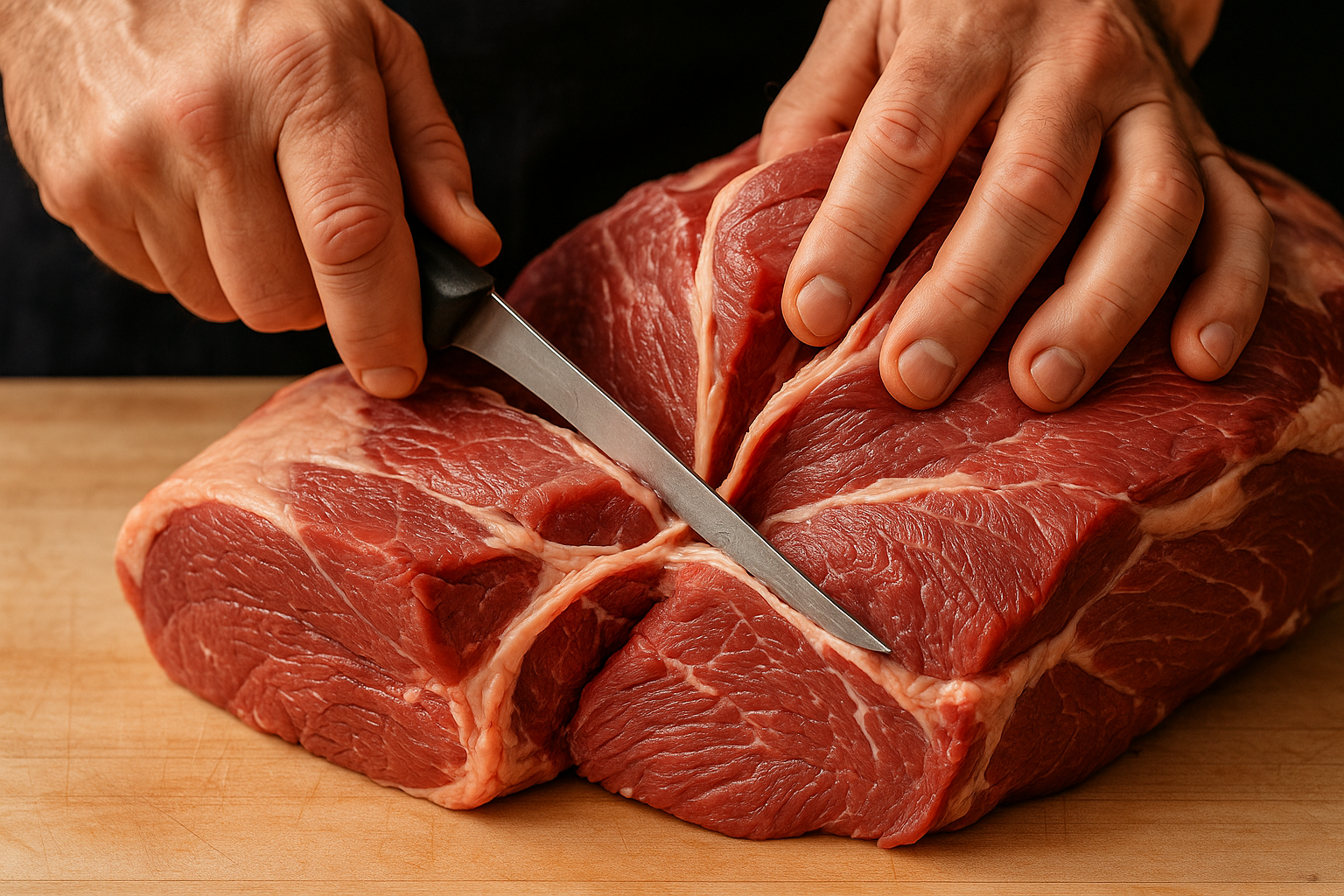
- Seam Cutting (Seaming)
- Separating muscles along their natural connective tissue boundaries rather than cutting through the muscle itself. Seam cutting produces whole-muscle cuts with minimal damage to the meat fibers. It is the preferred technique for maximizing value from complex primals like the chuck and round. This technique is what has driven the creation of "new" steaks like flat iron, Denver cut, and merlot in the past 20 years.
- Spatchcocking
- Removing the backbone from poultry and pressing the bird flat. This technique dramatically reduces roasting and grilling time (a whole chicken goes from 90 minutes to 45), promotes even browning, and allows the entire skin surface to crisp. Use poultry shears or a heavy knife to cut along both sides of the backbone.
- Sous Vide Preparation
- Vacuum-sealing meat and cooking it in a precisely controlled water bath at low temperatures (typically 130-185°F depending on desired doneness). While sous vide is primarily a cooking technique, butchers increasingly portion and package meat specifically for sous vide — removing silverskin, trimming excess fat, and portioning to exact weights for consistent results.
- Tunneling
- Creating a cavity through the center of a roast or cut for stuffing. Common with pork loin roasts and bone-in leg of lamb. Requires a long, thin boning knife and a steady hand — the tunnel should run the length of the roast without breaking through the sides.
- Trussing
- Tying a roast or whole bird with butcher's twine to create a compact, uniform shape. Trussing ensures even cooking, prevents thin sections from overcooking, and maintains an attractive shape during roasting. A basic butcher's knot is all you need.
- Trimming
- Removing excess external fat, silverskin, bloodshot areas, and ragged edges from a cut of meat. Trimming is both functional (improving texture and appearance) and a value judgment — leave more fat on cuts destined for smoking, less on those for searing.
Knife and Tool Terms
- Boning Knife
- A narrow, pointed knife (5–7 inches) designed to navigate around bones, separate joints, and remove silverskin. Available in flexible and rigid versions — flexible for poultry and fish, rigid for beef and pork.
- Breaking Knife (Cimeter)
- A large, curved knife (8–12 inches) used for separating primal cuts, portioning large roasts, and slicing steaks. The curved belly allows long, sweeping cuts through thick muscles in a single stroke.
- Butcher's Saw
- A specialized handsaw with fine teeth designed to cut through bone without splintering. Essential for breaking down primals, removing chine bones, and cutting cross-sections like osso buco. Keep blade clean and sharp to prevent binding.
- Butcher's Twine
- Heavy cotton string used for trussing roasts and poultry. Unlike synthetic twine, cotton is oven-safe and won't melt. Typically sold in 16-ply or 24-ply thickness — thicker for large roasts, thinner for poultry.
- Cleaver
- A heavy, rectangular-bladed knife designed for chopping through bone and cartilage using downward force. The weight of the blade does the work. Not for precision cuts — use a cleaver when you need power, not finesse.
- Granton Edge
- A knife blade with a series of oval scallops (dimples) ground into the side. These create air pockets that reduce suction between the blade and meat, allowing slices to release cleanly. Common on slicing knives and some boning knives. Also called a "kullenschliff" edge in German cutlery.
- Honing Steel
- A ridged metal rod used to realign the microscopic edge of a knife blade between cuts. Honing does not remove metal or sharpen — it straightens the edge that bends during use. Use every 10–15 minutes during a butchering session for consistent cutting performance.
- Meat Hook
- An S-shaped or T-shaped steel hook for hanging carcasses, primals, and sub-primals during processing and aging. Proper hanging allows air circulation and provides ergonomic working angles for butchers.
- Poultry Shears
- Heavy-duty kitchen scissors designed to cut through poultry bones. Feature a spring-loaded handle and often include a notch for gripping bones while cutting. Essential for spatchcocking chickens and breaking down whole birds.
- Sticking Knife
- A narrow, rigid knife with a sharp point used in slaughter for the initial bleeding cut. Not relevant for home processors working with already-slaughtered animals, but a term you will encounter in historical and professional butchery literature.
Grading and Quality Terms
- BMS (Beef Marbling Score)
- The Japanese grading scale for intramuscular fat, ranging from 1 (minimal marbling) to 12 (extraordinary marbling). A5 Wagyu — the highest Japanese grade — typically scores BMS 8–12. For comparison, USDA Prime beef generally falls around BMS 4–5.
- Conformation
- The overall shape and muscling of an animal's carcass. Good conformation means thick, blocky muscles with minimal bone — translating to higher yields of premium cuts. An important factor in livestock judging and wholesale carcass valuation.
- Dressing Percentage
- The ratio of carcass weight to live weight, expressed as a percentage. A typical beef steer has a 62–64% dressing percentage — meaning a 1,200 lb animal yields approximately 750 lbs of hanging carcass. Further cutting and trimming reduces this to roughly 500 lbs of retail cuts.
- Quality Grade (USDA)
- The USDA's assessment of eating quality based primarily on marbling and animal maturity. From highest to lowest: Prime, Choice, Select, Standard, Commercial, Utility, Cutter, Canner. Only Prime, Choice, and Select are commonly sold at retail. The USDA Agricultural Marketing Service provides detailed specifications for each grade.
- Yield Grade
- A USDA grade (1–5) that estimates the percentage of boneless, closely trimmed retail cuts from a carcass. Yield Grade 1 has the highest ratio of lean meat to fat and bone. Yield Grade 5 has the lowest. Important for wholesale buyers and ranchers, less relevant at retail.
Preservation and Processing Terms
- Brining
- Soaking meat in a salt-water solution (wet brine) or coating it in salt (dry brine) to improve moisture retention, tenderness, and flavor. The salt denatures proteins and allows the meat to absorb and hold more liquid during cooking. Especially effective for lean cuts like pork loin and poultry breast.
- Curing
- Preserving meat with salt, nitrates, or nitrites — often combined with sugar and spices. Curing inhibits bacterial growth, develops distinctive flavor (think bacon, ham, corned beef), and creates the characteristic pink color of cured meats. Can be dry (rubbed) or wet (immersed in brine). The USDA regulates nitrite/nitrate levels for food safety — FSIS guidelines detail approved usage rates.
- Equilibrium Curing
- A precise curing method where the exact amount of salt and nitrite needed is calculated and applied, then vacuum-sealed with the meat. The cure distributes evenly over time without risk of over-salting. Preferred by many modern charcuterie makers for consistent results.
- Grinding
- Passing meat through a grinder to produce ground meat of various textures (coarse, medium, fine). The ratio of lean to fat in the grind determines the final product — 80/20 (80% lean, 20% fat) is the classic burger ratio. Always grind cold meat (below 40°F) for clean texture — warm meat smears and creates a pasty mouthfeel.
- Hanging
- Suspending a carcass or primal in a cooler after slaughter. Hanging allows the meat to go through rigor mortis and then relax, which improves tenderness. Beef is typically hung for 7–14 days at minimum; game meats benefit from similar treatment.
- Jerking
- Cutting meat into thin strips and drying it — traditionally with smoke and salt, now often in a dehydrator or low oven. Lean cuts (top round, eye of round) work best because fat can go rancid during drying. Slice against the grain for tender jerky, with the grain for chewier texture.
- Pellicle
- The dried, tacky surface that forms on meat during dry aging or before smoking. In dry-aged beef, the pellicle is trimmed away (it is too dry to eat). In smoking, the pellicle helps smoke adhere to the surface, creating better bark and smoke ring.
- Smoking
- Exposing meat to wood smoke at controlled temperatures for flavor and preservation. Cold smoking (below 90°F) adds flavor without cooking. Hot smoking (225–275°F) cooks and flavors simultaneously. Different woods (hickory, oak, cherry, mesquite) impart different flavor profiles.
- Tempering
- Allowing frozen meat to warm slightly (to around 26-28°F) before grinding or slicing. Tempered meat slices and grinds more cleanly than fully frozen or fully thawed meat. Commercial processors use tempering chambers; home butchers can temper meat in the refrigerator for 12-24 hours.
- Vacuum Sealing
- Removing air from a package before sealing it closed. Vacuum sealing prevents freezer burn, extends shelf life by 3–5x compared to standard wrapping, and is essential for wet aging and sous vide cooking. A worthwhile investment for anyone processing significant quantities of meat.
Industry and Business Terms
- Box Beef
- Vacuum-sealed sub-primals shipped in cardboard boxes — the standard form in which beef moves from packer to retailer. Buying box beef (whole sub-primals like strip loins, tenderloins, or ribeye rolls) and cutting your own steaks is significantly cheaper than buying individual retail cuts.
- Carcass
- The body of a slaughtered animal after removal of the hide, head, feet, and internal organs. A beef carcass is typically split into two "sides" along the spine, then each side is divided into forequarter and hindquarter.
- Case-Ready
- Meat that is cut, packaged, and labeled at a central processing facility, then shipped ready for retail display. Case-ready programs reduce labor costs for retailers but eliminate the traditional butcher counter. Most supermarket chains use case-ready systems for at least some products.
- Cutability
- The estimated yield of saleable meat from a carcass. Higher cutability means more retail product per pound of carcass weight. Related to but distinct from yield grade — cutability considers the specific cutting style and product mix.
- Custom Exempt
- A USDA designation for small-scale slaughter operations where the animal's owner processes meat for personal consumption only (not for sale). Custom-exempt processing does not require federal inspection but must still meet state sanitation standards. This is the legal framework under which most home butchering of farm-raised animals operates.
- Fabricator
- A professional who specializes in cutting sub-primals into retail portions. Fabricators work behind the scenes in larger meat operations, supplying pre-cut steaks and roasts to retail counters. High-volume fabricators can portion hundreds of steaks per hour.
- Hanging Weight
- The weight of a carcass after slaughter and removal of hide, head, and organs, but before any further cutting or trimming. When you buy a "whole" or "half" animal from a farm, the price is typically quoted per pound of hanging weight. Expect to take home approximately 60–65% of hanging weight as finished cuts.
- IMPS (Institutional Meat Purchase Specifications)
- A standardized numbering system developed by the USDA for identifying meat cuts. Each cut has a unique number (e.g., IMPS 180 = strip loin, IMPS 109 = ribeye roll). IMPS numbers ensure consistent identification in wholesale purchasing. The full specifications are available from the USDA Agricultural Marketing Service.
- Kill Floor
- The area of a slaughterhouse or processing facility where animals are slaughtered. Subject to strict USDA or state inspection requirements. Not relevant for home butchers, who work with already-slaughtered carcasses or primals.
- NAMP (North American Meat Processors Association)
- The industry trade group that works with USDA to develop IMPS standards. "NAMP number" and "IMPS number" are often used interchangeably in the meat industry.
- Retail Ready
- Cuts that are fully trimmed, portioned, and packaged for sale directly to consumers. The final stage of the processing chain — from carcass to primal to sub-primal to retail-ready.
Regional and International Terms
- Asado
- In Argentine butchery, the term for beef short ribs or rib plate, cooked over open flame. Also refers to the social gathering/barbecue itself. Argentine asado culture includes specific cuts like tira de asado (cross-cut short ribs) and vacío (flank).
- Butcher's Tenderloin
- British term for the hanging tender (hanger steak) — same etymology as the American "butcher's steak."
- Contre-Filet
- The French term for strip loin or New York strip steak. Literally "against the fillet" because it sits opposite the tenderloin across the T-bone.
- Entrecôte
- French for "between the ribs" — refers to ribeye steak. In classic French butchery, entrecôte specifically means a boneless ribeye cut between two ribs.
- Picanha
- The Brazilian Portuguese name for the top sirloin cap (coulotte). Picanha is a prized cut in Brazilian churrascarias, typically grilled whole with a thick fat cap and carved tableside. Increasingly popular in American steakhouses.
- Porterhouse vs T-Bone
- Both are steaks cut from the short loin with the T-shaped bone separating strip and tenderloin. According to USDA standards, a Porterhouse must have a tenderloin section at least 1.25 inches wide at its widest point; a T-bone has a smaller tenderloin (at least 0.5 inches but less than 1.25 inches). The distinction is about location — Porterhouse comes from the rear of the short loin where the tenderloin is thickest.
Commonly Confused Terms
- Loin vs. Tenderloin
- The loin is a large primal section along the back of the animal, containing multiple muscles. The tenderloin is one specific muscle (the psoas major) that runs along the inside of the spine within the loin section. A loin chop includes portions of multiple muscles; a tenderloin steak (filet mignon) is cut from only the tenderloin muscle.
- Ribs vs. Short Ribs
- Back ribs come from the rib primal (upper back) and are the bones left after removing the ribeye. Short ribs come from the plate primal (lower chest) and contain more meat and connective tissue. Back ribs are typically grilled; short ribs are braised.
- Steak vs. Chop
- Both are individual portions cut perpendicular to the muscle. "Steak" typically refers to beef cuts, while "chop" is used for pork, lamb, and veal. A bone-in pork loin steak and a pork chop are essentially the same cut with different names.
- Roast vs. Braise
- These are cooking methods, not cuts — but they dictate which cuts to buy. Roasting uses dry heat and works best with tender cuts (rib roast, tenderloin). Braising uses wet heat at low temperature and is designed for tough, collagen-rich cuts (chuck roast, shank, short ribs) that need time to break down.
Using This Glossary
This glossary is a living reference. As you develop your butchering skills, these terms will shift from vocabulary to instinct. The best way to learn is to combine reading with practice — pick up a whole chicken or a beef sub-primal from your local butcher and start cutting. Every cut teaches you something no glossary can.
When I started my butchery apprenticeship in 1999, I carried a small notebook and wrote down every unfamiliar term I heard on the cutting floor. Twenty years later, these terms are second nature — but I still consult reference materials when working with unfamiliar regional cuts or specialty preparations. Continuous learning is what separates good butchers from great ones.
For hands-on guides that put these terms into action, explore our other resources:
- How to Butcher a Whole Chicken — applies seaming, boning, and fabrication terms to poultry
- How to Trim a Brisket — demonstrates proper fat cap removal and silverskin trimming
- Home Butchering Safety Guide — covers knife safety, temperature control, and sanitation for home processors
- Primal Cuts of Beef: Complete Breakdown — visualizes the eight beef primals and how they're fabricated into retail cuts
- Essential Meat Cutting Techniques — step-by-step instruction on seam cutting, butterflying, and portioning
- Professional Knife Sharpening Guide — essential for maintaining the boning and breaking knives referenced throughout this glossary
References: Butchering terminology in this guide follows standards established by the USDA Food Safety and Inspection Service (FSIS) and the North American Meat Processors Association (NAMP) Meat Buyer's Guide, which standardizes meat cut nomenclature across the industry.
Frequently Asked Questions
What are the 8 primal cuts of beef?
The eight beef primals are chuck, rib, loin, sirloin, round, flank, plate (short plate), and brisket. Each primal is a large section of the carcass that gets further divided into sub-primals and retail cuts like steaks and roasts.
What is the difference between a primal cut and a sub-primal?
A primal cut is one of the large initial sections a carcass is divided into (like the loin or chuck). A sub-primal is a smaller section cut from a primal (like the strip loin or tenderloin cut from the loin primal). Sub-primals are then fabricated into retail cuts.
What does fabrication mean in butchering?
Fabrication is the process of cutting primal and sub-primal cuts into retail-ready portions — steaks, roasts, stew meat, and ground. It is the final cutting stage that turns large wholesale pieces into what consumers purchase at the butcher counter.
What is seam cutting in butchery?
Seam cutting (or seaming) means separating muscles along their natural connective tissue boundaries rather than cutting through the muscle. This produces whole-muscle cuts with minimal damage and maximum value — it is the preferred professional technique for breaking down complex primals.
What is silverskin and should I remove it?
Silverskin is a tough, silvery-white membrane of connective tissue (fascia) covering certain muscles, especially tenderloins and ribs. It does not break down during cooking and becomes unpleasantly chewy, so yes — always remove it before cooking. Slide a sharp boning knife under the membrane and angle upward to peel it away.
What is the difference between dry aging and wet aging beef?
Dry aging stores beef in a controlled open-air environment (34-38°F, 80-85% humidity) for 21-45+ days, developing concentrated nutty flavor through moisture loss. Wet aging stores vacuum-sealed beef in its own juices under refrigeration, improving tenderness without the flavor concentration or weight loss of dry aging.
What is the difference between a ribeye cap and the ribeye eye?
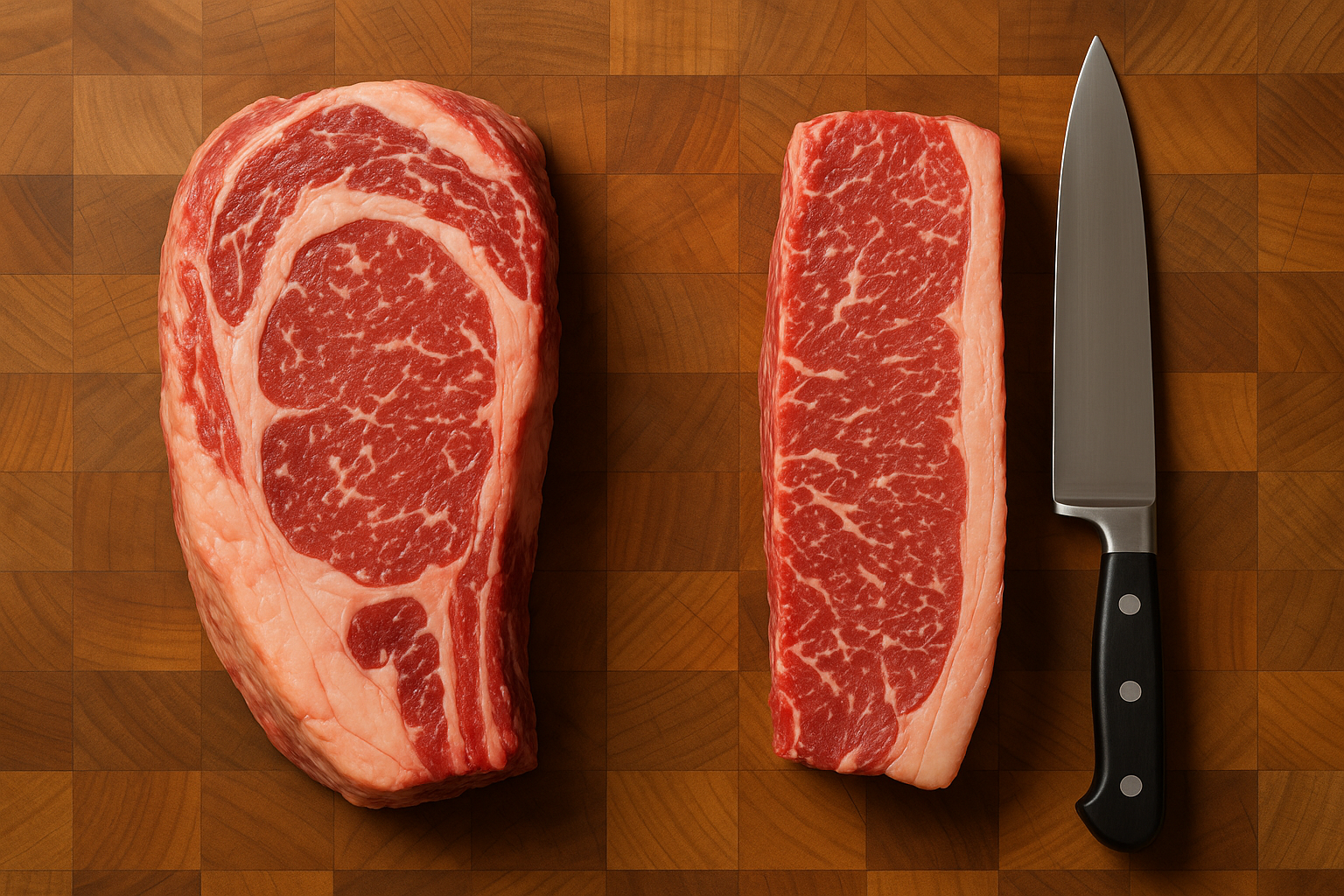
The ribeye eye (longissimus dorsi) is the main central muscle in a ribeye steak. The cap (spinalis dorsi) is the outer curved muscle wrapped around it — the most marbled, tender, and flavorful part of the ribeye. Some butchers separate and sell the cap as a premium cut.
What does it mean to French a rack of lamb?
Frenching means scraping the meat, fat, and membrane away from the ends of the rib bones to expose clean bone for presentation. It is purely aesthetic and creates the classic restaurant appearance, but does not affect flavor or cooking. Common on rack of lamb, crown roasts, and tomahawk steaks.
Why is hanger steak called the butcher's steak?
Hanger steak is called the butcher's steak because there is only one per animal (about 1-2 lbs), and tradition was that butchers kept it for themselves rather than selling it. It hangs between the rib cage and loin attached to the diaphragm, and has intense flavor with a loose grain.
What is the grain in meat and why does cutting direction matter?
The grain is the direction muscle fibers run within a cut. Slicing against (perpendicular to) the grain shortens the fibers, making each bite more tender. Slicing with the grain leaves long fibers that are chewy. This is especially important for cuts with prominent grain like flank steak, brisket, and skirt steak.
What is the USDA quality grading system for beef?
The USDA quality grades beef based primarily on marbling (intramuscular fat) and maturity. From highest to lowest: Prime, Choice, Select, Standard, Commercial, Utility, Cutter, Canner. Only Prime, Choice, and Select are typically sold at retail. Prime has abundant marbling, Choice has moderate marbling, and Select has slight marbling.
What is the difference between a Porterhouse and T-bone steak?
Both are cut from the short loin with the T-shaped bone separating strip and tenderloin. According to USDA standards, a Porterhouse must have a tenderloin section at least 1.25 inches wide; a T-bone has a smaller tenderloin (0.5-1.25 inches). Porterhouse comes from the rear of the short loin where the tenderloin is thickest.
More Expert Guides
Butcher Terms Explained: What to Ask For at the Meat Counter
Stop guessing at the meat counter. This practical guide decodes essential butcher terms so you can confidently request exactly what you need, explained with real-world examples from 15 years behind the block.
18 min readButcher Terms Glossary: 50+ Essential Meat Cutting Terms Every Home Cook Should Know
Master the language of professional butchery with this comprehensive glossary. Learn 50+ essential butcher terms, from primal cuts to seam butchery, explained by Elena Vasquez.
14 min readButcher Shop Slang: What Your Butcher Really Means When They Talk Shop
Walk into a butcher shop and you will hear phrases like "break it down," "clean it up," or "two-finger thick." Here is what your butcher really means — and how to speak the language like a pro.