How to Fabricate a Tomahawk Steak: The Complete Butcher's Guide
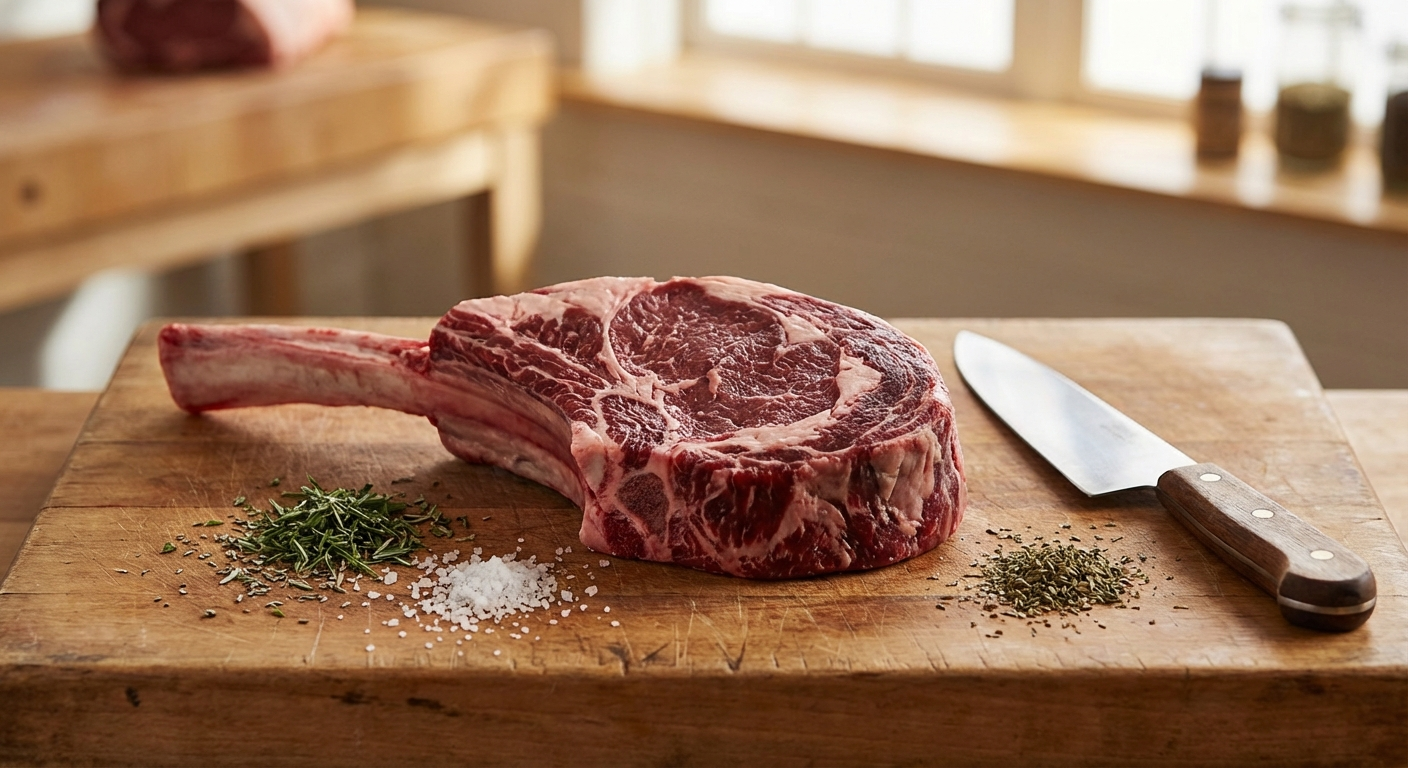
A tomahawk steak is a bone-in ribeye with one defining feature: a long, frenched rib bone that extends 6 to 8 inches beyond the meat. The bone is purely aesthetic — it does not change how the steak cooks — but the visual impact transforms a great steak into a showpiece. At restaurants, tomahawks sell for $80 to $150. Fabricating your own from a bone-in rib primal costs a fraction of that and takes about 15 minutes per steak once you understand the process.
This guide covers every step: selecting the right primal, portioning individual steaks, frenching the rib bone to restaurant-grade cleanliness, and final trimming for the best cook. If you have cut a whole boneless ribeye before, this is the bone-in version with one extra technique.
What You Need
- A bone-in beef rib primal or rib subprimal (NAMP 103) — typically 25 to 35 pounds with 7 ribs (ribs 6 through 12). You can also start with a shorter section of 3 to 4 ribs if a full primal is too much.
- A sharp boning knife (5 to 6 inch flexible blade) for frenching and detail work
- A sharp breaking knife or cimeter (10 to 12 inches) for portioning steaks
- A bone saw or hacksaw for cutting through the chine bone if it is still attached
- A cutting board large enough for the primal (at least 24 inches)
- Clean towels or paper towels for gripping bone during frenching
If you are buying from a butcher or wholesale supplier, ask them to remove the chine bone and feather bones but leave the rib bones long (at least 8 inches from the eye). This saves you from needing a saw. Most wholesale suppliers sell the primal this way as a “frenched export rib rack” or NAMP 109E.
Understanding the Rib Primal Anatomy
The beef rib primal spans ribs 6 through 12 and contains the same muscles as a boneless ribeye — the longissimus dorsi (eye), spinalis dorsi (cap), and complexus — but with the curved rib bones still attached. For tomahawk steaks, you need those rib bones intact and long.
- Ribs 9 through 12 (the loin end): These produce the best tomahawk steaks. The eye is largest and most uniformly round, the spinalis cap is well-defined, and the rib bones are straighter. This is the premium end.
- Ribs 6 through 8 (the chuck end): The eye is smaller and less uniform. More connective tissue between muscles. The rib bones are more curved. These still make good steaks but are not as photogenic.
A full 7-rib primal yields 5 to 7 tomahawk steaks depending on how thick you cut them. At 2 inches thick (the standard), expect 5 to 6 steaks with some trim from the ends.
Step 1: Remove the Chine Bone and Feather Bones
If your butcher did not already remove these, you will need a bone saw. The chine bone is the flat section of the spine running along the base of the ribs. Feather bones are the small finger-like bones projecting upward from the chine.
Position the primal bone-side up. Using a bone saw, cut along the base of the rib bones where they meet the chine, staying as close to the chine as possible to preserve meat. Remove the chine bone and feather bones in one piece. Switch to your boning knife to clean up any bone fragments or chips.
With the chine removed, you should have a rib roast with long, exposed rib bones curving away from the meat.
Step 2: Clean the Intercostal Meat (Between Ribs)
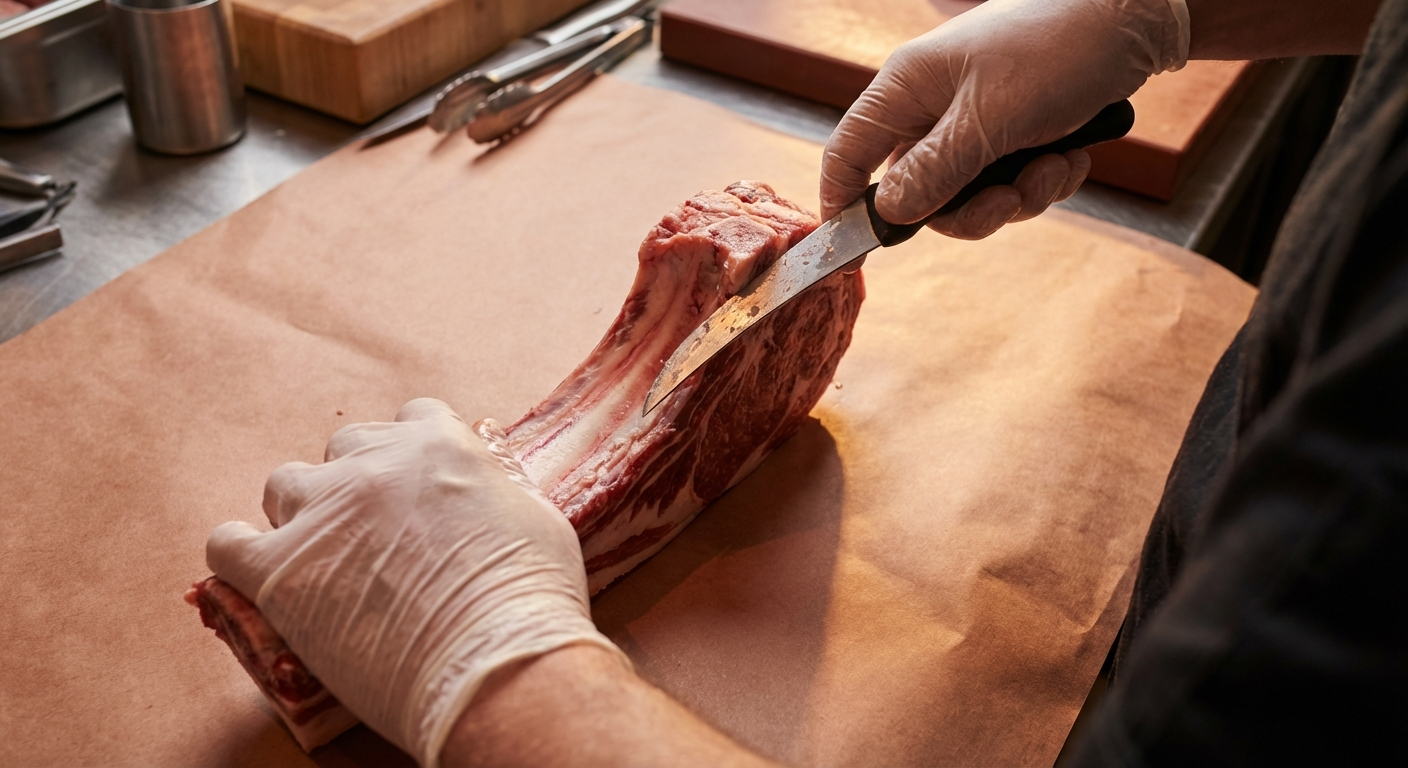
Before portioning into individual steaks, remove the intercostal meat (the thin strips of meat between each rib bone) from the section of bone you want exposed. Measure approximately 6 inches from the eye of the ribeye outward along the rib bones. Everything beyond that 6-inch mark will be frenched clean.
Using your boning knife, cut across all the rib bones at the 6-inch mark, slicing through the intercostal meat perpendicular to the bones. Then work between each pair of ribs, cutting the meat free from the bones. This intercostal meat is excellent for grinding or making burger blend.
Step 3: French Each Rib Bone
Frenching is the process of scraping each rib bone perfectly clean. This is the same technique used for frenching a rack of lamb but on a larger scale.
For each rib bone:
- Score around the bone. At the point where you want clean bone to begin (6 inches from the eye), cut a shallow ring around the bone through any remaining meat and membrane.
- Scrape toward the tip. Hold the boning knife at a 45-degree angle to the bone and scrape firmly from the score line toward the bone tip. Use the back of the knife or a clean towel for grip.
- Remove all tissue. Scrape until the bone is perfectly white with no meat, fat, sinew, or membrane remaining. The periosteum (thin membrane covering the bone) should come off with firm scraping.
- Clean the tip. Cut off any ragged meat or cartilage at the bone tip for a clean finish.
This step takes 2 to 3 minutes per bone. Wrap a dry towel around the bone for grip while scraping — raw bone is slippery. The bone should be bright white when finished. Any remaining tissue will char and look messy during cooking.
Step 4: Portion Individual Steaks
Now cut individual tomahawk steaks from the prepared rack. Standard tomahawk thickness is 2 to 2.5 inches — this gives you a steak that weighs 30 to 40 ounces (bone included) and cooks beautifully with a reverse sear.
Position the rack meat-side up with the bones pointing away from you. Using your breaking knife or cimeter:
- Identify the first rib bone. Feel along the meat surface to locate where each rib bone enters the eye. You will cut between ribs for single-bone tomahawks.
- Cut straight down between ribs. Place your knife midway between two rib bones and cut straight down through the meat in one smooth motion. Keep the blade perpendicular to the cutting board. Do not saw — let the weight and sharpness of the knife do the work.
- Maintain consistent thickness. Each steak should include one rib bone. If your ribs are spaced less than 2 inches apart, cut double-bone tomahawks (two ribs per steak) for proper thickness.
The first and last steaks from the primal will have one flat side where the primal was originally cut. These end pieces are still excellent steaks but may not present as well. Save them for personal use rather than display.
Step 5: Final Trim and Fat Cap
Each portioned tomahawk steak needs final trimming:
- Fat cap: Trim the external fat cap to a uniform 1/4 inch thickness. Leave it on — it bastes the meat during cooking and adds flavor — but remove any thick deposits over 1/2 inch.
- Tail flap: The thin tail of meat and fat that wraps around the bottom of the eye. Trim it to about 4 inches long and tuck it under for cooking, or remove it entirely for a cleaner look. This is the same decision you make with a rib primal breakdown.
- Silver skin: Check for any silver skin on the meat surface and remove it with your boning knife held nearly flat against the meat.
- Bone base: Where the bone meets the meat, ensure the transition is clean with no ragged bits of tissue.
Storage and Aging
Freshly fabricated tomahawk steaks store well in several ways:
- Refrigerator (3 to 5 days): Wrap loosely in butcher paper. Do not use plastic wrap directly on the meat surface — it traps moisture and promotes bacterial growth.
- Freezer (6 to 12 months): Vacuum seal for best results. If you do not have a vacuum sealer, wrap tightly in plastic wrap, then aluminum foil, squeezing out as much air as possible.
- Dry aging (14 to 45 days): If you have a dedicated aging setup, tomahawk steaks are excellent candidates for dry aging. The bone and fat cap protect the meat while the exposed surface develops the characteristic dry-age crust.
Common Mistakes to Avoid
- Cutting steaks too thin. Anything under 1.5 inches does not have enough mass for a proper reverse sear, which is how most people cook tomahawks. Go 2 inches minimum.
- Incomplete frenching. Leaving tissue on the bone is the number one amateur mistake. It chars during cooking and ruins the presentation. Scrape until the bone is white.
- Using a dull knife. A dull boning knife tears tissue instead of cutting it, making frenching frustrating and leaving ragged results. Sharpen your knives before you start.
- Cutting through bone. If you hit bone while portioning, reposition your cut. Forcing a knife through rib bone damages the blade and creates bone chips in the meat.
- Removing too much fat. The fat cap and intramuscular marbling are what make a ribeye great. Trim the exterior fat to 1/4 inch but do not remove it entirely.
Yield and Cost Breakdown
A typical 30-pound bone-in rib primal at wholesale price ($7 to $10 per pound) costs $210 to $300. From that, expect:
- 5 to 6 tomahawk steaks (30 to 40 ounces each) = 12 to 15 pounds of portioned steaks
- 3 to 5 pounds of trim (intercostal meat, fat cap trim, end pieces) — excellent for grinding or sausage
- 8 to 10 pounds of bone (rib bones, chine, feather bones) — perfect for beef stock
At $250 for the primal and 6 steaks, each tomahawk costs approximately $42. A comparable steak from a butcher shop runs $60 to $90 and from a restaurant $100 to $150. That is 50 to 70 percent savings, and you control the thickness, trim, and aging.
Frequently Asked Questions
What is the difference between a tomahawk steak and a bone-in ribeye?
They are the same cut of meat. The only difference is how the rib bone is handled. A bone-in ribeye has the rib bone trimmed short (1 to 2 inches). A tomahawk steak has the rib bone left long (6 to 8 inches) and frenched clean for presentation. The meat, marbling, and flavor are identical.
How thick should a tomahawk steak be?
A standard tomahawk steak is 2 to 2.5 inches thick, weighing 30 to 40 ounces including the bone. This thickness is ideal for reverse searing — low oven first, then high-heat sear — which is the preferred cooking method. Steaks under 1.5 inches are too thin for this technique.
Can I fabricate a tomahawk from a boneless ribeye?
No. A tomahawk steak requires the rib bone to be intact and long. You need a bone-in rib primal (NAMP 103) or a bone-in rib roast with at least 8 inches of rib bone. A boneless ribeye has already had the bones removed.
What is frenching and why is it important?
Frenching is scraping all meat, fat, and membrane from the exposed section of rib bone until it is perfectly white. It is purely aesthetic but essential for the tomahawk presentation. Unfrenched bone tissue chars during cooking and ruins the clean look.
How many tomahawk steaks from a full rib primal?
A full 7-rib bone-in primal typically yields 5 to 6 tomahawk steaks at 2-inch thickness. You may get 7 if you cut slightly thinner (1.75 inches). The exact count depends on rib spacing and how you handle the end pieces.
More Expert Guides
How to Trim a Brisket: The Complete Butcher's Guide
Proper brisket trimming is the difference between a backyard experiment and competition-quality results. Here is the professional technique for shaping a whole packer brisket before it ever touches the smoker.
14 min readHow to Butcher a Whole Chicken: Step-by-Step Guide
Breaking down a whole chicken yourself saves 40-50% compared to buying individual parts. Here is the professional technique for turning one bird into perfectly portioned pieces.
14 min readHome Butchering Safety Guide: Essential Protocols for Safe Meat Processing
Learn professional butchering safety protocols from a master butcher with 25+ years of experience. Essential guidance for anyone processing meat at home.