How to Cut Against the Grain: The Most Important Butchering Skill Nobody Teaches
How to Cut Against the Grain: The Most Important Butchering Skill Nobody Teaches
I have watched thousands of home cooks pull a perfectly cooked steak off the grill, slice it the wrong direction, and turn tender meat into something chewy and stringy. It happens every weekend at barbecues across the country. The steak was great. The slicing ruined it.
Cutting against the grain is the single most impactful technique in meat preparation, and it takes about thirty seconds to learn. Yet most people never think about it. They grab a knife, pick a direction that looks right, and start slicing. Half the time they cut with the grain — and half the tenderness disappears.
This guide will teach you to identify grain direction on every major cut of meat, understand why it matters at a muscle fiber level, and apply the technique whether you are slicing a brisket, portioning steaks, or carving a roast at the table.
What Is the Grain in Meat?
The grain is the direction that muscle fibers run through a piece of meat. Every muscle in every animal is made up of long, thin fibers bundled together like cables. These fibers all run in the same direction within a given muscle, and you can see them as parallel lines on the surface of raw meat.
On some cuts, the grain is obvious. Flank steak has fibers you can see from across the kitchen — thick, clearly defined lines running lengthwise down the cut. Brisket has a pronounced grain that changes direction between the flat and the point. Skirt steak looks like corduroy.
On other cuts, the grain is subtler. A tenderloin has very fine fibers that are harder to spot. Chicken breast has a faint grain that most people never notice. But it is always there, in every piece of meat you will ever cut.
Why Grain Direction Matters
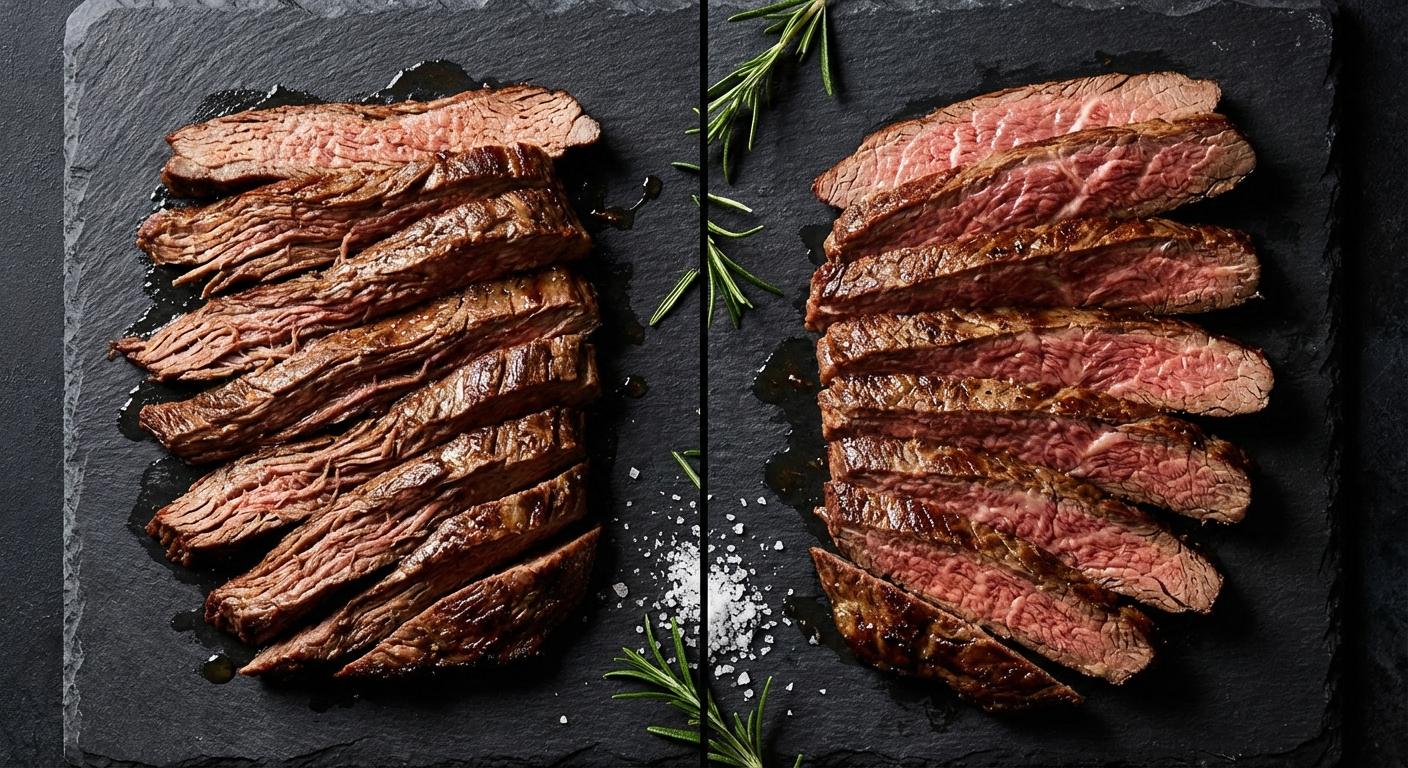
Think of muscle fibers as rubber bands bundled together. If you cut parallel to those rubber bands — with the grain — each piece you cut still contains long, intact fibers. Your teeth have to work to tear through those fibers when you chew. The result is tough, chewy meat regardless of how well it was cooked.
When you cut perpendicular to the fibers — against the grain — you sever those rubber bands into short segments. Each piece of sliced meat contains only short fiber fragments. Your teeth barely have to work at all. The meat feels tender, almost buttery, because the structural integrity of the fibers has already been broken by your knife.
This is not a subtle difference. On a cut like flank steak or brisket, slicing against versus with the grain can be the difference between "this is incredible" and "this is too tough to eat." No amount of marinating, brining, or careful cooking can overcome the damage of slicing with the grain on a fibrous cut.
How to Identify the Grain on Any Cut
Before you can cut against the grain, you need to find it. Here is how to identify grain direction on any piece of meat:
Step 1: Look at the Raw Meat Before Cooking
This is the easiest time to spot the grain. On raw meat, the fibers are clearly visible as parallel lines on the surface. They look like fine ridges or striations running in one direction. Hold the meat at eye level under good lighting and rotate it slowly — the grain becomes obvious when light catches the fiber ridges.
Pro tip: Before you season or cook the meat, make a mental note of which direction the grain runs. Better yet, make a small notch or score mark on one edge perpendicular to the grain. After cooking, especially if the surface is heavily seared or coated in bark, the grain can be harder to see. That notch tells you exactly which way to slice.
Step 2: Look for the Parallel Lines
The grain always appears as parallel lines. They might be thick and obvious (flank steak, skirt steak, brisket flat) or fine and subtle (tenderloin, chicken breast). But they are always parallel. If you see lines running in one direction, that is your grain.
Step 3: Confirm with the Finger Test
Run your finger across the surface of the meat in different directions. When you drag perpendicular to the grain, you will feel the ridges of individual fiber bundles — it feels like running your finger across corduroy fabric. When you drag parallel to the grain, the surface feels smoother because your finger is following the fibers instead of crossing them.
The Technique: Cutting Against the Grain
Once you have identified the grain direction, the technique is straightforward:
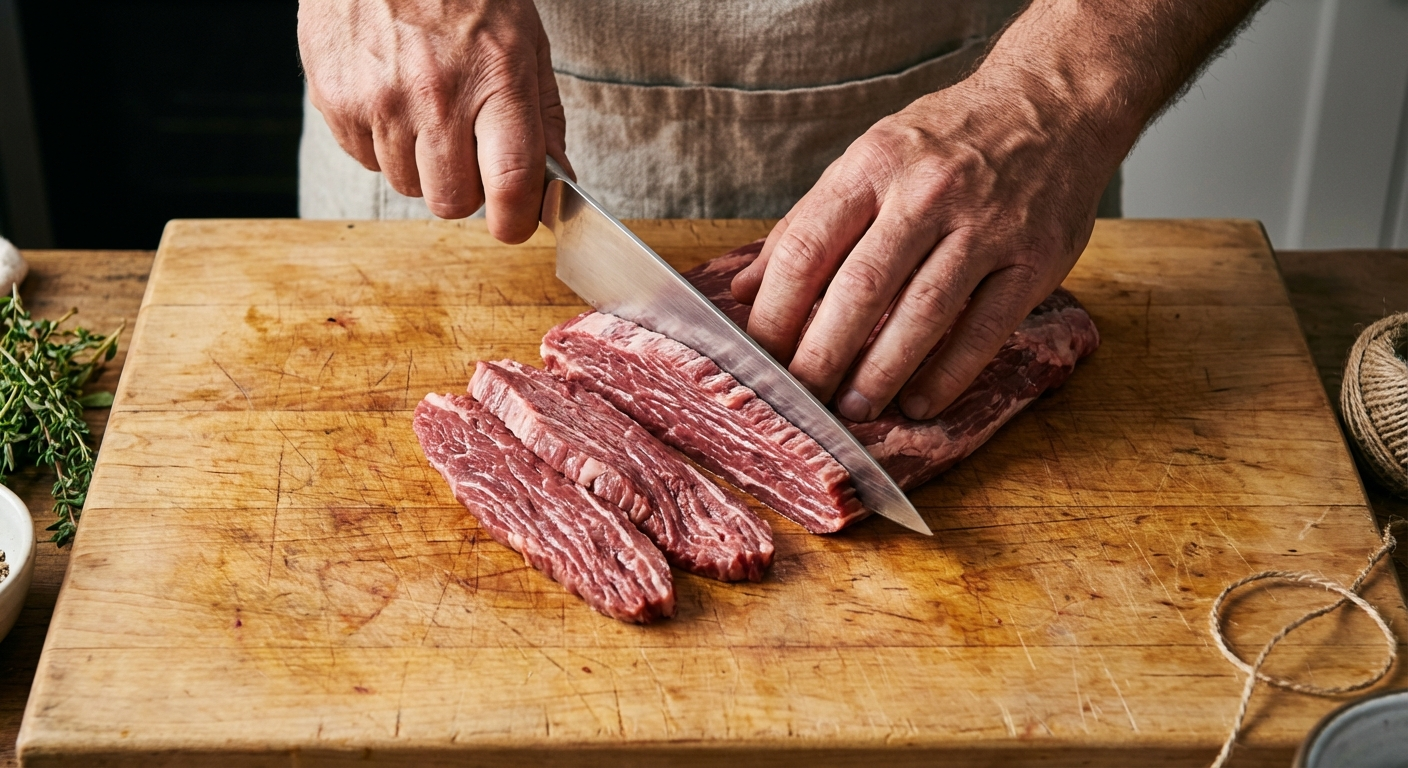
- Position your knife perpendicular to the grain. Your blade should cross the fibers at a 90-degree angle. If the grain runs left to right, your knife cuts top to bottom.
- Use a sharp knife. A dull knife tears fibers instead of cutting them cleanly, which creates ragged edges and a less tender result. A sharp carving knife or chef’s knife makes clean cuts that preserve the texture.
- Slice in smooth, single strokes. Draw the knife through the meat in one confident motion rather than sawing back and forth. Sawing shreds the fibers and creates an uneven surface.
- Control your thickness. For most cuts, slices between one-quarter and three-eighths of an inch work best. Thinner slices are more tender because the fiber segments are shorter. Thicker slices retain more juiciness. The sweet spot depends on the cut and your preference.
- Angle the knife slightly for tough cuts. On very fibrous cuts like flank steak and skirt steak, angle your knife at about 45 degrees against the cutting board rather than cutting straight down. This bias cut creates wider slices with even shorter fiber cross-sections, maximizing tenderness.
Cut-by-Cut Grain Guide
Grain direction and visibility vary by cut. Here is a quick reference for the most common cuts you will encounter:
Flank Steak
The grain on flank steak is the most visible of any beef cut — thick, clearly defined fibers running lengthwise (the long direction) of the steak. Always slice across the short dimension. Use a bias cut at 45 degrees for maximum tenderness. Flank steak is the cut where grain direction matters most — with-grain slices will be genuinely unpleasant to eat.
Skirt Steak
Skirt steak has very visible grain running across the width (the short dimension) of the cut — the opposite of flank steak. Slice along the length of the skirt, cutting across those short fibers. Many people confuse skirt and flank grain directions because the cuts look similar but the fibers run perpendicular to each other.
Brisket
Brisket is the most complex because the grain changes direction. On the flat (the leaner, thinner portion), fibers run lengthwise. On the point (the fattier cap), fibers run roughly perpendicular to the flat. When you separate the flat from the point, slice each piece against its own grain direction. This is why experienced pitmasters rotate the point 90 degrees before slicing.
Ribeye and Strip Steaks
These cuts from the rib and short loin have relatively fine grain that is less critical than on flank or brisket. The fibers generally run parallel to the length of the steak. Slice across the width. Because these cuts are already tender from marbling and their position on the animal, grain direction matters less — but it still makes a noticeable difference.
Pork Tenderloin
The fibers run lengthwise down the cylinder. Slice crosswise into medallions. The grain is very fine and hard to see, but crosswise slicing is intuitive on this cut because of its cylindrical shape.
Pork Shoulder (Pulled Pork)
When you break down a pork shoulder, the grain runs in multiple directions because the shoulder contains several muscles. When pulling rather than slicing, this is less critical — the shredding process naturally breaks fibers. But if you slice shoulder steaks or carnitas portions, identify the grain on each piece individually.
Chicken Breast
Chicken breast has a subtle grain running lengthwise from the thick end to the tapered end. Most people slice chicken breast crosswise out of habit, which happens to be against the grain — so they get it right without thinking about it. If you ever notice sliced chicken breast that seems stringy, check whether you accidentally sliced lengthwise.
Leg of Lamb
A deboned leg of lamb contains multiple muscles with grain running in different directions. When carving, treat each muscle separately. Find the grain on each section before slicing, and change your knife angle as you move between muscles. This is why lamb leg carving takes more attention than most cuts.
Common Mistakes and How to Avoid Them
Mistake 1: Forgetting to Check Before Cooking
The grain is much easier to see on raw meat than on cooked meat, especially cuts with heavy bark, crust, or seasoning. Get in the habit of identifying the grain before the meat hits the heat. The notch technique described above solves this permanently.
Mistake 2: Confusing Flank and Skirt Grain
These two cuts are frequently mixed up, and their grain runs in opposite directions. Flank grain runs lengthwise (slice across the narrow width). Skirt grain runs across the width (slice along the length). Getting this backwards is one of the most common slicing mistakes in home kitchens.
Mistake 3: Ignoring Grain on Tender Cuts
People assume that tender, well-marbled cuts like ribeye do not need grain attention. While the difference is less dramatic than on fibrous cuts, slicing against the grain still improves tenderness on any cut. A Prime ribeye sliced correctly is better than the same ribeye sliced incorrectly. Why leave tenderness on the table?
Mistake 4: Using a Dull Knife
A dull knife tears and shreds fibers instead of cutting them cleanly. Even when you slice in the right direction, a dull blade creates ragged edges that feel tougher in the mouth. Keep your knives sharp — it affects the final result more than most people realize.
Mistake 5: Cutting Too Thick on Fibrous Cuts
Thick slices of flank steak, even cut against the grain, can still be chewy. The fiber segments are shorter than with-grain slices, but they are still long enough to require work from your jaw. On fibrous cuts, thinner slices (one-quarter inch or less) make a significant difference. Save the thick slices for tender cuts.
The Science Behind It All
Meat tenderness is primarily determined by three factors: connective tissue content, intramuscular fat (marbling), and muscle fiber structure. Cutting against the grain addresses the third factor directly.
Muscle fibers are composed of myofibrils — long, thin protein strands that contract to produce movement. These myofibrils are bundled into fibers, and fibers are bundled into fascicles, all wrapped in connective tissue sheaths. When you chew, your teeth must rupture these fiber bundles to break down the meat.
Long fiber segments (from with-grain slicing) require multiple chewing cycles to rupture. Short segments (from against-grain slicing) rupture easily. The difference in perceived tenderness is dramatic because you are changing the amount of mechanical work your jaw must perform.
This is why grain direction matters more on working muscles (flank, brisket, shank) than on support muscles (tenderloin, ribeye). Working muscles have thicker, tougher fibers because they were used more during the animal’s life. The baseline fiber toughness is higher, so the slicing direction has a proportionally larger impact.
Putting It All Together
Here is the habit to build: every time you pick up a knife to slice meat, pause for three seconds and find the grain. Look for the parallel lines. Run your finger across the surface if needed. Then position your knife perpendicular to those lines and slice.
Within a week of conscious practice, this becomes automatic. You will start noticing grain direction without thinking about it — on raw meat at the grocery store, on cooked meat at a restaurant, on the brisket at a barbecue competition. Once you see it, you cannot unsee it.
The payoff is immediate and permanent. Every piece of meat you slice for the rest of your life will be more tender. No new equipment, no special ingredients, no complicated technique. Just a three-second pause and a change in knife angle.
That is the power of cutting against the grain. It is the simplest, most impactful meat cutting technique that exists — and now you know how to do it on every cut in the case.
Frequently Asked Questions
What does it mean to cut against the grain?
Cutting against the grain means slicing meat perpendicular to the direction of the muscle fibers. This severs the fibers into short segments, making each bite significantly more tender than slicing parallel to (with) the grain.
How do I find the grain on a piece of meat?
Look for parallel lines or striations on the surface of the raw meat — those are the muscle fibers. You can also run your finger across the surface: perpendicular to the grain feels ridged like corduroy, while parallel feels smooth.
Does cutting against the grain matter for all cuts?
It matters for all cuts, but the impact is greatest on fibrous, working-muscle cuts like flank steak, skirt steak, and brisket. On tender, well-marbled cuts like ribeye, the difference is less dramatic but still noticeable.
Which direction does the grain run on flank steak?
On flank steak, the grain runs lengthwise — along the long dimension of the cut. To cut against the grain, slice across the short dimension (the width) at a 45-degree bias angle for maximum tenderness.
What is a bias cut and when should I use it?
A bias cut means angling your knife at roughly 45 degrees relative to the cutting board rather than cutting straight down. This creates wider slices with shorter fiber cross-sections. Use it on very fibrous cuts like flank steak and skirt steak for extra tenderness.
More Expert Guides
How to Trim a Brisket: The Complete Butcher's Guide
Proper brisket trimming is the difference between a backyard experiment and competition-quality results. Here is the professional technique for shaping a whole packer brisket before it ever touches the smoker.
14 min readHow to Butcher a Whole Chicken: Step-by-Step Guide
Breaking down a whole chicken yourself saves 40-50% compared to buying individual parts. Here is the professional technique for turning one bird into perfectly portioned pieces.
14 min readHome Butchering Safety Guide: Essential Protocols for Safe Meat Processing
Learn professional butchering safety protocols from a master butcher with 25+ years of experience. Essential guidance for anyone processing meat at home.